How Mindfulness And Compassion Could Help You Do What Really Matters

The end of one year and the beginning of another is often an opportunity to torment ourselves with difficult questions:
Did I give enough energy to the things that really matter to me?
Did I give too much energy to things that aren’t important in the long term?
Did I live my values? (To get a visual picture of this, you might fill out Tobias Lundgren’s Values Bulls Eye.)

When you review the previous year, it is likely that you have done well in some areas of your life and have some regrets about others. We often don’t devote as much time and energy as we would like, to what really matters . We often don’t live our values as consistently as we want. We frequently waste time and energy on things that, it turns out, don’t really matter in the long run.

When you consider the aspects of life you neglected last year, you may notice that some are very familiar to you. They will have shown up for you many times over the course of your life. Perhaps there is some aspiration that is important to you, that just keeps being put to one side?

To give you an example.

Since I was 11, I have wanted to be a writer. I love reading and I wanted to be like the authors I admired. I wanted to be one of those people, the people that befriend strangers by sharing their thoughts in a book.
I have started many books but, despite this deep desire to be an author, I have never finished writing a book. This desire to write seems to matter a lot to me but each year goes by and I still don’t accomplish my goal.

A couple of years ago, I turned 50 and I realised that time was running out. If I really want to be an author, I need to knuckle down and actually write a book. So I started another book. It is on a topic that matters to me (Meaningful Success). Sitting at my Mac trying to express my ideas with honesty and courage is hard and scary and wonderful. Two years later and I am still wading through this project. Trying to create something useful. Something that isn’t rubbish. In the process, I am discovering that this writing lark is harder than it looks!

But even though this matters deeply to me. Even though I love writing. Even though every thing I read about how to become a good writer starts with the advice – just write.
I often don’t write. My days are filled with other stuff. Stuff that isn’t writing.

How about you? What are the goals that really matter to you? The goals that year after year, you don’t quite manage to give enough time and energy to? It could be:

Creating a beautiful garden;
spending more time playing with the kids;
travelling to beautiful and exotic places;
learning to play an instrument or speak another language….
What is the goal that calls from your heart?

And …what gets in the way of you pursuing that goal?

There are lots of reasons why we don’t pursue these important goals with the necessary energy and passion. One reason that seems increasingly common is, ‘I am too busy.’

So what are we too busy doing?
If you analyse what you are too busy doing, you can divide your actions into:
1. Things that were genuinely, at that moment, a higher priority than the important but non urgent task.
For example: spending time with the people you love; caring for your fragile human body; doing meaningful work; earning enough money to pay the bills; volunteering for causes that matter to you…
These choices are valued actions. You are being the person you want to be. Life is full of conflicting priorities, can you notice these choices and be gentle to yourself about them?

2. Things that, at that moment, felt like they were a higher priority than the important but non urgent task but they actually weren’t.
For example: trying to impress or please people; trying to earn more money than you need; doing things just to get prestige or recognition; doing things to avoid unwanted feelings.
This is a recurring problem for many of us. I certainly keep getting hooked by these activities. I look back on my life and I have spent too much time focussing on things that seemed important at the time, but actually, from the perspective of a few months or years later, I realise didn’t really matter.

3. Things that, at that moment, didn’t even feel like they were a higher priority than the important but non urgent task.
This is basically all the things we do to procrastinate and avoid the harder stuff. It might be: watching inane TV or silly YouTube clips; checking in on Facebook; going shopping. (NB These activities can also be acts of self care – in which case they are category one activities – only you can decide this.)

At this point I could just tell you to make sure you focus your energy on the right things. But I don’t think that advice is very helpful. I know it doesn’t work for me.

So I want to encourage you to do something different. To start gently.

I want to suggest that mindfulness and compassion might be a better response.

Just start by noticing with curiosity what you are doing. In real time. Notice which category your behaviour is in. You might also notice if you tend to berate yourself for spending time on the ‘wrong’ things. How effective has this harshness been for you? What would happen if, instead, you responded with compassionate understanding of your human failings?

Instead of harshness, could you notice how each behaviour feels? Notice how it feels in your body as you take these various actions? What emotions are you feeling? Notice which circumstances seem to encourage you to do which types of behaviour. Are there any common themes?

For me the ‘category two’ activities – the ones that seem important at the time but actually aren’t important- are often associated with a scrabbly feeling, like I am desperately trying to get something. At those times, if I pause and notice what is going on inside me; I realise that I am often hooked by thoughts that I am not good enough in some way and/or there isn’t enough of what I think I need. The best response to this seems to be to pause and breathe. To turn to myself in kindness. To be willing to be with myself and the thoughts that I am not adequate or the world is not the way I want it to be.

‘Category three’ activities – the ones where I know I am frittering time away – sometimes feel to me like I am hiding out. Trying not to think about the scary task I am avoiding. At other times these activities are accompanied by a whiny voice – ‘I don’t want to…I am too tired…I deserve a break…It is too hard…’ It feels like when I was a kid and I used to put my fingers in my ears and loudly say ‘I can’t hear you…LA…LA…LA…I can’t hear you’.
If I am courageous enough to pause and check in. I notice the thoughts and feelings I am trying to avoid. Can I turn towards these feelings with compassion, knowing they are part of being human?

I want to encourage you to do the same. Instead of trying to get it right. Instead of fighting with yourself.

Just notice.

Notice whether what you are doing is moving you towards your values; towards what matters to you or whether it is taking you away.

Notice what is going on inside you at those moments.

Be mindful and curious.

Turn towards yourself with compassion.

And then notice what happens next.

It may be that you will make a small move towards what matters. It may be that you won’t.

Could you notice that with compassion and curiosity?

How Science Can Help You to Use Words to Weave Magic

Photo Credit: Patrick Self Visuals

It was like he was performing some form of magic. He seemed to knows how to structure his questions and interactions in a way that freed people up. As I watched, I could tell that he was doing something extraordinary but I couldn’t work out how he was doing it. This was my first experience of Kelly Wilson. It was 2008 and I was at a workshop Kelly was running on applying mindfulness to psychotherapy. Kelly is a Professor of Psychology and an extraordinary therapist. He wrote the first ACT book with Steve Hayes and Kirk Strosahl.

As I watched Kelly, it was clear that he was incredibly compassionate and caring. That he was truly present in his interactions with people. That he was open to what turned up.  You knew you could tell Kelly your deepest darkest secret and he would turn to you with kindness and understanding.

And he was doing something more than that.

Something I didn’t understand.

When Kelly asked a question it was as though he was selecting the exact words and phrases deliberately, like a master chef who knows that the dish needs just a tiny pinch of nutmeg to turn pleasant into exquisite.I had no idea how he chose which words were the right ones but I wanted to discover what he was doing. I wanted to use those skills to help my coaching clients.

That desire took me on a long and arduous journey.

It was hard.

I felt lost a lot of the time. I felt stupid. But I knew that there was something important here. Over time, I saw other people doing the same extraordinary thing as Kelly.

Sitting in the cool marble foyer of a hotel in Parma, Italy in 2011, Jonathan Kanter said one sentence to me. When I heard it, pain that I had held tight since childhood simply unravelled. Years of therapy had barely dented this pain but Jonathan says this one sentence and it melts, never to return again (more on that in another post).

A few months later, I had a 1:1 Skype session with Benji Schoendorff. This kind Frenchman asked me a few simple questions and the anxiety I feel when I give a presentation changed from something bad to something that now makes me smile.

I was impressed. I wanted to be able to do what these people could do. To be able to use language to do magic.

Step by step, I discovered that what makes these people so extraordinarily effective is a deep understanding of something very nerdy and scientific – contextual behavioural science, in general and relational frame theory, in particular. (You can read the research support for this approach here.)

The reason contextual behavioural scientists can use words with the same precision a master chef uses spices is that they understand the impact each person’s learning history has on their current behaviour. They understand how everything we do is an attempt to get something – even if that something is just avoiding the voice inside that says, ‘You aren’t good enough’. Contextual behavioural scientists understand how metaphors work and why they are so powerful. They understand how each new piece of information we are given slots into the network of what we have learnt in the past. They know that ideas don’t stand alone, they are inextricably linked to thousands of other thoughts and memories.

Kelly, Benji, Jonathan and thousands of other ACT therapists and coaches use that knowledge to help people to move towards flourishing. Bit by bit I am slowly getting a sense of how to do this. These theories are very complex. We touch on them over and over again in this blog. So, in this post I just want to give you a bite sized portion.

I want to describe how ‘transformation of stimulus functions’ can help people to grow.

‘The transformation of stimulus functions is said to occur when the functions of one stimulus alter or transform the functions of another stimulus in accordance with the derived relation between the two, without additional training.’ Dymond & Rehfelt 2000

What does transformation of stimulus functions mean in practical language? A stimulus is an event that influences behaviour. A stimulus can serve a range of functions, which means that it can make certain behaviours (both in our body and our mind) more or less likely.
Our environment and the people around us teach us many of these responses (i.e. we learn the function a stimulus has in a particular situation). Once you have learnt a particular response it is very difficult to unlearn it, but you can change your response to the stimulus by linking it to something that has a different function. (for RFT folk reading this and judging me, I know this is a ridiculous oversimplification but you didn’t really expect me to explain this, did you?)

For example, when I stand in front of a group to give a presentation I often feel very anxious. That anxiety then triggers an urge to make myself small and stay safe by sticking to dry clever theory. I have discovered that if I give in to those urges then my speech tends to become boring!

In our Skype session, Benji, asked me some questions about the anxiety I feel when I give a speech. As we talked, I started to see how the anxiety turns up because I care deeply about being genuinely helpful to the people in the room. This sounds obvious but noticing that connection between my anxiety and what matters to me has meant that the stimulus of anxiety now acts as a reminder that I care very much about what I am doing. It tells me that now is the moment to speak from my heart, risking rejection and judgement because I genuinely care about the impact of my session. I find myself smiling with the joy of knowing that right here, right now I can do something meaningful. When I do that my speeches tend to become more interesting!

Benji used language to create something that felt like magic to me. The function of my anxiety changed, it was now linked to my values. Transformation happened!

I want to walk you through an example of how you could transform your relationship with a tricky stimulus in your life.

Using Words to Weave Your Own Magic

Firstly, consider what tends to trigger you to be safe and boring rather than courageous and impactful?

When you are in the grip of that trigger, exactly how do you feel? What thoughts tend to be there for you? How does it feel in your body?

Really sink into that question. How does it feel to be inside your skin at that moment?

Now pause and ask yourself, what do you care about deeply in this? Kelly Wilson says that suffering and values are poured from the same vessel. It is likely that this issue is causing you pain because it links to something you really care about. What is it?

Once you have got a sense of what is important to you here, ask yourself – If I was being the person I want to be, how would I respond to that trigger?

Next time you notice that trigger and the associated thoughts and feelings, ask yourself:

Am I willing to take a small step towards being the person I want to be?

What would that look like?

And how would it feel?

I hope that for at least some of you, the trigger now acts to remind you to live your values.

———————————————————————————————————————————
If you are interested in learning how Benji uses RFT to transform people’s relationship with painful emotions then watch this presentation. (I particularly enjoy his gorgeous French accent and the cooing of his baby in the background)

If you want to know how Kelly weaves his magic then read this book and if you want to understand what Jonathan does then read this book.

And, if you are interested in learning how to apply ACT and RFT to workplace coaching and you are in Australia then check out this workshop. It would be great to see you there.

Working in a harsh environment can mess you up more than you think…

Have you ever had to survive a harsh environment at work? This woman has…

Most of us have lived through an unpleasant time at work. When it ends, we sigh with relief and assume all will now be fine. Unfortunately things aren’t that simple.

The hostile environment changes us, we learn strategies to cope, to get our work done despite the difficulties. However, the very strategies that helped us to survive a dysfunctional workplace can be counterproductive in a more supportive environment. And in a cruel twist of fate, it is seems to be almost impossible to unlearn something that you learnt when you were scared or stressed. So we often continue to be defensive, aggressive or self-protective even when it is no longer needed.  We can’t seem to get rid of the mental junk we have acquired during our painful experiences.

A reader wrote to us about a problem she encountered when she moved from a hostile, aggressive environment to a much more harmonious workplace.

She was really happy in her new job and was doing well but she was given feedback that her communication skills needed work. This hadn’t been a problem for her in previous workplaces. She realised that she had learnt some unhelpful habits in her last role. Now she needed to relearn how to interact in more workable ways. She was worried that she didn’t know how to bring about this change.

So how do you let go of problematic interpersonal behaviour and start to behave in ways that work? Here are some tips:

1. Start with self-compassion. The less you beat yourself up for your failings, the more you will be able to notice the times when your behaviour isn’t working.

2. Get present. Mindfulness helps us to act on our good intentions. In this moment now, what is happening? Try to notice your behaviour moment to moment.

3. Do a self-assessment and get feedback from people you trust. There are some good questions about interpersonal functioning here that you could adapt to the workplace.

4. Don’t just change as a reaction to what others want. Spend some time thinking deeply about your values. Who do you want to be at work? How do you want others to experience you? Changing your behaviour is a hard slog, linking the change to your values will help you to keep going.

5. Aim to gradually evolve your behaviour rather than suddenly transforming yourself overnight. Just focus on one or two small changes and see if you can repeat those behaviours over and over until they are a habit. Then pick some more behaviours you would like to change.

6. Get really present in your interactions with people. Notice the impact of your behaviour on others. See if you can get out of your head and into this moment now.

7. Accept that when you feel threatened you are likely to revert to self-protective and unhelpful behaviours. Consider what might trigger that in you and make a plan to be particularly mindful and self-compassionate at those moment. Hold those feelings gently.

8. Seek feedback on your progress but accept that it may take people a while  to notice that you have changed. Our opinions of others are quickly formed and slow to change.

Becoming the person we want to be is hard. Facing those times where our behaviour isn’t in line with those ideals is painful. Can you turn to yourself in kindness?

The Science of Gratitude (or What your Mother didn’t teach you about how to say ‘Thank You’)

Spring Bouquet 032909Saying thank you is important. Your parents probably spent hours drilling this into you. A polite ‘Thank you’ smooths social interaction and makes life a little kinder.

But what your Mum probably didn’t teach you, was how to express heartfelt gratitude in a way that enriches your relationships, has genuine meaningful impact on the other person and can also make you happier.

Expressing sincere appreciation is risky. The other person is often pleased but sometimes they seem uncomfortable and occasionally they seem to see it as an invitation to tell you how disappointing you are. Which can be unpleasant.

Is it possible to be more skilful in the way we express gratitude?

Behavioural science has some suggestions.

How Behavioural Psychology Can Increase The Impact Of Gratitude

In the new book, Mindfulness, Acceptance and Positive Psychology,  Mairéad Foody et al analyse a positive psychology intervention called the gratitude visit.

This activity involves writing a letter of gratitude and delivering it in person.

Foody et al suggest that, in behavioural terms, gratitude involves a complex interplay between the thanker and thankee.

If you thank someone for something they don’t see as important or if your ‘thank you’ feels transactional, that you are doing it out of obligation or as a reward for good behaviour rather than as a genuine expression of what really matters to you, then the interaction can easily go awry.

So the first step is to ask yourself whether expressing gratitude is a behaviour that you value. Is it an expression of your best self?

If your answer to this is ‘Yes’ (and research would encourage you in this) then the next step is to realise that:

‘Gratitude requires complex levels of perspective taking, in terms of recognising what you value for yourself and how you perceive this should be … appreciated by others’

“Gratitude is an intimate expression of shared values that goes above and beyond what is felt’

Mairéad Foody, Yvonne Barnes-Holmes & Dermot Barnes-Holmes

This means that if you want your expression of gratitude to have the best chance of positively impacting on the other person, it would be wise to consider:

1. How does what happened link to the values of the other person? For example, ‘Thanks for signing my expenses form when I don’t have the receipts’ is unlikely to link to your manager’s values but ‘Thank you for trusting me enough to know I wouldn’t put in a false expenses claim. I promise to be more careful with my receipts next time’ might have more meaning for them.

2. How does what happened link to your own values? And where is the overlap between your values and theirs? It is in this shared space that deeper connection can form.

Taking a moment to think through these questions is likely to increase the chance that your expression of gratitude feels meaningful to the other person. And if, despite your best efforts at perspective taking, your thanks still don’t seem to have the positive impact you were hoping for – you will know that in that moment you were doing your best to be the person you want to be, which isn’t bad.

So…

I want to thank you for reading this blog post to the end; for trusting that I will do my best to write something helpful and meaningful that, in some small way, enriches your life.

Thank you!

PS For Brisbane based readers  – I am running another low-cost ‘Introduction to ACT’ session on May 26th. Details here.

ACT and conscious evolution Part A: Why cant we get our act together to respond to global change?

We live on a planet completely transformed by humanity.  Our impacts upon the planet are so great that scientists have now coined a term for a new geological age – the Anthropocene.   We are changing the climate, the chemical balance of the oceans and soils, biodiversity and even the physical structure of the planet –humans move more sediment and rock than all natural processes combined.  Together this is referred to as ‘global change’.  Whether we like it or not, and whether we are conscious of it or not, we are designing the future of not just our species, but every other species on the planet.

In this blog and the next I argue that Contextual Behavioural Science is not just a tool for individual wellbeing, it is a tool for global transformation.  For future generations to live meaningfully, happily and sustainably, we must master our thinking and feeling at least as much as we have learned to master the physical world. We need to more consciously evolve our behaviour, choosing our evolutionary path instead of reacting unconsciously.

Getting better at choosing is critical for many of our most pressing problems, but nowhere is it more important than the choices we make about our treatment of the natural world. The natural world is the context for everything else: It is the cradle of our development as a species, the support system for our thriving today and the legacy we leave our children.

Evolution has provided us with great strategies for coping quickly with simple, short-term, and individual challenges, but these very strategies get in the way of coping with complex, long-term and collective challenges.  In this blog, I outline some of the reasons we seem to be so ineffective at collectively responding to anthropogenic changes to the natural world.  Next week I will explore some ways contextual behavioural science can help us to respond more effectively to such wicked problems.

Why cant we get our act together?

From a contextual behavioural perspective, human beings have at least six characteristics that get in the way of successfully responding to complex problems [1].   These characteristics served us well in old contexts, but might just be big problems for our ongoing survival.

Responding to reinforcement

a)      Immediate consequences outweigh delayed consequences – we might be concerned about the fate of our children, but we tend to act on our desire for that new car or second helping of food right now.

b)      Strongly unpleasant stimuli presented abruptly prompt action, but gradually increasing unpleasant stimuli do not – This is the story of the boiled frog. So long as global conditions worsen gradually, we will tolerate bad air, foul water, and species loss that would once have been considered intolerable.

Complexity and Accuracy of Thinking

c)       Simple, familiar ideas are often preferred over complex, alien ideas that are more correct. It is estimated that evolution, about as well-established a fact as it is possible to obtain in science, is rejected by 46% of the American population, one of the best educated populations on earth.  This figure doesn’t appear to be changing – there is a limit to the power of science and education, in part because…

d)      Coincidental events often strengthen ineffective behavior –  Short term weather events lead to claims that climate change isn’t happening. Our cognitive systems are tuned to use even random patterns as evidence supporting our beliefs.

e)      Thinking more complexly puts us in contact with uncertainty and paradox which can both feel aversive – As we learn language we are repeatedly rewarded for being coherent [2]: Parents discourage children for saying they like spinach one day and not the next.  Uncertainty, ignorance and inconsistent beliefs feel deeply aversive for most of us and thinking about complex environmental issues inevitably exposes us to these states.

Our relationships

f)       Consequences for the individual usually outweigh consequences for others – although we can and do act altruistically, our primary concern is usually to protect ourselves and satisfy our own needs.

So what can we do about it?

This is a pretty depressing list. But actually these characteristics are just the products of human evolution.  Evolution has provided us with great strategies for coping quickly with simple, short-term, and individual challenges, but these very strategies get in the way of coping with complex, long-term and collective challenges.

But what makes human beings really interesting are the times when we act differently to the basic tendencies outlined above.  Next week I will explore how ACT and contextual behavioural science help us to make sense of what happens when we are at our best as a species – when we plan well for the future and act beyond our own self-interest.

Between now and then, you might like to see if you can notice examples of these evolved tendencies in action.  How do they serve you and how do they get in the way of living the life you want to live?  I would love to read about what you notice.

1. Chance, P. (2007). The ultimate challenge: prove B. F. Skinner wrong. The Behavior analyst, 30(2), 153-160.  Available at http://www.ncbi.nlm.nih.gov/pmc/articles/pmc2203635/

2. Hughes, S., Barnes-Holmes, D., & Vahey, N. (2012). Holding On to Our Functional Roots When Exploring New Intellectual Islands: A Voyage through Implicit Cognition Research. Journal of Contextual Behavioral Science, 1, 17-38. doi: 10.1016/j.jcbs.2012.09.003. Available at http://www.sciencedirect.com/science/article/pii/S2212144712000075

When Feeling Awkward Gets In The Way Of Change

Have you ever wanted to try something new but because it felt awkward you backed away from the change and went back to what felt more comfortable, even though part of you really wanted to persist with the change?

I have been struggling with such a difficulty.

I recently become aware of something small that could lessen the influence I potentially have in the world. It looks like this:

Dotty Rachel

When you look at that photo do you think – ‘There sits a credible executive coach and corporate facilitator?’ I didn’t think so!

Although I don’t actually turn up to meetings with clients looking this dishevelled and dotty (really I don’t!). I do have wild hair and a tendency to present myself a bit like a kindly lady doctor (as this is what I was for many years!).

However, I recently read this paper and also this one and realised that appearances do impact on whether others take us seriously. Then a dear friend, who is also a client, told me, ‘Rachel, one of the things I love about working with you is that you turn up to run a session and people don’t expect you to be so competent because you aren’t dressed in a sharp suit and you appear so unassuming and then you do amazing work and they are surprised‘.

And I became concerned. I want my work to have a significant impact on others. I want to play a part in helping people to have more vitality and meaning in their work. I don’t want something as simple as my appearance to mean I am starting at a disadvantage with new clients.

So I decided that I wanted to present myself in a way that is authentic but perhaps a little more skilful. Goffee and Jones call this: Be Yourself – More – with Skill.

What does that look like for me? Probably not a sharp suit but perhaps a little tidier?

So I ask my lovely daughter, Ellie, to teach me how to put my hair in a bun. I have found this new skill very hard to learn. I feel clumsy and awkward. My mind kicks into action telling me, ‘Why are you wasting time learning something so silly when you could be learning something useful and important like Relational Frame Theory‘. The bun falls out halfway through the day and my mind says, ‘Told you this was ridiculous’.  I start to wear a little more make up and my mind tells me ‘It is so superficial to focus on your appearance’ and ‘Everyone is judging you‘. I feel like a fraud. But part of me is excited about the possibility of who I could become.

In the presence of these conflicting thoughts and feelings I remind myself that the best values and actions are freely chosen. It is okay for something as small as learning how to put my hair in a bun to matter to me. I ask Ellie to help me again..and again. I write down her instructions and follow them carefully.Notes on how to make a french roll I am still rubbish at buns but I persist. One day I will be a lady who weaves beautiful buns, knots and french rolls. Hopefully, as a result, I will look a little less dotty and a little more competent and I will ‘be myself – more – with skill’.

If you were to ‘be yourself – more – with skill’ what would be different about how the world experiences you? Is there a change that you want to make but it feels awkward?Would the change be a move towards your values? If so, are you willing to persist with the change and have the feelings of awkwardness?

I hope so! Because:

‘It is never too late to be who you might have been’

George Elliot

I am going to be the lady who both knows Relational Frame Theory and wears a beautiful bun.

How about you? Who will you be?

Closing the intention-behaviour gap

Over Christmas I put on an additional 3kg. I have been getting rid of it ever since and I have realised that losing weight is a fantastic practice in psychological flexibility.  Just about every minute of the day there are opportunities to be mindful of bodily sensations associated with hunger or satiety, and each day there are dozens of opportunities to reconnect with why losing weight is important to me.

This experience also got me thinking about why weight is such an enormous problem. Obesity rates doubled globally between 1980 and 2008.  In 2008, the total annual cost of obesity in Australia, including health system costs, productivity declines and carers’ costs, was estimated at around $58 billion.  In Australia 68% of men and 55% of women were overweight or obese in 2008. Part of the problem here is diminishing physical activity. The World Health Organisation reports “Globally, around 31% of adults aged 15 and over were insufficiently active in 2008 (men 28% and women 34%). Approximately 3.2 million deaths each year are attributable to insufficient physical activity.”  Nobody wants to be obese but people are getting fatter, and everybody knows that they should exercise more than they do.   Clearly there is a disconnect between intentions and actual behaviour. 

We don’t do what we say we will do

Many studies have examined the relationship between intentions and behaviour and, somewhat surprisingly, the correlation between the two is not all that high.  Have you ever had the experience of setting strong goals to exercise or eat well and then not followed through?  Timothy Wilson wrote a fascinating book called “Strangers to Ourselves” outlining all the evidence for unconscious, automatic influences upon our behaviour.  Meta-analyses have revealed:

“… intentions account for a weighted average of only 30% of the variance in social behavior (Armitage & Conner, 2001; Hagger et al., 2002), mainly because people with strong intentions fail to act on them (Orbell & Sheeran, 1998).”  (Chatzisarantis & Hagger, 2007).

Why might this be the case?  One reason people fail to act on strong intentions is because they simply forget to start the behaviour.  Have you ever said something like “This week I will exercise three times” and then before you know it, the week is over and you haven’t exercised at all?  This is why setting specific goals and thinking about contextual reminders is so important.  In the literature, this sort of planning is called “implementation intentions”.

But another reason why people fail to act on their intentions is because their responding has become habitual and automatic.  When we don’t reflect on our moment to moment behaviour we are very likely to do what we have always done in the past.

Mindfulness helps us act on our intentions

From one point of view, this might be a bit of a problem for the ACT model.  If our behaviour is relatively independent of our intentions, then what is the point on getting clear on our values when we might just act out of our habits and unreflected impulses anyway?  This is where mindfulness becomes really important.  Values clarification on its own is of little use unless we bring awareness to what we are doing and we have the self-regulatory skills to enact new behaviours.

But is there any evidence that mindfulness can help us do what we want to do?  Chatzisarantis and Hagger (2007) explored how mindfulness affects the relationship between people’s intentions to engage in vigorous physical exercise and their actual behaviour.

First they confirmed that people’s intentions to exercise didn’t actually predict whether people exercised or not. But the really interesting finding was that more mindful people were more likely to act on their intentions than those who are less mindful, even controlling for the physical exercise was already a habit for the participant.  So mindful people, but not non-mindful people, were more likely to do what they said they would do!  Isn’t that just the coolest reason for learning to be mindful?  “Learn mindfulness and you will do what you say you will do!”

Why does mindfulness help us act on our intentions?

The authors then went on to explore reasons why mindfulness might strengthen the relationship between behaviours and intentions. Before we go any further, what do you think? Why might mindfulness increase the tendency to act on intentions?

Got something?

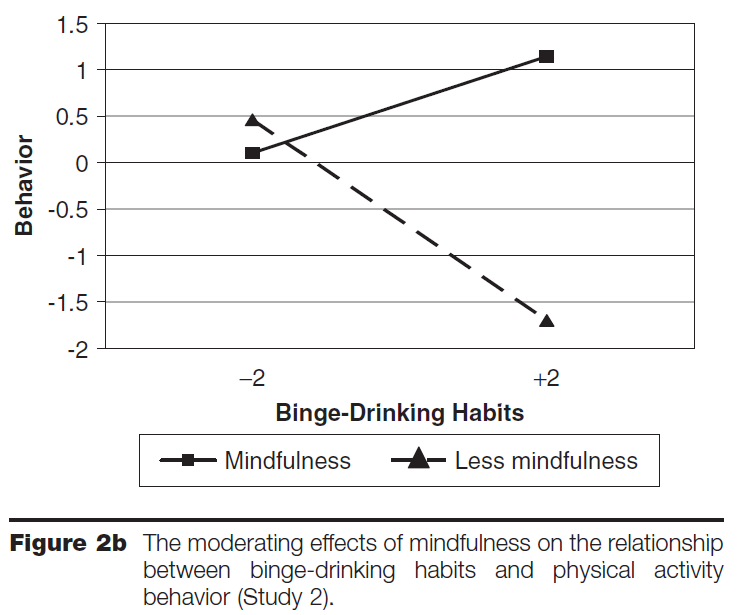
Perhaps mindfulness increases awareness of goals in each moment and therefore reduces the tendency to forget what we said we would do. Or perhaps mindfulness improves our self-regulatory skills so that we are more likely to be able to manage the difficult emotions that arise when we do something new or challenging. Chatzisarantis and Hagger (2007) tested a third possibility, that mindfulness helps us control counter-intentional behaviours, in this case binge drinking.   They reasoned that binge-drinking probably interferes with doing vigorous physical activity (is it just me or do you too have an image of lying on a couch with a pillow over your head?), and that mindfulness might reduce the extent to which habitual binge-drinking interferes with intentions to exercise.

And this is what they found:

C and H 07 Fig 2b 3

Let me step you through this diagram.  Start with the dotted line first. What this says is that people who are NOT mindful and who habitually engage in binge-drinking are LESS likely to engage in physical exercise. That is, habitual binge-drinking decreases the likelihood of engaging in physical activity. So far so good, this confirms the idea that binge-drinking ain’t great for getting up in the morning and going for a run!  But look at the solid line. For this group, even if they did engage in habitual binge-drinking they were still just as likely to engage in exercise as those who did not habitually binge drink. So some mindful folk still go out on the town, but they don’t let this interfere with their intentions to exercise.  In the words of Chatzisarantis and Hagger (2007: 672):

“These results, therefore, corroborate the view that greater awareness of and attention to internal states and behavioral routines helps mindful individuals shield good intentions from unhealthy habits and thus can play a key role in fostering effective self-regulation. In contrast, diminished attention and awareness of counterintentional routines and habits is likely to prevent individuals acting less mindfully from engaging in effective self-regulation, as the negative relationship between habitual binge-drinking and physical exercise suggests (see Figures 2a and 2b).”

So maybe next Christmas I will be better at mindfully saying no to that Christmas pudding!

How You Can Make 2013 A Successful Year

So here we are in 2013. What will it take for you to define this year as successful?

Let’s start by looking back on 2012. What did you achieve? What mistakes did you make? Where do you feel you failed?

measuring up
measuring up (Photo credit: woodleywonderworks)

Did you get a promotion or an increase in salary? Did you buy something important like a house or a car? Did you fail to get elected to serve as President of the USA?

It can be easy to focus on these external markers of success or failure. But what about your internal yard stick? How much were you the person you want to be? How often were you mindful or generous or brave or loving or …(insert your own values here).

How good were you at noticing the times when you weren’t living your values and then gently adjusting your behaviour so it aligned more closely with who you want to be?

‘Values are your heart’s deepest desires for how you want to behave as a human being. Values are not about what you want to get or achieve; they are about how you want to behave or act on an ongoing basis.’

Russ Harris  – The Happiness Trap

Measuring your life by what you achieve isn’t wrong but the research suggests that we over estimate the impact of these events. We think that if we get the good job and nice house we will be happy and so we conscientiously pursue those goals. Sometimes we are so busy striving that we neglect other important aspects of our life, like nurturing our health and our relationships, and we forget who we are and what we want to stand for.

The second way of measuring your life – Did I live my values? Was I the person I want to be? – is both more likely to create richness and meaning and will tend to support you in making those moment to moment choices that determine the direction of your life.

So as you review 2012 and before you set yourself some goals for 2013, spend a few moments revisiting your values.  Lundgren’s Bull’s Eye activity is a cool way of doing this.

Growing Compassion in Organisations

Hello!

I am so excited to be joining “Working with ACT” exactly two years to the day since Rob and Rachel started this wonderful blog. Working with mindfulness and values is a big part of my professional and personal life. My aim is to bring you interesting perspectives on ACT research.

By way of introduction, I thought I might briefly review one of my own papers written with Sharon Parker.  I promise I will focus on papers by other people in the future 🙂  Here is the citation from which you can link to the paper if you would like to read more.

Atkins, P. W. B., & Parker, S. K. (2012). Understanding individual compassion in organizations: the role of appraisals and psychological flexibility. Academy of Management Review, 37(3).

——————————————————————————————

“I don’t do emotions!”  This was a comment made by one of my students in reaction to an exercise exploring values and stressors at work. But in reality, we all “do emotions”. A growing body of evidence clearly shows that emotions are a major determinant of performance in all workplaces, including public sector organisations.  Emotions alert us to what matters, they allow us to communicate and make decisions that are effective.  Emotions are at the heart of thinking about how we wish to live and what we wish to create in society?

Becoming skilful at recognising and influencing emotions at work is a key facet of effective leadership and management. Such skill rests upon the quality of our awareness and perspective taking ability. We need to be able to take the perspective of others to act effectively. We need to be compassionate if we are to respond skilfully to our own and others emotions.

Compassion towards oneself and others is a critical part of building effective relationships and making good decisions at work. Think for example of how you handle situations where you or someone in your team fails to achieve important goals. What would it be like if people were more compassionate towards themselves and others at these times?

Compassion is not just a feeling.  It involves four stages:

  1. Noticing another is suffering,
  2. Making judgments about what is going on,
  3. Feeling empathy, and
  4. Taking action.

There are three judgments that can get in the way of compassion towards self or others.

First, we can fail to be compassionate because we judge that the person who is suffering is not deserving of our compassion. For example, we might judge that the person brought their suffering on themselves.

Second, we might judge that the person’s suffering is not relevant to us. Research shows we are much less likely to extend suffering to others who have different goals, or belong to groups with which we do not identify. If we make this judgment, we are more likely to feel disconnection rather than compassion.  One can easily see how this judgment is involved in the debate over immigration in this country.

Third, we make a judgment about our personal resources. If we don’t feel as though we can cope with being in the presence of another who is suffering in some way, we are more likely to feel distress rather than compassion.  The manager who cannot bear to be in the presence of a person crying is making this sort of judgment.  This judgment appears to be involved in the experience of burnout many people feel when they work in jobs that involve caring for others.

Of course, these judgments are sometimes justified.  Modern evolutionary theory suggests that such judgments are an important aspect of self-protection and effective group function.  Sometimes it is best not to feel compassion, or at least not to act upon it. Our argument is not that we should always feel more compassion. Our argument is that it is helpful to become more aware of the automatic reactions that drive our behaviour. To the extent that we can catch our reactions in motion, we can choose our responses more deliberately and improve our effectiveness.

So how might we learn to catch our automatic reactions, and act more in line with what really matters?

If you have been following this blog you will know that there are two aspects of effective training in emotional skills. First, we need to increase mindfulness. Being mindful means being aware of what is happening in each moment both within ourselves and in the world and bringing an attitude of openness to that experience. Second, we need to be clear about our values and the values of the organisation in which we work. There is no point developing awareness if we don’t know how we want to act in the world. Values act as a compass to guide our behaviour.

What has been your experience of compassion at work? Is it encouraged? Does it have a positive impact?

Jumping Off A Piece Of Paper

Do you have something important that you need to do but even the thought of it makes you feel so uncomfortable that you just avoid it?

It might be risking rejection; doing something boring; risking looking stupid…..

In this great podcast, DJ Moran talks about slicing these challenges up really thinly. Finding the point where you have made it small enough that you will take action. He uses the metaphor of jumping off a piece of paper. Even though the jump is really, really tiny; you are still jumping and that is very different to not jumping at all.

And once you have gotten moving, you might tackle jumping off the phone book next!