You must have a good reason to….

Last week I was wandering around Kmart trying to find an adapter plug. In my search I found myself walking through the Lego aisle. I was taken aback by the fierce feeling of joy and longing that hit me as I walked into that aisle. When my son, Patrick, was little we would spend a lot of time in this aisle. Pat would carefully examine each box – trying to decide, ‘Is a Luke Skywalker + Desert Skiff set better than a Hans Solo + StarFighter set?’ I would get bored and impatient as he carefully pondered these questions and start to hurry him along.

Standing in that aisle, those memories came back to me with such intensity. I felt so proud of the young man that Pat has become and at the same time I longed to go back in time, hug that earnest little boy and gently tell that younger version of myself not to be in such a rush, that these moments were precious.

I drank in that memory and walked on. A moment later, I saw these bargain jeans.

I thought, ‘How can they do that for $7?’ and unbidden, thoughts of the recent news about deaths in garment factories in Bangladesh came to mind. I felt sad, guilty and powerless.

Someone watching me might have been surprised by the emotions I seemed to be experiencing. They might have come up with a story for why I seemed upset looking at a pile of jeans or why I had a tender smile in the Lego aisle. It is unlikely that they would accurately work out what was going on inside me.

These two moments show why perspective taking can be so hard.

On the surface they seem very similar. I was reminded of something and then I felt an emotion. But they are quite different in one important respect. In the Lego Aisle I was reminded of something that had actually happened to me. But in the jeans aisle the ideas that provoked the painful emotions weren’t a result of my direct experience. I had looked at a series of squiggles on a computer screen a few days earlier and now seeing some jeans makes me sad. This difference might seem pedantic but it has some important practical implications.

The second incident requires language.  Language means that a pair of jeans can make me sad because of something that has happened to some people I have never met, in a place I have never been to. This is an important difference between humans and other animals.  It is part of the reason that humans are much more vulnerable to emotional pain than other animals. It also means it can be incredibly hard to interpret, predict and influence our own and other people’s emotions.

Say my manager tells me I haven’t done a good job on a piece of work. My response won’t just be to that event, it won’t even just relate to all the other experiences I have had that my mind tells me are similar  – conversations with this manager, with previous managers or other colleagues and possibly even that time 40 years ago when Mrs Leary (the scary teacher) shouted at me in grade 3. (I asked to go to the bathroom 10 minutes after we had returned from lunch break, she found this annoying.) Experiences I have had in the real world won’t be the only factors influencing me. I will also be influenced by what I have learnt through language. It could be my Dad telling me that most managers are fools, the theory I learnt at university about how these conversations should go or the story I have about myself that I am disorganised and incompetent.  The factors influencing my response could be numerous. (Psychological flexibility is the skill of not being pushed around by these responses and is the central theme of this blog.)

This means that when my manager tries to do the right thing and work out my perspective on the feedback, she is likely to get it wrong.

It is almost impossible to really see the world through another person’s eyes. Insoo Kim Berg used to say ‘You must have a good reason to…’ She believed that people’s behaviour always made sense to them. If the behaviour doesn’t make sense to us then it is because we don’t have enough information. Her response was to ask questions with a stance of genuine curiosity and a real interest in understanding the other person and their behaviour.

Unsurprisingly, research shows that negotiations lead to better outcomes when at least one party asks good questions. Negotiators tend to make false assumptions about the other person’s needs and motives. Acting on those assumptions leads to poorer outcomes for both parties.

So next time you need to have a difficult conversation with someone – do spend time considering their perspective before the conversation but also make sure you remain curious throughout the conversation, gathering information that will help you both to reach a good outcome.

“You must have a good reason to…” Insoo Kim Berg

Understanding the Real You

As a psychologist, many clients want me to help them understand themselves better. Who am I? Who is the ‘real’ me? How do I become more like the real me?

And because I am all seeing and knowing, I am able to tell them and their lives are transformed.

In particular, people going through a transition (for example a career change) are understandably keen to understand who they really are, because this will help guide them and inform their decisions.

It is very easy to believe that if we can just understand who we are, then we can be  liberated to be that person.  It is an alluring thought, as the pull to certainty always is.

The problem is that whilst the idea of a ‘core’ you; a fixed, immutable essence of you (that sounds like a brand of perfume: Immutable Essence of You by Chanel) is alluring, it is also dangerous.  It can lead people to see their lives from a narrow perspective, as the content of their history and experience. Then we create powerful stories of who we ‘really’ are – I am an introvert, I am bad at Maths, I am depressed. In ACT this is known as the self as content perspective.

Yet there is another perspective of the self which is where we are the context or the holder of our ever changing experiences.  This allows us to take a more fluid, flexible perspective of our selves. One exercise I like to do with people to explore this idea is to take their Myers Briggs ‘type’ and then list all the ways in which they regularly act against their type. It is easy to do, and helps loosen the power of the self as content perspective.

In this short video Julian Baggini explores exactly this idea, but what’s interesting is that he does this without any knowledge of ACT, thereby bringing a fresh perspective.  He asks whether the self is an illusion, and concludes that this is not a helpful question. It is more helpful to see the self as a process, rather than a thing.

It is this view of our self as a process which can liberate us. Instead of something fixed to discover, our selves become something we create.  Instead of ‘being’ depressed, I am someone who sometimes experiences feelings of depression.  What I like about this advert is that it takes just such a view – I have pain and my life is bigger than pain:

In turn this flexible, ‘context’ perspective helps us act more flexibly.  We are free to experiment, and to transcend narrow, fixed views of ourselves.

Instead of asking who we really are, we can begin to see that we are the person we create, one behaviour at a time.

The Science of Gratitude (or What your Mother didn’t teach you about how to say ‘Thank You’)

Spring Bouquet 032909Saying thank you is important. Your parents probably spent hours drilling this into you. A polite ‘Thank you’ smooths social interaction and makes life a little kinder.

But what your Mum probably didn’t teach you, was how to express heartfelt gratitude in a way that enriches your relationships, has genuine meaningful impact on the other person and can also make you happier.

Expressing sincere appreciation is risky. The other person is often pleased but sometimes they seem uncomfortable and occasionally they seem to see it as an invitation to tell you how disappointing you are. Which can be unpleasant.

Is it possible to be more skilful in the way we express gratitude?

Behavioural science has some suggestions.

How Behavioural Psychology Can Increase The Impact Of Gratitude

In the new bookMindfulness, Acceptance and Positive Psychology,  Mairéad Foody et al analyse a positive psychology intervention called the gratitude visit.

This activity involves writing a letter of gratitude and delivering it in person.

Foody et al suggest that, in behavioural terms, gratitude involves a complex interplay between the thanker and thankee.

If you thank someone for something they don’t see as important or if your ‘thank you’ feels transactional, that you are doing it out of obligation or as a reward for good behaviour rather than as a genuine expression of what really matters to you, then the interaction can easily go awry.

So the first step is to ask yourself whether expressing gratitude is a behaviour that you value. Is it an expression of your best self?

If your answer to this is ‘Yes’ (and research would encourage you in this) then the next step is to realise that:

‘Gratitude requires complex levels of perspective taking, in terms of recognising what you value for yourself and how you perceive this should be … appreciated by others’

“Gratitude is an intimate expression of shared values that goes above and beyond what is felt’

Mairéad Foody, Yvonne Barnes-Holmes & Dermot Barnes-Holmes

This means that if you want your expression of gratitude to have the best chance of positively impacting on the other person, it would be wise to consider:

1. How does what happened link to the values of the other person? For example, ‘Thanks for signing my expenses form when I don’t have the receipts’ is unlikely to link to your manager’s values but ‘Thank you for trusting me enough to know I wouldn’t put in a false expenses claim. I promise to be more careful with my receipts next time’ might have more meaning for them.

2. How does what happened link to your own values? And where is the overlap between your values and theirs? It is in this shared space that deeper connection can form.

Taking a moment to think through these questions is likely to increase the chance that your expression of gratitude feels meaningful to the other person. And if, despite your best efforts at perspective taking, your thanks still don’t seem to have the positive impact you were hoping for – you will know that in that moment you were doing your best to be the person you want to be, which isn’t bad.

So…

I want to thank you for reading this blog post to the end; for trusting that I will do my best to write something helpful and meaningful that, in some small way, enriches your life.

Thank you!

PS For Brisbane based readers  – I am running another low-cost ‘Introduction to ACT’ session on May 26th. Details here.

ACT and Conscious Evolution Part B: How ACT can help us respond to global change

Last week we looked at how our psychology gets in the way of effective responding to the challenges of global change. This week we look at how ACT might help us meet some of those challenges by helping us think long-term, more complexly and with others. I want to explore with you how ACT could impact upon society not just individuals.

(As I write this, I notice my doubts – ‘who am I to write about global change?’, ‘these issues are far too complex for a short blog’, ‘do I really think ACT can make a difference in the face of huge, powerful and rich vested interests?’ and so on. And yet, here I go – stepping beyond the ways my language machine tries to protect me, and just moving my fingers to write something that might be of value to you.)

How can ACT help us to meet the psychological challenges I outlined in my last blog? Challenge number 1 was our natural human tendency to respond to short-term reinforcers.  This challenge is at the heart of ACT in the way it helps us name and act in the service of long-term values. Do we want our society to be about ever-increasing consumption or something deeper?

ACT helps us to think long-term

We are evolving in at least four dimensions: genetic, epigenetic, behavioural and cultural [1].  Just as genetic evolution is based upon variation, selection and retention of genes, behavioural evolution is based upon variation, selection and retention of behaviours. Conscious evolution happens when we turn our language machine back on itself, and consciously select behaviours that work well in the long-term, not just the short-term.

We usually think of ACT as being about individual change. And change at that level is important. ACT helps people better manage their emotions so they might reach out to a friend instead of, for example, buying another pair of shoes to feel better in the short-term. Furthermore, mindfulness training might help people act on their pro-environmental intentions.

But global change is happening so quickly we cannot rely upon incremental individual change. We need new forms of public dialogue oriented around purpose and values. ACT works to support dialogue: suspending our own beliefs long enough to take multiple perspectives, keeping conversations directed towards bigger interests not particular positions, and loosening the hold of automatic, self-protective and reactive patterns of responding. We need these skills to get beyond polarised debates and turn our collective attention towards the longer term.

ACT helps us to think more complexly

The second family of barriers to change I talked about last week concerned the complexity of our thinking.  As Einstein recognised, we cannot solve global problems at the same level of thinking that created them.

From the perspective of ACT, thinking is our capacity to relate things to one another, even arbitrary and abstract symbols.  As we mature, given the right mix of challenges and supports, we can learn to relate things in increasingly complex ways  including being able to take bigger perspectives on our own and others behaviour. More complex thinking helps us notice how our existing assumptions, beliefs and values are constraining the range of solutions we can imagine to global challenges. Do I really need that large house, new car or overseas holiday to be happy?

The complexity of our thinking also depends on emotional balance. Thinking about complex issues is uncomfortable because we experience doubt, uncertainty and fear.  And we think more simplistically when we are under stress, relating in ways that make us feel more certain, more right or more comfortable in the short-term.

Learning to manage discomfort helps us to think more complexly.  If you are anything like me, you might have noticed yourself sometimes switching off from even thinking about global change because of the difficult emotions it raises.

ACT enhances awareness and emotional balance. Both contribute to thinking more complexly.

ACT helps us to think together

The last psychological barrier that I considered was how self-interest often trumps the interests of others.  Effectively responding to global change will inevitably involve responding in the collective interest. ACT appears to enhance pro-social behaviour.

Within evolutionary theory there is increasing recognition that selection occurs at the group level as well as the individual. So there is a selection pressure for pro-social behaviour. In other words, groups that work well together tend to survive. In highlighting self-interest, public discourse based upon economics has unduly ignored how cooperative we are. Governments, laws, hospitals, schools and even language itself are all fundamentally cooperative.

The science underpinning ACT shows that language, cognition and even our sense of self is intrinsically social.  ACT increases pro-social responding in different ways: Increasing self-compassion increases compassion for others, increasing self-awareness increases our capacity to understand others’ perspectives, learning to defuse from harsh self-rules and critical stories about ourselves is associated with reduced stereotyping of others [2]. The skills we learn in ACT not only help us get along better with others, they call into question the very idea that we were ever separate to begin with.

It is this aspect of ACT that may ultimately have the most impact upon the way we deal with global change. We need an ‘orthogonal rotation’ in consciousness (to quote Jon Kabat Zinn) where ‘me’ becomes ‘we’ not just conceptually but lived sense conveyed so beautifully by Martin Luther King:

“In a real sense all life is inter-related. All men are caught in an inescapable network of mutuality, tied in a single garment of destiny. Whatever affects one directly affects all indirectly. I can never be what I ought to be until you are what you ought to be, and you can never be what you ought to be until I am what I ought to be. This is the inter-related structure of reality.” (Martin Luther King)

In a real sense, all life, not just human life, is inter-related. ACT turns that idea into science and action.

[1] Jablonka, E., & Lamb, M. J. (2006). Evolution in Four Dimensions: Genetic, Epigenetic, Behavioral, and Symbolic Variation in the History of Life: The MIT Press.

[2] McHugh, L., & Stewart, I. (2012). The Self and Perspective Taking: Contributions and Applications from Modern Behavioral Science: Context Press.

ACT and conscious evolution Part A: Why cant we get our act together to respond to global change?

We live on a planet completely transformed by humanity.  Our impacts upon the planet are so great that scientists have now coined a term for a new geological age – the Anthropocene.   We are changing the climate, the chemical balance of the oceans and soils, biodiversity and even the physical structure of the planet –humans move more sediment and rock than all natural processes combined.  Together this is referred to as ‘global change’.  Whether we like it or not, and whether we are conscious of it or not, we are designing the future of not just our species, but every other species on the planet.

In this blog and the next I argue that Contextual Behavioural Science is not just a tool for individual wellbeing, it is a tool for global transformation.  For future generations to live meaningfully, happily and sustainably, we must master our thinking and feeling at least as much as we have learned to master the physical world. We need to more consciously evolve our behaviour, choosing our evolutionary path instead of reacting unconsciously.

Getting better at choosing is critical for many of our most pressing problems, but nowhere is it more important than the choices we make about our treatment of the natural world. The natural world is the context for everything else: It is the cradle of our development as a species, the support system for our thriving today and the legacy we leave our children.

Evolution has provided us with great strategies for coping quickly with simple, short-term, and individual challenges, but these very strategies get in the way of coping with complex, long-term and collective challenges.  In this blog, I outline some of the reasons we seem to be so ineffective at collectively responding to anthropogenic changes to the natural world.  Next week I will explore some ways contextual behavioural science can help us to respond more effectively to such wicked problems.

Why cant we get our act together?

From a contextual behavioural perspective, human beings have at least six characteristics that get in the way of successfully responding to complex problems [1].   These characteristics served us well in old contexts, but might just be big problems for our ongoing survival.

Responding to reinforcement

a)      Immediate consequences outweigh delayed consequences – we might be concerned about the fate of our children, but we tend to act on our desire for that new car or second helping of food right now.

b)      Strongly unpleasant stimuli presented abruptly prompt action, but gradually increasing unpleasant stimuli do notThis is the story of the boiled frog. So long as global conditions worsen gradually, we will tolerate bad air, foul water, and species loss that would once have been considered intolerable.

Complexity and Accuracy of Thinking

c)       Simple, familiar ideas are often preferred over complex, alien ideas that are more correct. It is estimated that evolution, about as well-established a fact as it is possible to obtain in science, is rejected by 46% of the American population, one of the best educated populations on earth.  This figure doesn’t appear to be changing – there is a limit to the power of science and education, in part because…

d)      Coincidental events often strengthen ineffective behavior –  Short term weather events lead to claims that climate change isn’t happening. Our cognitive systems are tuned to use even random patterns as evidence supporting our beliefs.

e)      Thinking more complexly puts us in contact with uncertainty and paradox which can both feel aversive – As we learn language we are repeatedly rewarded for being coherent [2]: Parents discourage children for saying they like spinach one day and not the next.  Uncertainty, ignorance and inconsistent beliefs feel deeply aversive for most of us and thinking about complex environmental issues inevitably exposes us to these states.

Our relationships

f)       Consequences for the individual usually outweigh consequences for others although we can and do act altruistically, our primary concern is usually to protect ourselves and satisfy our own needs.

So what can we do about it?

This is a pretty depressing list. But actually these characteristics are just the products of human evolution.  Evolution has provided us with great strategies for coping quickly with simple, short-term, and individual challenges, but these very strategies get in the way of coping with complex, long-term and collective challenges.

But what makes human beings really interesting are the times when we act differently to the basic tendencies outlined above.  Next week I will explore how ACT and contextual behavioural science help us to make sense of what happens when we are at our best as a species – when we plan well for the future and act beyond our own self-interest.

Between now and then, you might like to see if you can notice examples of these evolved tendencies in action.  How do they serve you and how do they get in the way of living the life you want to live?  I would love to read about what you notice.

1. Chance, P. (2007). The ultimate challenge: prove B. F. Skinner wrong. The Behavior analyst, 30(2), 153-160.  Available at http://www.ncbi.nlm.nih.gov/pmc/articles/pmc2203635/

2. Hughes, S., Barnes-Holmes, D., & Vahey, N. (2012). Holding On to Our Functional Roots When Exploring New Intellectual Islands: A Voyage through Implicit Cognition Research. Journal of Contextual Behavioral Science, 1, 17-38. doi: 10.1016/j.jcbs.2012.09.003. Available at http://www.sciencedirect.com/science/article/pii/S2212144712000075

Building Psychological Flexibility by Turning Rules into Ribbons

This post was co-authored with Marie-France Bolduc . Marie-France is an incredibly warm and compassionate ACT therapist and trainer based in Quebec. In a recent training session, her partner, Benjamin Schoendorff, described a lovely metaphor Marie-France has developed and I wanted to share it with you:

Our mind is a rule-making factory. It constantly tries to make sense of the world. It does this by developing rules that tell us what to do next; what something means; how we should feel; what we should think…

These rules can be helpful. They can save us time and energy.

For example, I have recently made a rule that I will walk 10,000 steps every day. It is a good rule that will help me to stay healthy. But what if I become overly rigid about that rule? What if I insist on walking 10,000 steps, even when I am sick? Then the rule becomes like a ruler – rigid and inflexible. I will also tend to beat myself up when I don’t follow it (like those teachers from my childhood, who used their rulers to wallop disobedient pupils!).

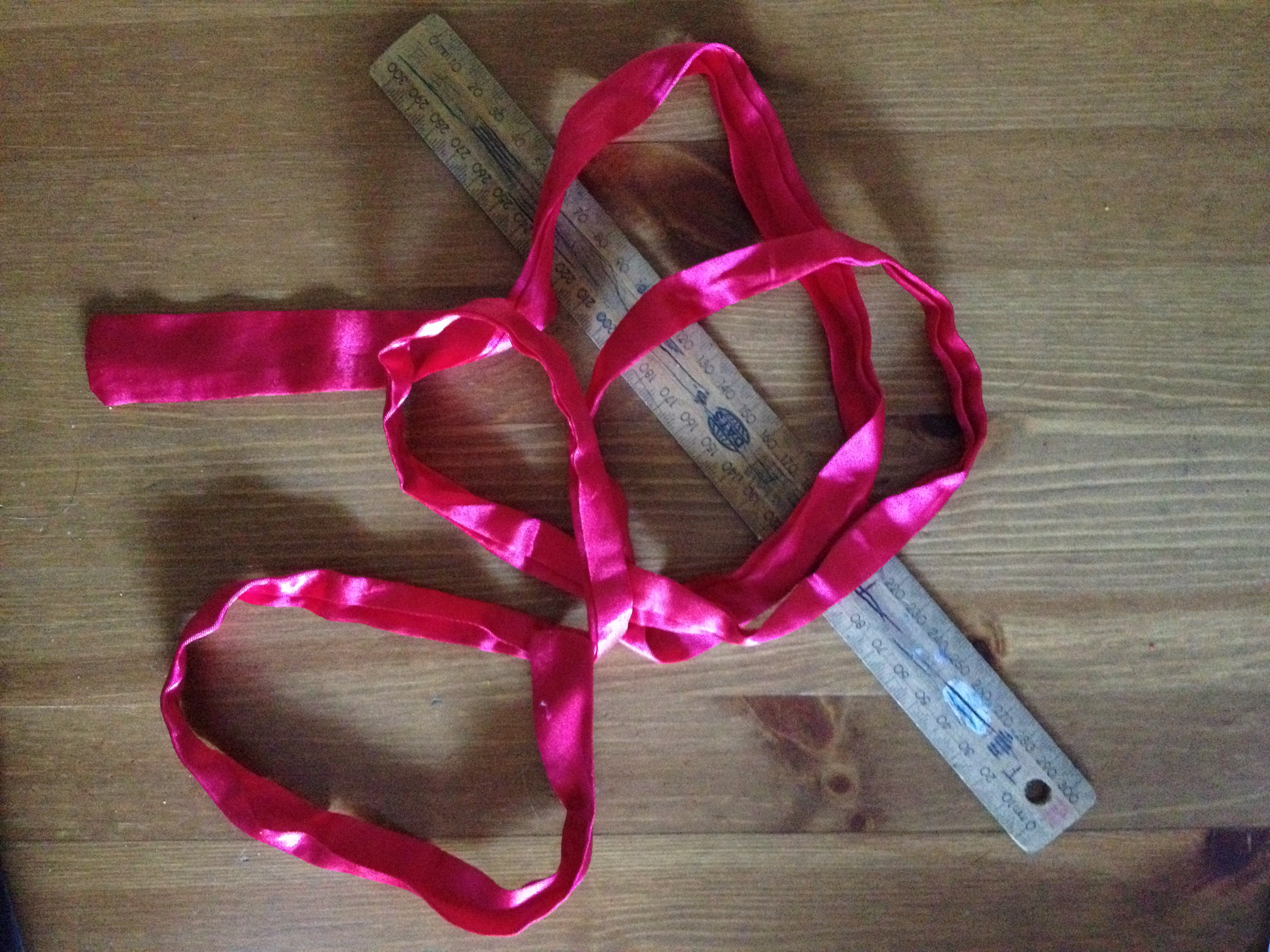
Ribbon and RulerA more helpful approach to these internalized rules is to treat them more like flexible ribbons. They can be applied when it is helpful and not when it isn’t.

To give you another example of how this works in practice. I have a rule that, before I raise a concern, I need to have worked out how I contributed to the problem. This is another ‘good’ rule. It stops me from blaming people unfairly. But if I apply it rigidly, it can hold me back from being authentic. What if, try as I might, I can’t work out my part? Or, if actually no one caused the problem – it just happened? If I follow the rule rigidly, I am paralysed, unable to raise my concerns and sometimes as a result; my silence actually damages the relationship.

You might want to start to notice where rulers and ribbons turn up in your life.

English: tape measure Français : Metre de cout...
If you combine a ruler with a ribbon you get… (Photo credit: Wikipedia)

What does it feel like when you turn a rule into a ruler? What is it like when you apply it more flexibly and gently like a ribbon?

The only man I know who behaves sensibly is my tailor; he takes my measurements anew each time he sees me. The rest go on with their old measurements and expect me to fit them.

George Bernard Shaw

When Feeling Awkward Gets In The Way Of Change

Have you ever wanted to try something new but because it felt awkward you backed away from the change and went back to what felt more comfortable, even though part of you really wanted to persist with the change?

I have been struggling with such a difficulty.

I recently become aware of something small that could lessen the influence I potentially have in the world. It looks like this:

Dotty Rachel

When you look at that photo do you think – ‘There sits a credible executive coach and corporate facilitator?’ I didn’t think so!

Although I don’t actually turn up to meetings with clients looking this dishevelled and dotty (really I don’t!). I do have wild hair and a tendency to present myself a bit like a kindly lady doctor (as this is what I was for many years!).

However, I recently read this paper and also this one and realised that appearances do impact on whether others take us seriously. Then a dear friend, who is also a client, told me, ‘Rachel, one of the things I love about working with you is that you turn up to run a session and people don’t expect you to be so competent because you aren’t dressed in a sharp suit and you appear so unassuming and then you do amazing work and they are surprised‘.

And I became concerned. I want my work to have a significant impact on others. I want to play a part in helping people to have more vitality and meaning in their work. I don’t want something as simple as my appearance to mean I am starting at a disadvantage with new clients.

So I decided that I wanted to present myself in a way that is authentic but perhaps a little more skilful. Goffee and Jones call this: Be Yourself – More – with Skill.

What does that look like for me? Probably not a sharp suit but perhaps a little tidier?

So I ask my lovely daughter, Ellie, to teach me how to put my hair in a bun. I have found this new skill very hard to learn. I feel clumsy and awkward. My mind kicks into action telling me, ‘Why are you wasting time learning something so silly when you could be learning something useful and important like Relational Frame Theory‘. The bun falls out halfway through the day and my mind says, ‘Told you this was ridiculous’.  I start to wear a little more make up and my mind tells me ‘It is so superficial to focus on your appearance’ and ‘Everyone is judging you‘. I feel like a fraud. But part of me is excited about the possibility of who I could become.

In the presence of these conflicting thoughts and feelings I remind myself that the best values and actions are freely chosen. It is okay for something as small as learning how to put my hair in a bun to matter to me. I ask Ellie to help me again..and again. I write down her instructions and follow them carefully.Notes on how to make a french roll I am still rubbish at buns but I persist. One day I will be a lady who weaves beautiful buns, knots and french rolls. Hopefully, as a result, I will look a little less dotty and a little more competent and I will ‘be myself – more – with skill’.

If you were to ‘be yourself – more – with skill’ what would be different about how the world experiences you? Is there a change that you want to make but it feels awkward?Would the change be a move towards your values? If so, are you willing to persist with the change and have the feelings of awkwardness?

I hope so! Because:

‘It is never too late to be who you might have been’

George Elliot

I am going to be the lady who both knows Relational Frame Theory and wears a beautiful bun.

How about you? Who will you be?

(How to) Stay on The F*****G Bus

I recently came across Helsinki bus theory, an interesting metaphor by the photographer Arno Minkinnen which is usually applied to creativity.  Being a big fan of bus metaphors, I started using it with my coaching clients and it resonates, so let me explain:

In Helsinki all buses follow the same route at the start of their journey.  For at least 1 km all buses take the same route and make the same stops, irrespective of their number and eventual destination.

After this they diverge and the differently numbered buses start to separate into more distant and less familiar parts of Helsinki.

Let’s imagine that in the metaphor you are a new artist who wants to create innovative art.  Each bus stop represents one year of your life, so the third bus stop represents 3 years of learning your craft and trying new things out.

After 3 years people begin to notice your work but they start by comparing it to people who have done similar work before.  Being driven to do something unique, you feel discouraged at finding you’re following someone else’s path.   So what do you do?

You get off the bus, go back to the terminus and try another route.

This time you take a different number bus in the hope that it will lead to something different.

But the same thing happens.  You had the intention of changing to something new, but you get compared to others and feel discouraged.  So back to the terminus you go. As Minkinnen says “This goes on all your creative life: always showing new work, always being compared to others.”

So what’s the answer?

Well the advice offered by Minkinnen is simple:

Stay on the fucking bus.

Exactly!  Stay on the bus!  And this is true not just for creative endeavours, but for anything that requires persistence, including career, life or behaviour change.  As this HBR article makes clear, it is long term commitment to a direction which is often the key to success.

The Problem with Staying on the Bus

Unfortunately, most of us find staying on the bus very difficult, mainly because we are directed by our short term thoughts and feelings. Just as in the case of the artist, we feel as though nothing has really changed, that this is just the same as before, that maybe we should have taken a different route.

This is where we all need help to understand how to stay on the bus.

How to Stay on the Bus

The first step is to get clear on which bus you want to get on.  I suggest a combination of decision science, The Dip and values work for this.

But next we need to learn how to deal with the thoughts and emotions that come from staying on the bus.

Let’s be clear that it is not the feelings themselves that force us off the bus.  It is our interpretation of those feelings – our relationship to them – which leads us to get off early.

The Role of Psychological Flexibility

Psychological flexibility is the ability to see our immediate experience from different perspectives.  For example, instead of thinking about our immediate thoughts and emotions, we can consider our longer term values.  Instead of seeing emotions as reliable guides to behaviour, we can place them in a different context as the flipside of what really matters.   Instead of running away automatically from certain thoughts, we can see them as just learned behaviour and not something we necessarily need to listen to or struggle with.

With practice, we can become less influenced by our short term impulses (‘this is just the same as last time!’) and more by our long term values.

This can help us to stay on the bus, and to persist even when our immediate thoughts and emotions make persisting difficult.

Passengers on the bus

The Dangers of Language

“So, how do you feel?”

“I feel like I’m grinding through life, sort of like I’m pushing a heavy boulder uphill.  Every day I’m grinding forward, but it feels relentless.”

“So how does this feeling of ‘grinding’ actually show up in your body?”

Pause.  Interesting question.

I was receiving supervision from one of the most respected therapists within the ACBS and the question threw me for a moment.  I scanned my body as mindfully as I could.

“I notice I feel a bit tired.”  Pause.  “And I notice that I have some tension in my shoulders”.

“OK.  Anything else?”

“Hmmm.  Not really.  The tension is certainly there but it’s not that severe.  It’s actually pretty bearable.”

“OK.  So what would the person you want to be do next?”

Another long pause.

“I guess I would take a few more breaks, but other than that nothing, actually”.

And there we had it. For several weeks my mind had been telling me about the grind; how tough my life was and how relentless.  But on closer examination that story turned out to be based on feeling slightly tired and having slightly sore shoulders.  From where I was now – skillfully led to a different perspective – my life was actually going really well.  I was doing the work I wanted, with people I liked, whilst making my own small dent in the universe.  If this is a grind, then it is the kind of grind I would definitely have chosen.

This is a clue to one of the most powerful lessons within contextual behavioural science; that part of our lives (or ‘context’) is shaped by the words that we use to describe it.

If we get it wrong, language has the capacity to sell us a version of life that is not particularly accurate or helpful and which may leave us feeling shortchanged.  In my case this was certainly true as it was detracting from the joy and privilege I felt when doing my job.

This was a timely reminder that whilst language is incredibly useful and powerful, it should come with a warning.  Checking in on the accuracy of the metaphors we us  in everyday life is really useful (as the brilliant Yvonne Barnes Holmes makes clear in this talk about constructing effective metaphors).

But every now and again it also pays to connect to our actual ‘felt’ experience of life, and separate this from the language we use to describe it.

Noticing How Desire Can Pull You Away From Your Values

When does desire pull you away from your values?

It might be the impulse to buy more stuff that you don’t really need; watch TV instead of doing some exercise; let work dominate your  life; make poor choices that change your life forever…

In this TEDx talk, Kelly McGonigal explains that the urges provoked by desire (the promise of happiness) have a tendency to overpower current happiness and satisfaction.

Desire for something you don’t have, but would like (in my case, millions of dollars and to write a best selling book!) can create stronger impulses than the feelings of contentment associated with what you do have (for me now: love, health, safety, meaningful work that uses my strengths). Even though what you have now may be much more important to you than what you desire.

When we feel that experience of wanting something, we feel an urge to do something to get that desire met. If we are to handle this tricky emotion wisely then we need to be clear about who we want to be and what we want our life to stand for. We need to have chosen the values we want to live by. But knowing your values isn’t enough.

Last week, Paul suggested that mindfulness helps us to turn our values into action. When desire is moving you away from what really matters, mindfulness can help you to ride out the urges rather than mindlessly chase what you desire .

You can mindfully notice how feelings of wishing and wanting are pulling you in a particular direction and check if that would be a move towards your values. You can become aware when desire is in control of your behaviour, catch yourself and come back to what really matters to you in the long term – love? kindness? connection? your health? security?

I want to be clear here that I am not suggesting that you abandon your ‘big, hairy, audacious goals‘, what I am suggesting is that you also:

1. Compassionately notice when pursuit of those goals feels driven and addictive. Pause and breathe and see if you can ride those impulses like waves rather than act on them.

2. Keep checking in as to how the goals you are currently pursuing fit with your values and life purpose

3. Have the ‘willpower’ to spend some time paying attention to other important areas of your life even though you may feel the addictive pull of the desire for something ‘bigger and better’ calling to you. Your thoughts might whisper, ‘I’ll just send one more email; read/write one more blog post; sign up for that course that promises to make me rich.’ Can you have those thoughts and the feelings associated with them and still spend the afternoon in the garden with your loved ones? Can you have those thoughts and feelings and bring your attention back to this moment now with all its small pleasures and pains?

Kelly McGonigal suggests that the recurring difficulties we experience in handling our desire well is not a sign that there is:

Something uniquely wrong with us – but it is actually part of being human. it is not just you, it is all of us.

Oddly, for me, accepting this makes it easier to deal with. How about you?

[I am running a low cost, one day workshop on ACT at The Relaxation Centre of QLD on  Sun 3rd March.  All proceeds go to the centre. I would love to see you there.]