I think this is a hugely important contribution to the development of effective, ACT-consistent coaching interventions, and essential reading for:
Members of the ACBS with an interest in using ACT in the workplace: the paper explains how to make interventions which organisations will actually buy and which organisational clients will respond to. It also provides a fantastically clear outline of how and why ACT is relevant to organisational contexts.
Organisational coaches with an interest in evidence-based practice: in a previous post I argued that coaches need ACT (and that ACT needs coaches). This e-book will provide you with all the information you need about why this is the case, as well as practical tools and suggestions to get started. There are specific chapters dedicated to coaching Alpha Executives and Poor Performers, as well as overviews of an ACT-consistent GROW process and goal setting.
I am going to read it again as I travel around Europe over the next few weeks. I am looking forward to it, and I know it will make me a better coach. Thank you Rachel (and well done)!
This is a story about two blog posts, two people wanting to make a contribution, and the price that comes with doing that.
In my last post I promised to write something about the difference between ACT as therapy and ACT as coaching. Before I did, I checked with Rachel that she was happy for me to do so, as we’d presented together on a similar subject before. This was her (edited) reply:
Also, if you think it is helpful, I would love you to link to the ACT Coaching e-book that goes with my ACT coaching training.
I have decided to just give it out free to folks.
No pressure, if you don’t think it is appropriate in the context of the post.
I then read the e-book. Reader, it is AMAZING.
It is the most valuable contribution to this developing field I’ve read and beautiful too (very Rachel). Needless to say it is far more useful, well written and valuable than my blog was going to be. I will be devoting the whole of the next post to it (no way am I shoehorning it into this).
But the question is, how does this happen? Here’s the next exchange:
Err. …Rachel this is amazing. Why didn’t I know about this??
From: Rachel Collis [mailto:racheljanecollis@gmail.com] Sent: 24 April 2015 22:58 To: Rob Archer Subject: Re: ACT and coaching
Cos I am an idiot!
It needs more work but I am quite pleased with it!
I then asked Rachel about the functions of ‘cos I am an idiot’ and she hinted at some aspect of her learning history that made praise both craved for and difficult to receive:
From: Rachel Collis [mailto:racheljanecollis@gmail.com] Sent: 25 April 2015 23:42 To: Rob Archer Subject: Re: ACT and coachingThe function of ‘cos I am idiot’ is that I do something- like spend hours writing an ebook – and then don’t tell people. I think it is EA around embarrassment and shame.
And there we have it.
Meaningful work, ‘towards moves’, contribution: all come with a price. And the more we value the contribution, the higher the price.
So I wonder what the next ‘towards moves’ are for me and Rachel?
I asked her if I could post the link for her, because I didn’t want her to undersell it. But then I felt caught between two options. I could:
Post it myself, to reinforce her value to the community by praising her work. This sounds good, but am I really trying to rescue Rachel from her discomfort, and thereby reinforcing her avoidance?
Let Rachel post it. But is that just testing Rachel’s willingness? And why wouldn’t I actively support a colleague who I believe, has done such important and valuable work?
And what should I now do with my post?
I am left with something I have worked on, not as important as Rachel’s, but a contribution nevertheless. I could:
Not post, and perhaps work on it some more, trying to offer something different to Rachel.
Post anyway, in the service of making my own contribution to something that matters to me.
Both of these feel like ‘towards’ moves to me….and both will probably come with a price.
If I don’t post, I will need to make way for feelings of jealousy that Rachel has written something far better than me, without even mentioning it.
If I do post, will I secretly hope that somehow my post will be seen as just as valuable (oh Rob, this is really good too!) – and move straight to feelings of rejection if that doesn’t happen?
So there we are again. Two humans, on different sides of the world, both wanting to make a contribution to something that matters.
I’ve been been talking to fellow coaches at Ashridge Business School about the benefits of using ACT as part of coaching.
In the interests of space I won’t try to explain what ACT is, but will restrict myself to listing some of the benefits of using it in a coaching context. My intention is to generate responses below, which I’ve learned are nearly always more valuable than mine.
Evidence-based. If coaching is to be progressive and credible, then the interventions used should have been shown to be effective. They should have achieved a desired effect over and above alternative interventions. Over 100 Randomised Control Trials now show ACT works, with most of these in the last 5 years.
Theory-based. ACT is based on a clear theory which attempts to explain something fundamental: how language and thinking influences human behaviour. Because of this theoretical basis, ACT is clear about why changes happen, i.e. the mechanisms of change. When using ACT, coaches know that it works and why it works. In session, this enables coaching to become more accurate, as ACT coaches can focus exclusively on the active ingredients of behaviour change.
Liberating. Just in case this is sounding too hard-edged, in practice ACT is deeply personal because it puts people in contact with the things they truly care about (if you haven’t read this post by Rachel, please do). The aim is to increase psychological flexibility – the ability to choose one’s behaviour even when experiencing difficult thoughts and emotions. For some people, moving towards one’s values is only possible in the presence of immense pain. But by increasing flexibility, they can be liberated to do just that…and the world opens up before them.
Universality. ACT is a therapy, but it is not only a therapy. The 100 RCTs apply to almost every outcome you can think of; from smoking cessation to chronic pain to workplace performance. By promoting psychological flexibility ACT enables people to choose their behaviour with greater purpose, broadening peoples’ choices in life. This is therefore a fundamental life skill which applies equally to the clinic and the boardroom. (And don’t get me started on schools…).
Mindfulness, with a purpose. Yes, this is another trendy mindfulness-based intervention and ACT benefits from the immediacy and vitality of being strongly in the moment. At the same time, ACT is more than just mindfulness; it is mindfulness with a purpose. It uses mindfulness as a call to action, for people to get out of their minds and into their lives, rather than a desirable end state in itself. This is mindfulness used as a lightsaber, to help deal with the danger and messiness of real life.
Practical and pragmatic. ACT has strong behavioural roots, which means that coaching conversations are primarily about tangible and practical behaviour change. ACT has a cognitive component of course, but there is no ‘right’ mindset to achieve, no ‘good’ way to think. Behaviour is not judged as ‘good’ or ‘bad’, but pragmatically assessed for its ‘workability’, i.e. whether a given action works over the long term.
Consistency. Because of ACT’s theoretical roots, coaches work to a single, coherent and testable model of human behaviour. This allows coaches to multiply reinforce or model psychological flexibility, lending coherence and consistency to sessions. This contrasts with other approaches that more resemble a collection of techniques. NLP is a good example, as it borrows a number of tools and techniques and relates them to a theory based on language. However, this model has not stood up to scrutiny, and is therefore haphazard pseudoscience.
Ignore this final point. In ACT training you are taught not to believe what the ACT text books tell you, or what Steve Hayes tells you, or even what your mind tells you. You are taught to trust your own experienceof what works. So here is my experience…
Before ACT I was a fairly good coach. I established good relationships, was sensitive, brave and as a former consultant I had wide experience.
But post-ACT, everything is different. When my mind tells me that everything is going wrong, that I am incompetent, that I am a terrible psychologist, I can respond with compassion for myself instead of reacting.
This tiny breathing space allows me more options for responding to my client than I had before. Maybe I will share my experience and model acceptance, maybe I will choose to refocus on the working alliance, or maybe I will reconnect to what matters to me, and recommit to being of service to another human being.
As a result, I feel as though I am more purposeful as a coach, making more of a difference, helping good people do good work in often bad systems. And that’s not a bad way to spend my time on earth.
But then, of course, don’t believe what I tell you either….
Postscript
If coaches need ACT, it is equally clear that ACT needs coaches. We in ACBS want to change the world for the better….and coaches are out there, right now, having helping conversations with powerful people.
I believe coaches are a force for immense good – bringing much-needed support and challenge to people who may not receive this elsewhere. If we want to get evidence-based practice into the water supply, then we must learn from coaches and welcome them.
For regular WWA readers, some context. I’ve been working as one of the Faculty at the brilliant Escape School, in particular an amazing Tribe of 50 people who have been on a 3 month journey to get unstuck and do something more meaningful with their careers. It was so enjoyable and moving that I wanted to write them a short letter…and I’m sharing it here because it is hopefully a good example of ACT being used in coaching (and getting into the water supply).
Dear Escape Tribe,
I can’t tell you my admiration for your courage to stand for something in your lives, even in the presence of your fears. It feels like a privilege to watch you and work with you; in many ways one of the highlights of my career. So I wanted to write you my own letter, perhaps because I was so moved by those you wrote to yourselves…
Get out of your mind and into your life
This is a great book with a cheesy title, yet which captures a critical idea in psychology.
Society teaches us to think that if we can only get more confident, certain, less anxious etc, then all will be well. But it’s really the other way round. Thinking follows behaviour. From another great book:
“We think that the key to successful career change is knowing what we want to do next and then using that knowledge to guide our actions. But change usually happens the other way round. Doing comes first, knowing second”.
Herminia Ibarra, Working Identity
Remember the anemone
When stuck, our minds often tell us that the action we must take has to be big and bold.
If that works for you then great, go for it. But if it doesn’t, think of an anemone.
If you aren’t willing to open your whole self up to some big change, see if you can be willing to start by opening one tentacle out into the ocean; exploring and experimenting.
Experiential avoidance will always be an option….
Our minds can always find an excuse not to do difficult things. And that is normal.
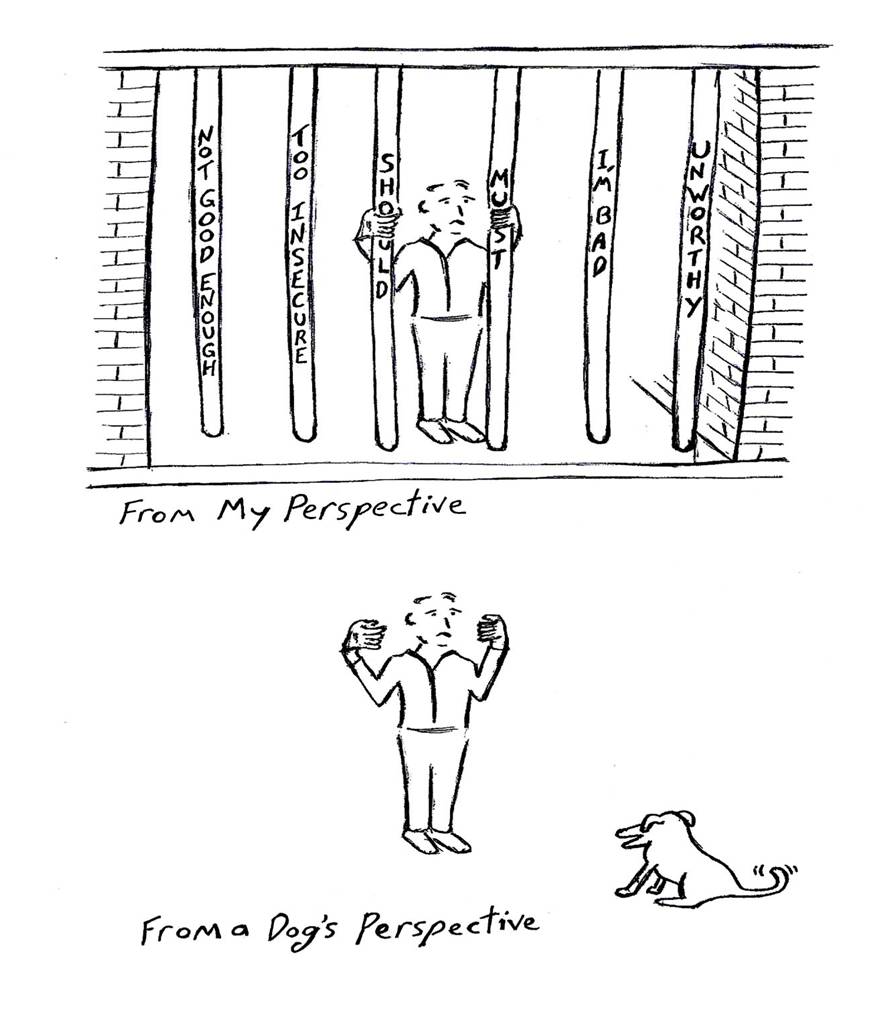
But if avoidance becomes our objective, then it narrows our lives. And over a lifetime this can lead us to feel trapped – trapped in prisons made only by the words in our minds.
Values are about the here and now
Instead of seeing values as ‘out there’, a remote and distant pipe dream, remember that they are accessible to you right now.
You have a choice to tune into them and show up to them, right now. What will you stand for in this moment? Put enough of these moments together and you become a different person.
‘The road less travelled’ is less travelled for a reason
The irony of human existence is that if something feels important to us then it will have a flipside which feels scary.
If you dare greatly, you will feel fear. If you commit to love then you risk rejection.
Happiness and sadness are not exclusive, but intimately connected. They grow weak together, or strong together.
Acceptance changes everything
Once you start those first few steps out in the real world, the feedback you receive may be mixed. If avoiding pain is your objective then it is tempting to retreat into the narrow repertoires of behaviour that have trapped you.
But if you are willing to accept yourself – that is, the whole of yourself – then you will have pain and joy, anxiety and meaning.
Only if you can accept the thorn, do you get to keep the rose.
Don’t forget; the world needs you
Don’t be fooled into thinking there is nothing for you to do. The world is full of challenges which need you – your skills, talent and energy.
This may not be fighting great battles of justice or injustice, but contributing to the world in the best, most vital version of your self.
That is really what the world needs more than ever.
Therefore, for yourselves, but not only for yourselves, may you all find the courage to keep going.
And in so doing, may you all be ignited.
with huge thanks, admiration and hope for all of you,
Rob
What I have Learned So Far
Meditation is old and honorable, so why should I
not sit, every morning of my life, on the hillside,
looking into the shining world?
Because, properly attended to, delight, as well as havoc, is suggestion. Can one be passionate about the just, the ideal, the sublime, the holy and yet commit to no labor in its cause? I don’t think so.
All summations have a beginning, all effect has a story, all kindness begins with the sown seed. The gospel of light is the crossroads of indolence, or action.
One of the best productivity systems is David Allen’s Getting Things Done, where he explains why we need a system (a ‘second brain’) which we trust if we are to work without distraction.
It’s great stuff, but I think ACT has much to add to his system, in particular two key ideas:
1. Clarify values. The distinctive problem with knowledge work is that it is difficult to know what the ‘right’ work is at any given moment. There are so many competing priorities; should I be writing this blog or perfecting a proposal?
For knowledge workers, how we define our work is our most important task, so a clear understanding of what matters to us – what we want to stand for – will help. I certainly want to stand for more than winning commercial contracts, hence me finding time to contribute to this blog.
2. Acceptance. So often productivity is not actually at the mercy of external factors, but our own thoughts and emotions. For example, I know that if a task makes me anxious or bored then I will find a sudden urge to clean the shiny handles on my kitchen cupboards.
This is where all the advice to do work you love or find your passion is so dangerous. If we focus on how we feel during a task, we start to hand control of our lives over to our emotions. And our emotions – even the ones we want – are not really in our control, or reliable bellwethers of where to head next.
The most quotable psychologist in this area is Shoma Morita –> who always makes a point of separating how we feel from what we do:
“Begin taking action now, while being neurotic or imperfect, or a procrastinator or unhealthy or lazy or any other label by which you inaccurately describe yourself. Go ahead and be the best imperfect person you can be and get started on those things you want to accomplish before you die”.
Ultimately it is only by holding our emotions lightly – by committing to our values in the presence of anxiety and boredom if necessary – that we will build the kind of working life we want. Or, as Morita says:
When running up a hill, it is all right to give up as many times as you wish – as long as your feet keep moving.
(And as my mind says ‘check this post one more time’ with my finger I press…PUBLISH).
My father was a doctor. When he finished medical school, he planned to pursue a career with some prestige attached to it. He was going to become a surgeon or physician in some teaching hospital. He would work his way up the hierarchy until he was like Sir Lancelot Spratt, with a host of nurses, doctors, medical students and sundry allied health professionals traipsing after him, writing down his pronouncements and doing his bidding.
My mother had a different view of what sort of life would suit them and she persuaded my dad to instead become a country GP in a relatively poor part of Derbyshire. He spent much of his working life visiting patients in their cramped terraced houses or sitting in his surgery looking into the ears of snotty nosed children. He was not followed around by an entourage. His work was not with the rich or the famous and he didn’t become rich or famous himself. On the surface, he might seem like a relatively insignificant figure.
But if you walk into the local newsagent with my father, who has been retired for 14 years now, it is very likely that someone will rush up to him and say something like, ‘Oh Dr Collis, It is my lovely, lovely Dr Collis’.
In his small way, in this small village in the middle of England, my dad is famous. He is famous to these people because he was very, very kind and caring to them at a point in their life when they needed this more than anything. Because he listened to his patients with great interest, even if they were telling him about problems with endless green snotty noses. He started with the assumption that his patients mattered and their worries were important and that meant everything to them.
My mother is also ‘famous’ in this small village in Derbyshire. She is famous for her stalwart support of people through the tough times of life, for her capacity to be with people through the periods of grief, loneliness and overwhelmingly bad odds that visit us all. People often say to me, ‘I don’t know what we would have done without your Mum when…happened.’
The river is famous to the fish
….
I want to be famous in the way a pulley is famous,
or a buttonhole, not because it did anything spectacular,
but because it never forgot what it could do.
There is so much written about how to become successful. But the success these articles describe is about fame and fortune rather than the gratitude of a middle aged lady in the local newsagent. And that is a problem.
It is a problem because chasing prestige leads you to focus energy on things that aren’t really important to you:
“What you should not do, I think, is worry about the opinion of anyone beyond your friends. You shouldn’t worry about prestige. Prestige is the opinion of the rest of the world…..Prestige is like a powerful magnet that warps even your beliefs about what you enjoy. It causes you to work not on what you like but what you’d like to like…Prestige is just fossilised inspiration. If you do anything well enough, you’ll make it prestigious…
Prestige is especially dangerous to the ambitious. If you want to make ambitious people waste their time on errands, the way to do it is to bait the hook with prestige. That’s the recipe for getting people to give talks, write forewords, serve on committees, be department heads, and so on. It might be a good rule to simply avoid any prestigious task. If it didn’t suck, they wouldn’t have had to make it prestigious.’ Paul Graham
When you are in your late 70’s, as my father is. What will touch you most:
That you rose through the corporate ranks?
That you earned lots of money and drove a fancy car?
That you were, in your own world, a Lancelot Spratt?
Or,
That somewhere there is a person; someone who, like you, is insignificant in the scheme of things; and they remember how you treated them?
That somewhere there is a piece of work, something that was done really well…by you.
I want to highly recommend this podcast to you.
Trent Codd talking with Anthony Biglan about creating nurturing environments.
Key points for me:
There are now many randomised controlled trials of family and community interventions that have been shown to make a significant difference to the development of children and adolescents. We now have the science to impact on problems that we used to think were intractable.
Helping parents let go of harsh, critical or coercive approaches and become more nurturing, supportive, loving and caring is important.
If we want to build well being then we need to create environments that:
– are richly reinforcing of pro-social behaviour
– limit opportunities and cues for damaging behaviour
– encourage psychological flexibility
Dr Biglan goes on to talk about a range of approaches that have been shown to help to create these environments.
His suggestions are highly relevant for organisations.
What would it be like if leaders decided they were going to create nurturing environments at work?
I suspect that problems with employee retention, absenteeism and engagement would significantly improve.
The end of one year and the beginning of another is often an opportunity to torment ourselves with difficult questions: Did I give enough energy to the things that really matter to me? Did I give too much energy to things that aren’t important in the long term? Did I live my values? (To get a visual picture of this, you might fill out Tobias Lundgren’s Values Bulls Eye.)
When you review the previous year, it is likely that you have done well in some areas of your life and have some regrets about others. We often don’t devote as much time and energy as we would like, to what really matters . We often don’t live our values as consistently as we want. We frequently waste time and energy on things that, it turns out, don’t really matter in the long run.
When you consider the aspects of life you neglected last year, you may notice that some are very familiar to you. They will have shown up for you many times over the course of your life. Perhaps there is some aspiration that is important to you, that just keeps being put to one side?
To give you an example.
Since I was 11, I have wanted to be a writer. I love reading and I wanted to be like the authors I admired. I wanted to be one of those people, the people that befriend strangers by sharing their thoughts in a book.
I have started many books but, despite this deep desire to be an author, I have never finished writing a book. This desire to write seems to matter a lot to me but each year goes by and I still don’t accomplish my goal.
A couple of years ago, I turned 50 and I realised that time was running out. If I really want to be an author, I need to knuckle down and actually write a book. So I started another book. It is on a topic that matters to me (Meaningful Success). Sitting at my Mac trying to express my ideas with honesty and courage is hard and scary and wonderful. Two years later and I am still wading through this project. Trying to create something useful. Something that isn’t rubbish. In the process, I am discovering that this writing lark is harder than it looks!
But even though this matters deeply to me. Even though I love writing. Even though every thing I read about how to become a good writer starts with the advice – just write.
I often don’t write. My days are filled with other stuff. Stuff that isn’t writing.
How about you? What are the goals that really matter to you? The goals that year after year, you don’t quite manage to give enough time and energy to? It could be:
And …what gets in the way of you pursuing that goal?
There are lots of reasons why we don’t pursue these important goals with the necessary energy and passion. One reason that seems increasingly common is, ‘I am too busy.’
So what are we too busy doing?
If you analyse what you are too busy doing, you can divide your actions into: 1. Things that were genuinely, at that moment, a higher priority than the important but non urgent task.
For example: spending time with the people you love; caring for your fragile human body; doing meaningful work; earning enough money to pay the bills; volunteering for causes that matter to you…
These choices are valued actions. You are being the person you want to be. Life is full of conflicting priorities, can you notice these choices and be gentle to yourself about them?
2. Things that, at that moment, felt like they were a higher priority than the important but non urgent task but they actually weren’t.
For example: trying to impress or please people; trying to earn more money than you need; doing things just to get prestige or recognition; doing things to avoid unwanted feelings.
This is a recurring problem for many of us. I certainly keep getting hooked by these activities. I look back on my life and I have spent too much time focussing on things that seemed important at the time, but actually, from the perspective of a few months or years later, I realise didn’t really matter.
3. Things that, at that moment, didn’t even feel like they were a higher priority than the important but non urgent task.
This is basically all the things we do to procrastinate and avoid the harder stuff. It might be: watching inane TV or silly YouTube clips; checking in on Facebook; going shopping. (NB These activities can also be acts of self care – in which case they are category one activities – only you can decide this.)
At this point I could just tell you to make sure you focus your energy on the right things. But I don’t think that advice is very helpful. I know it doesn’t work for me.
So I want to encourage you to do something different. To start gently.
Just start by noticing with curiosity what you are doing. In real time. Notice which category your behaviour is in. You might also notice if you tend to berate yourself for spending time on the ‘wrong’ things. How effective has this harshness been for you? What would happen if, instead, you responded with compassionate understanding of your human failings?
Instead of harshness, could you notice how each behaviour feels? Notice how it feels in your body as you take these various actions? What emotions are you feeling? Notice which circumstances seem to encourage you to do which types of behaviour. Are there any common themes?
For me the ‘category two’ activities – the ones that seem important at the time but actually aren’t important- are often associated with a scrabbly feeling, like I am desperately trying to get something. At those times, if I pause and notice what is going on inside me; I realise that I am often hooked by thoughts that I am not good enough in some way and/or there isn’t enough of what I think I need. The best response to this seems to be to pause and breathe. To turn to myself in kindness. To be willing to be with myself and the thoughts that I am not adequate or the world is not the way I want it to be.
‘Category three’ activities – the ones where I know I am frittering time away – sometimes feel to me like I am hiding out. Trying not to think about the scary task I am avoiding. At other times these activities are accompanied by a whiny voice – ‘I don’t want to…I am too tired…I deserve a break…It is too hard…’ It feels like when I was a kid and I used to put my fingers in my ears and loudly say ‘I can’t hear you…LA…LA…LA…I can’t hear you’.
If I am courageous enough to pause and check in. I notice the thoughts and feelings I am trying to avoid. Can I turn towards these feelings with compassion, knowing they are part of being human?
I want to encourage you to do the same. Instead of trying to get it right. Instead of fighting with yourself.
Just notice.
Notice whether what you are doing is moving you towards your values; towards what matters to you or whether it is taking you away.
Notice what is going on inside you at those moments.
According to Ludeman and Erlandson (2004). ‘Alpha’ executives make up 70% of senior executives. They are confident and intelligent, competitive and impatient. They like to be in charge.
‘Alpha’ executives don’t tend to listen well to others. They engage in dominance behaviours, (Schmid Mast and Hall 2009) such as:
Taking charge of the conversation
Interrupting others
Talking down to people
Expressing strong opinions
Tending to steamroll others into doing what they want (Schmid Mast and Hall 2003)
Senior alpha executives can find it hard to let others influence their decision making. (See, Morrison et al. 2011)
Alpha executives often have unrealistic expectations of themselves and others. This can lead to burnout, both in themselves and in members of their team. Alpha executives can be dismissive of others feelings and can fail to notice the negative impact that their competitive and aggressive approach has on others. Colleagues and direct reports can sometimes experience the aggressive alpha behaviour as bullying.
Alpha’s often achieve results in the short to medium term; they look confident; they speak up in meetings. They look like potential C-Suite material and they get promoted.
But once they reach higher levels of management, the need for cooperation and collaboration grows and their dominance behaviours start to hold them back and sometimes even derail them.
I often coach executives who exhibit some, if not all, of those alpha behaviours. I enjoy working with them. I like their intelligence, their focus on results and honesty. It can also feel intimidating. The curiosity and exploration that is central to good coaching can seem like a waste of time to these executives – and they let me know this assessment in no uncertain terms!
How does ACT help these executives to develop more effective leadership behaviours?
In this post, I want to explore the tricky topic of working with these executives and their emotions.
My observation is that many, but not all, of these executives have learnt to disconnect from their own emotions. This disconnect is often contributing significantly to their insensitive and impatient behaviour. The behaviour is, in a sense, a form of running away from unwanted thoughts and feelings.
In many, the armour was actually created early in life. It may well have been adopted in the school years, as a response to the harsh experiences that many of us have during childhood. This means that many of these executives have never learnt to really notice and label their emotions, a core skill of emotional intelligence.
Emotionally intelligent leaders can tease out the different grades of their own and others emotion, for example separating impatience from frustration or anger. Emotionally intelligent leaders can notice emotions that may be pulling them in different directions. They can pause, notice their emotions and notice the urges that result from these emotions, without having to act on those impulses. They can hear the wisdom their emotions often offer, perhaps about the risks in a situation or how others may be feeling about something.
The lack of emotional awareness that some alpha executives experience is often coupled with avoidance of many of the ‘softer’ emotions. This does not mean, however, that the executives are genuinely emotionless, the emotions will still be present and will often drive behaviour unconsciously.
The aim of coaching alpha executives can often be to help them to learn to engage with their own emotions with more curiosity and wisdom.
This work can be scary for executives, many of them have an emotion phobia; where approaching certain emotions, such as sadness or fear, can make them freeze or escape. Just like with other exposure work, this needs to be done with the consent of the individual concerned and with gentleness and curiosity.
Often the most important thing that a coach can do in this situation is to help the executive to pause and notice. How does it feel in your body as you talk about this issue? And what does that tell you? And what do your values and the needs of the situation suggest you do next?
As people become more fluent with their own emotions, they become less driven by them and have a greater capacity to choose the most effective behaviour in a given moment.
As people become more open to their own emotions, they also become more aware and empathic towards others.
As emotions become welcome companions, the corporate armour becomes less necessary, vulnerability becomes possible and life becomes richer.
(For Australian Readers – I am running a workshop on this topic at the APS International Coaching Congress in Melbourne in November 13th to 15th)
We are experiencing a rapid increase in the incidence of ‘lifestyle’ disorders such as diabetes, obesity, cardiovascular and cerebrovascular disorders, depression and anxiety.
At a recent workshop, Kelly reflected on the impact of the 24/7, hyper-connected yet socially isolated world many of us inhabit and he kept coming back to: ‘We aren’t that kind of a monkey’.
Now Kelly knows we are hominids not monkeys, but ‘We aren’t that kind of hominid’ is a bit less catchy.
The hominid family includes humans and our close genetic relatives – gorillas, chimpanzees, bonobos and orang-utans. Just sit with that for a moment – think about what our ‘cousins’ need to thrive…
A sense of belonging?….Lots of fresh fruit and vegetables?….Time to rest?
What if many of the problems that beset us are because we are ignoring our most basic ‘monkey’ needs?
Based on an extensive review of the literature, Kelly suggests that, in order to flourish, you probably need to:
Minimise your exposure to toxins (physical and social)
Eat real food
Move your body
Give yourself more sleep/rest opportunities
Engage in meaningful activity
Practice mindfulness
Cultivate your social network, and,
Cultivate self-compassion
Now Kelly isn’t saying that, if we do this, there will be no more illness or distress. What he is suggesting is, if we look after ourselves in these ways. Then, when stressors visit us, as they will, we will have a little more resilience. We won’t be living at the limit of our resources. We will be less vulnerable to those ‘lifestyle’ disorders.
And during less challenging times, perhaps we will be more likely to flourish?
Read that list again:
Minimise your exposure to toxins (physical and social)
Eat real food
Move your body
Give yourself more sleep/rest opportunities
Engage in meaningful activity
Practice mindfulness
Cultivate your social network, and,
Cultivate self-compassion
and ask yourself:
What would happen if I were to care for myself in these simple ways?
What would be one small step towards self care that I could take in just one of those areas?
Kelly travels the world delivering workshops. He currently in Australia teaching counselors and psychologists how to support their clients in making these simple but challenging changes. You can get details at his website. Highly recommended.

 Working with ACT