Is Meaningful Success Possible Within an Organisation?

Working in a twenty-first century organisation can feel pretty bleak. Many employees describe feeling increasingly discouraged, disconnected and disengaged. They struggle to feel a sense of meaning or joy in their work.

Do the harsh realities of the global economy make this inevitable? The situation can seem pretty depressing. But there is hope! New ways of running organisations may be about to change everything.

In his book, Reinventing Organizations, Frederik Laloux describes vibrant and meaningful workplaces that still deliver key outcomes. He calls these organisations ‘Teal organisations’.

in this approach, the organisation is considered to be a complex adaptive system, like a city or a forest. This is in contrast to the current dominant metaphor of the organisation as a machine. This change in metaphor is important. If an organisation is a machine, then people are seen as replaceable cogs. Whereas, in a complex adaptive system, all of the parts are important. Different parts interact in surprising ways and a small action by one element can create large, system wide changes.

In Teal organisations:

  • The usual hierarchies are dropped.
  • Individuals are given much more autonomy.
  • People often work in small, semi-autonomous groups that are nested together to create a larger system.
  • Everyone is seen as able to take on a leadership role whenever needed.
  • All employees are provided with training in the skills they need in order to navigate the complexity of this sometimes challenging environment.
  • Individual workers can make important decisions – as long as they seek advice from those who will be affected by the decision.
  • The CEO doesn’t decide on strategy or tell people what to do. The group agree a broad purpose, and then ‘the role of the leader is to listen for where this organisation naturally wants to go’ (Laloux). 

What I particularly like about Laloux’s perspective is that he doesn’t pretend this is easy. It is clearly challenging to implement this approach. If a Teal organisation is to flourish, appropriate processes and systems need to be put in place. For example, successful organisations adopting this new approach all have clear processes for dealing with conflict.

This model does give hope for the future. It suggests that grim and soulless workplaces may be replaced by something much better. Within a Teal organisation, it is highly likely that employees will experience a sense of meaningful success.

You probably don’t work in a Teal organisation at the moment, but it may be possible to start to shift the centre of gravity. In a complex adaptive system, small changes can lead to dramatic shifts. Just adopting some of the Teal daily organisation practices in your team could help build autonomy, meaning and a sense of community. Try picking one small change suggested on the Reinventing Organizations Wiki, implement it and see what happens.

Fostering these changes will require a degree of psychological flexibility. You will need to be present, open and flexible. You will need a capacity to observe what is happening; take thoughtful action; notice the outcome and then take more action.

You can watch Laloux explaining his research in more detail in this talk:

Mindfulness 2.0 – The Future of Mindfulness

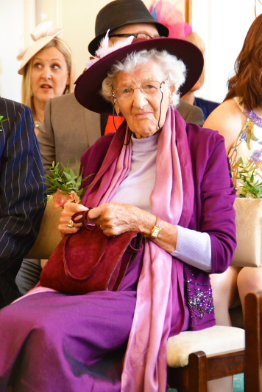
My Granny died last month, aged 97.  Good knock, Gran.

Granny 6

It wasn’t such a sad death really, as the real essence of Granny that we all knew and loved had long disappeared.

I wonder how much of our grief is like this; tiny portions of loss spread out across the days and weeks, regular downpayments helping to spread the cost. Well before she left Granny’s fingers had been prised away from the habits and routines that defined our lives.

Then once she was gone the routines of commemoration take over.  I had to read out some words from my Aussie family and then say some words of my own.  It was all very life affirming, as death can be.

I was struck by how we remembered Granny.  What she did, yes.  But also how she did it.  Granny could be quite formal, snooty even, but the Real Granny was also silly, curious and generous.

I mean, does this look like a woman who really cares whether your elbows are on the table?

Granny 1

Mindfulness

Comparing myself to Granny’s generation seldom goes well.

She and her friends fought a war for freedom with incredible modesty and courage.  I get annoyed with software updates on my smartphone.

I’m more caught up in my head, too.  Busy, but not always about important stuff.  Granny did stuff for her family and community.  If I’m not careful I do stuff on social media.

Of course this isn’t just me, and maybe this is why mindfulness has taken off.  This ancient practice has been seized upon as an antidote to the age of distraction, and there’s a lot of evidence suggesting it works too.

Yet at the same time there are problems with the mindfulness movement.  In his new book Carpe Diem Regained, Roman Krznaric highlights two:

First, the mindfulness movement focuses too much on the self, leaving it thin on moral foundations. 

Second, in placing so much emphasis on attending to the present moment, it overlooks how much human beings thrive on striving for meaningful goals. 

Krznaric also points out that studies suggest mindfulness may increase wellbeing, but not pro-social behaviour. (Author’s note: please see my comment below for an update on this).

So what is mindfulness really for, if all it does is help us bear these atomised, self-absorbed lives that would be so alien to Granny?

Mindfulness 2.0

Do you remember the early days of the web, when websites were static and focused on giving people information?  This was web 1.0, when the focus was all about spreading awareness and knowledge.

The next generation of websites were interactive.  Their focus was on changing the way we did things like communicating, finding jobs and looking at kittens. This was web 2.0.

The same leap is now happening with mindfulness – a movement away from simple awareness to using our awareness to do things.

Acceptance and Commitment Therapy (ACT) is in the vanguard of this movement.  ACT combines hard-edged science with the ability to move people, literally and figuratively.  There are four reasons why ACT is the future of mindfulness:

ACT RCTs 2016

  1. Evidence. It includes all of the benefits of mindfulness – with over 180 randomised control trials now demonstrating its effectiveness in everything from depression, chronic pain, smoking cessation and weight control to workplace effectiveness.
  2. Practical.  It offers different ways to be mindful – making mindfulness more  accessible to more people than ever before.
  3. Clarity.  ACT is based on a clear and transparent philosophy of science which helps practitioners learn faster and explain concepts more clearly.  (Once I got this I never thought in the same way again).
  4. Behavioural.  The use of the acronym ‘ACT’ is deliberate, because ACT is a behavioural intervention which focuses less on peoples’ thoughts than on what they want to DO in life.  ACT  explicitly links mindfulness to values and action: it is mindfulness for a purpose.

ACT positions mindfulness as a call to action.  It links awareness to behaviour that can actually change the world for the better.

Isn’t this what the world really needs?

And isn’t it how we will be remembered?

Granny 2
Margaret West 1919 – 2017

Using Values When You’re Somewhere You Don’t Want To Be

I am writing this whilst sitting comfortably on a plane, powering through a brilliant autumn sunset towards Helsinki.  I have everything I need, and the work will be great.20160126_152837

And I don’t really want to go.

This has nothing to do with Helsinki you understand.  Who couldn’t be excited by the land of sauna, summer cabins and err, Moomins?

Me.

I don’t want to go because it’s going to be hard work.  And lots of travel.  And above all I’m sad because I’m going to miss my family.  I feel like I just want to stop and go home.

Using Values When You’re Somewhere You Don’t Want To Be

This classic ACT move is easily forgotten, but when I remember it always helps:

  1. Ask the cabin attendant for an extra gin
  2. Take a moment to consider why I am making this trip in the first place:

What values are at the heart of my choice to be here?

This question tilts my attention towards the purpose of my being here.  And purpose is the great generator of meaning.

So, why did I choose to be here?

  1. Meaningful work.  I am here because the workshops I run often help people shift in a positive direction.  The data we’re collecting supports this.
  2. Learning.  I hope to learn something from the people I meet, and their reaction to the training.  And it’s exciting to learn something about the countries I visit; Denmark, Sweden, Norway and Finland.
  3. Security.  I want to provide for my family so that they have the stuff they need to thrive. It is not the sole purpose of being here, but it is a factor.
  4. Psychological Flexibility.  Deep down, I know that without moments like these, my capacity to experience joy in life would diminish. As Kelly Wilson said, happiness and sadness are twins that either grow strong together or die together.

ballon-2Tuning into my own values doesn’t get rid of the sadness, but it provides a different context for it.

It mixes something in with the sadness.  Something richer.

And now I’m flying in a different way.

I am not so consumed by thoughts of wanting to go home.

My sadness feels like it has been dignified somehow.

It is the admission price for a life I have chosen, and I am grateful for it.


The Psychology of Leaving

In my work as a psychologist I have worked with hundreds if not thousands of people who face a common career dilemma:

  1. They are dissatisfied with their current situation;
  2. They feel uncertain and anxious about alternative options.

This is when people get trapped in a dilemma; stay or leave?

From working with so many people in this situation, here are some general points I’ve observed.

The mind instinctively prefers the status quo

Our minds prefer the stuff they already know, because it is safer.

The problem is, most of my clients want more out of life than ‘safe’.  Overwhelmingly, they want the chance to author their own lives, make positive decisions, and to break free from inertia.  Yet it is impossible to do this without taking a risk and minds prefer certainty…

So people often end up staying where they are, but more by default than choice.  They console themselves with hopes that their situation will get better.  And the organisation often responds, offering enhanced status and perks.  I remember I was offered a promotion and a £5,000 pay rise.  Yet what I needed was a more fundamental change in my life.  Most people want a sense of control and authorship over their lives and that was certainly the case for me.

By accepting these short term compensations, we duck the human need to author our own lives – the ‘hard choices’ that Ruth Chang so brilliantly identifies as the way to build identity and meaning.

Other people have a stake in the status quo

Another common issue is that those around us often have a stake in the status quo. These vested interests can be hard to tease out, especially as they often show up as a kind of protective concern.

In my case, I had perhaps 3 or 4 friends who ‘got’ the change and offered support.  Many of the rest questioned and even ridiculed it.

Moving towards what we value always takes willingness

On the flipside of what we most value is always something that we fear.  Therefore, for the really big decisions in life we need to:

  • Define what we really want – for example meaningful work or more autonomy;
  • Develop willingness to experience some anxiety in exchange for making a choice which is in line with our values.

Without this willingness, it is very difficult to break out of patterns that are not working.  Change is essential for renewal, but it always takes courage to take that first step.

Change is never ‘in’ or ‘out’

There is always the temptation to see (career) change in terms of black and white. Do I stay in my job, or leave?  Yet the reality is rarely like this.  All of my clients make intelligent transition plans to gradually shift towards something better.  The most common is to stay in their current job, but changing their relationship to it so they can work on a ‘plan b’ on the side.

No matter what the choice – stay or leave –  the most important thing is the plan that follows.  After all, the plan is where we deal with the reality of what follows.

So what’s the right answer?  Of course there is no right answer, only context and choices.

But in general, whilst it is usually easier in the short term to stay, I notice that those who leave rarely regret it.  In fact, they almost all start to feel more authorship over their own decisions, and greater vitality, meaning and purpose in life as a result.

The Incredible Tale of Leicester City Football Club…and the (Limited) Power of Thinking

“Following today’s devastating result for the national team, I take full responsibility for the most unfortunate choice of coach, which has resulted in such a poor image of the national team being put before the fans.”

It is November 2014 and Giorgos Sarris, the head of the Greek Football Association, has just sacked Claudio Ranieri, a genial 62 year old Italian manager, after losing to the tiny Faroe Islands.

It was beyond embarrassing, and the end for Ranieri after only 4 games in charge.  It was also probably the end of his career.  His quirky, kindly personality seemed out of kilter with the hard realities of modern football.

At that time, Leicester City Football Club were rooted to the bottom of the English Premier League.  After a record 13 match winless streak they were certainties for relegation, which was really no surprise – Leicester are one of the ultimate ‘yo-yo clubs’.

Meanwhile the league title was again being won by Chelsea, a team managed by Jose Mourinho who had replaced Ranieri some years previous.  Mourinho was the opposite of Ranieri; knowing, calculating, snide.  He is the kind of man who stamped on insects as a child. Even his jokes contain a bitter aftertaste.

But Mourinho seemed modern, Ranieri a relic.  Chelsea, at the top of the league, had the manager and the money.  In contrast Leicester had 20% of the budget of Chelsea, and were facing certain relegation.

It’s all just maths.

Season 2015-16

The following season started out like any other, but then unfolded as though reimagined by Picasso.

One by one the established realities were inverted:

  • Leicester City had escaped relegation and somehow remained in the Premiership after all.
  • Jose Mourinho was sacked by champions Chelsea after a disastrous start to the new season.
  • Leicester City charged to the top of the table, stayed there, and – incredibly – last Saturday were crowned champions with largely the same players who had battled relegation a year ago.

The odds of Leicester winning were 5000-1 against.  To put that into perspective, the odds of finding Elvis alive today are 2000-1.  It was unthinkable, impossible.  The greatest upset in sporting history.

And at the helm of this towering, absurd achievement was a man called Claudio Ranieri.

 Explaining Leicester’s Season

There is now a cottage industry re-examining the leadership secrets of Leicester’s rise.  Of course Ranieri is no longer seen as a relic.  Now he is seen as having an ability to keep things light and deflect pressure, to ‘make his players believe’.

Certainly for months he had joked with the press, smiled with the fans, laughed at any talk of winning the league.  Suddenly he seemed a refreshing alternative to the cynicism of Mourinho.

But from a psychological perspective, there is one standout lesson from this incredible tale.

The (Limited) Power of Thinking

Leicester didn’t win the league because they believed they could do it. Let’s be clear, no one believed they could do it.

The psychology behind their success lies in being able to hold thoughts lightly, whilst focusing on constructive, workable actions in each moment.

Of course this isn’t easy.  Although thoughts are not reality, they feel like reality.   This is fusion – the process of seeing thoughts and reality as the same thing.  Fusion can be very useful, especially for survival.  But it can also limit our ability to thrive because our thinking can be so limited, prone to bias and swayed by ‘wisdom’ which turns out to be wrong.

Even now it feels wrong for Leicester to be champions, which is perhaps why so many people say that it still feels more like a dream than reality.

What does this have to do with ACT in the workplace?

So many people today feel trapped in jobs they don’t enjoy, or are drawn into lifestyles that are drained of joy.  Yet the traps are set by fusing to thoughts like:

  • ‘I am too old to change career’.
  • ‘I am too introverted to be a leader”.
  • ‘I can’t control my angry response with my kids’.
  • ‘I am not in a position to take control of my career’.

Whilt these stories may contain elements of fact, they are not reality. We feel trapped by these thoughts, but we are not trapped in a way that say, a dog would understand.

Picture1

The problem is that when we buy into our thinking and stories wholesale, we risk acting within the confines of the story and failing to author our own story.  We fall into the comfortable illusion that there is nothing to be done, events are outside of our control.

And this is what Leicester have really taught us.  It is not ‘if we dream it, we can do it’.  Most of us find it hard to control our thinking.

The skill we can learn is to hold belief (and disbelief) lightly, acknowledging that our own thinking is limited; an artist’s impression of the real thing.

Fusing to stories of hard luck or powerlessness may make life easier in the short term, but it also makes it smaller.

Leicester have shown us that reality is far from what our minds tell us it is.  If we learn to hold our thoughts lightly, and focus instead on workable behaviours in the direction of what really matters to us, then the world opens up.

And just occasionally, we far exceed what we can ever have imagined.

What Can You Do When You Feel In Over Your Head?

Many leaders are feeling ‘in over their heads’. The organisational landscape has become volatile, uncertain, complex and ambiguous (VUCA) and it can often feel so challenging and overwhelming that we feel out of our depth and swamped.

The skills that led to success in the past, no longer seem to work.

There is so much change happening that we can’t keep up. Everything is interconnected and, as a result, less easy to predict or control. Your outputs are increasingly dependent on other teams. Their mistakes or delays are disastrous for you but no-one seems to think that is a reasonable explanation when, as a result, your deadlines blow out. The future is highly unpredictable, it is unclear what the next right action is.

In their excellent book, Simple Habits for Complex Times, Jennifer Garvey Berger and Keith Johnston explain that many of the problems we are now grappling with are complex rather than complicated and that means they need to be handled differently.

In complicated situations, you create the outcome you want by working through things logically, defining the problem, breaking it down into it’s component parts, perhaps doing a root cause analysis and then making a step by step plan. It is hard, but manageable.

In a complex environment this isn’t the case. In complex situations, causality isn’t linear or predictable. So a root cause analysis quickly becomes messy and unhelpful. In complexity, you can’t predict the future from what happened in the past. You can’t work out logically what actions will create the outcomes you want to achieve, as things are interconnected – a small change in one place has an unpredictable impact in another place. So your attempts to create and act on a plan don’t seem to work. It is easy to feel swamped, powerless and uncertain.

What are better strategies for complex situations? Garvey Berger and Johnston suggest the following:

  • Have a broad sense of the direction you want the system to head in but avoid rigid plans and goals that can’t adapt and take advantage of changes in the system. (e.g. ‘Better customer service’ is a broad direction whereas ‘answering customer calls within 2 minutes and resolving all questions within a further 2 minutes’ is a rigid goal).
  • Become very curious about the present
  • Listen very deeply to what others are saying – recognize that others may be making sense of things differently to you
  • Be interested in multiple perspectives on the situation – including the perspectives that people (including you!) may have in a year or 5 years.
  • Take a wider, more systemic view. Rather than looking for root causes – look for combinations of factors that interact to push the system in a particular direction.
  • Notice what is tending to happen already in the system and then try to amplify any current tendencies that are aligned with the desired direction.
  • Take actions designed to nudge the system in a positive direction.
  • Instead of making and executing a plan, use ‘safe to fail’ experiments to try to shift the system – learn from the outcome of each experiment and feed that learning into the next safe to fail experiment. NB For this to work, you need a culture where is okay to take risks and fail (with boundaries given for what are acceptable and unacceptable risks).

My hunch is that psychological flexibility is a key skill that leaders will need in order to enact these new and challenging skills.

Psychological flexibility is: “contacting the present moment fully as a conscious human being, and based on what the situation affords, changing or persisting in behavior in the service of chosen values” – Steve Hayes

It is composed of a number of processes that are highly relevant when leading in complexity:

Acceptance helps leaders to cope with ambiguity, uncertainty and the associated anxiety that comes with that.

Present moment awareness (or mindfulness) helps leaders to be better at observing what is really happening.

Values clarity helps leaders to behave more consistently in volatile contexts, so that followers can trust them, even though the direction is unclear and the leader can’t give them any sense of certainty about the future.

Defusion helps leaders to look at the world as it is in this moment, rather than how the mind is saying it is. This is a particularly important skill in an ambiguous environment, in ambiguity, we tend to have thoughts that tell us, ‘This is certain to turn out badly’. We need to be able to hold those thoughts lightly and see the situation as it is in this moment.

Perspective taking skills enable leaders to be mindful of and listen to the needs and views of many different stakeholder and also to see the broader system.

These skills seem to be key for leaders to thrive in the new industrial age.

And, often you wont feel like you are thriving, if you are like me then you will feel overwhelmed and swamped. At those times, please be very, very kind to yourself. This is genuinely hard. Some self-compassion is vital.


If you want to build your psychological flexibility, then these blog posts might be helpful:

How to Clarify Your Values

Acceptance – here are some posts on handling painful emotions

Defusion Techniques

If you want to read more about leading in VUCA environments, these resources are good:

Simple Habits for Complex Times

Complexity Leadership in Health Care (BMJ- 2001) – relevant for non-health care settings

A Framework for Understanding VUCA – Scott Berinato in HBR


And finally…if you are interested in learning more about Leading in Complexity – Queensland University Of Technology (where I teach) is offering a new online course for leaders on this very subject.

How can Behaviour Analysis Help in Coaching? (part 2!)

I’ve recently been travelling around Europe and the Middle East on a kind of values and defusion tour.  It’s been an amazing experience.

And no matter where I went I saw humans.  Lots of them!  Some in busy cities like Brussels or Munich; others miles from anywhere, in the wilds of Sweden, the deserts of the Middle East or quiet fishing villages in the Med. And everywhere you see how humans have adapted to their environment through different cultures, clothing and lifestyle.  Clever old things.

EMEA tour

But if humans are so good at adapting, why do we sometimes struggle to adapt to what life throws at us?

Funny you should ask, because this is where our second Very Exciting Idea from Behaviour Analysis comes in:

“Fusion can be thought of as a generalised reinforcer”.

And why is this such a big idea?

Because it is useful for clients who struggle to adapt and that turns out to be, erm…

ALL OF US!

So sit back, take the soft top down and put on some rock classics, as we explore why ‘fusion can be thought of as a generalised reinforcer’ is such a useful idea, especially in coaching.

relief

What is Fusion?

In ACT, fusion is a term for when we become fused with, or stuck to, our thoughts.

In a state of fusion it can be hard to separate ourselves from our thoughts. For example, if I am fused to the idea that ‘this is a hopeless blog post’, that is all I can see.   Yikes!

fusion (1)

From this perspective, it is easy to act as if the thought is true. So I might give up writing halfway through and see that the garden needs watering, or that the cat urgently needs stroking.  (And I don’t even have a cat).

If this becomes a pattern I might fuse to a new story: I am hopeless…

Hopeless_TCP_illo_2

Here there is no distance at all between me and the thought.

One recent example I had was with a manager at a construction firm who had received negative reviews about his ability to influence senior execs. His story was that as an ‘I’ on Myers Briggs and someone who hates small talk, there was little he could do to influence others.  He was simply “not cut out for senior management”.

It is easy to see how fusing to stories like this can hinder development. But why do people fuse so readily to such unhelpful stories about themselves?

Meaning as the Brain’s Priority

Klinger (1998) argued that humans survive primarily by being able to respond to their environment. The brain evolved to help us understand our environment during the pursuit of goals, working to sort out “ambiguous or confusing stimuli…until they can be dismissed as irrelevant, or channelled into action”.

Understanding the ‘meaning’ of things is therefore the brain’s top priority.  This is why the experience of not understanding something is associated with feelings of unease, because we do not know how to respond. Conversely, when something is subsequently understood, we experience the ‘aha!’ response, which is much more pleasant (King, Hicks, Krull, & Del Gaiso, 2006).

With language, meaning takes on a wider metaphorical significance, so humans start to consider the ‘meaning of life’. But the priority remains the same:

meaning is a matter of human understanding, regardless of whether we are talking about the meaning of someone’s life…or the meaning of a word or sentence” (Klinger, p29).

Meaning is constructed in context ,and for humans especially this means it becomes socially constructed:  “the meaning of a gesture by one organism is found in the response of another.” (Mead and Morris, 1967).  Gergen and Gergen (1988) suggest that coherent self-narratives are essential for establishing credibility and maintaining relationships.

When someone tells me that I am ‘making sense’ (a rare occurrence) then I experience it as a compliment. ‘I know what you mean’ is often greatly reassuring:

Provided that languaging is reinforced from an early age, coherence is also reinforced. As a result, coherence… becomes a generalized reinforcer for verbally competent human beings.” (Blackledge, Moran, & Ellis, 2008).

Aha! Why Fusion acts as a Reinforcer

One reason why fusion is reinforcing is that it can quickly provide a sense of coherence (i.e. meaning) to otherwise confusing or ambiguous information.

story

For example, if I receive a poor assessment of my influencing skills, I can make sense of this by fusing to a story that I am an introvert, or have never had any training in assertiveness, or am ‘not cut out for senior management’.

Perhaps it is no surprise that people cling to these stories as a means of control over their lives. My life is a mess and this is why.

Meaning trumps everything, including whether the story is helpful or not.

For example I often fuse to a story that certain aspects of my character and upbringing make me unable to hold down relationships, and this can be consoling at times.  The story makes sense of my experience – and relieves me of the responsibility to change.

And this is when fusion becomes truly problematic.

Because when we fuse to language our behaviour tends to ossify, which can reduce our capacity to adapt.

But if we can learn to hold language more lightly we retain our ability to adapt, and the world opens up before us once more.

IMG_1134

Sources:

  • Examining the Reinforcing Properties of Making Sense: A preliminary Investigation. Wray, Dougher, Hamilton & Guinther, The Psychological Record (2012).      
  • The Search for Meaning in Evolutionary Perspective and its Clinical Implications, Klinger, from The Human Quest for Meaning edited by Wong & Fry (1998)
  • Mind, Self, and Society: From the Standpoint of a Social Behaviourist.  Mead and Morris (1967)


For more on using ACT in workplace and career coaching please follow The Career Psychologist blog.

Using the ACT Matrix to Help You to Be The Person You Want to Be…More Often

I use the ACT matrix a lot in my workshops and with my coaching clients… and on myself! It is a tool that helps to build mindfulness, self-awareness and valued living. It is based on contextual behavioural science and is very easy to use.

I have made a video explaining how I use it:


You can download a pdf handout of the ACT Matrix here.

Kevin Polk (who is one of the people who developed the ACT matrix) has lots of free resources relating to the ACT matrix at his website.

Learning To Step Over Coercion And Create The Workplace Culture That You Want

In his wonderful book, The Nurture Effect, Tony Biglan, states that ’the most important stressor we humans typically face comes in the form of coercive interactions with other humans.

Coercion is where people use unpleasant behaviour to influence you. If you do what they want, then the aversive behaviour will stop…at least for a while. Coercive behaviour in the workplace includes overt bullying and intimidation but it also can be more subtle – put downs, teasing, social exclusion etc. It can even involve using expressions of disappointment as a form of control.

Pause for a moment. What workplace situations have you found most stressful?

How much of your stress was because other humans were being coercive towards you?

My hunch is that coercion is an almost universal quality of deeply unhappy workplaces.

Sadly, some organisations have a culture which encourages coercive behaviour. These organisations are unpleasant places to work.

Biglan writes:

 ‘We need to replace all of this coercive behaviour with behaviour that calms, supports and teaches – the kind of behaviour that helps others thrive.’

What would that be like? Imagine a workplace where people ask directly for what they want in a calm way. Where they support each other to do well, to learn and to thrive.

Biglan suggests many empirically supported strategies for creating these nurturing environments. The one that has resonated most strongly with me is to make a personal commitment to this sort of calm, supportive and nurturing behaviour.

This is, of course, easier said than done. It is particularly hard to be calm, supportive and nurturing when others are being harsh and coercive towards you. Our impulse in these situations is to either respond with our own harsh, coercive behaviour or to just give in. The nature of coercion is that we want it to stop and we want it to stop quickly, so we tend to react to it in unhelpful ways.

If we want to create change, Biglan suggests that we need to learn forbearance. We need to step over our initial impulse to punish and coerce others and instead focus on responding with firm kindness. We need to be able to shift gear and respond in ways that build connection and foster growth.

Biglan quotes reams of research to support his suggestion that what the world needs now is for millions of us to just decide – ‘I want to step away from harsh and coercive treatment towards others, Instead I will nurture connection and growth. I will focus on creating environments where humans flourish.’

He also suggests empirically supported strategies for how to put this into practice.

These strategies include the behavioural analysis that Rob described in the previous post. Looking with openness and curiosity at what antecedents and consequences may be encouraging the damaging behaviour and also at what antecedents and consequences would encourage the desired behaviour.

Biglan also explores how ACT skills can be important in achieving this change to a more nurturing culture. As people become more mindful, practice acceptance of their emotions and are more connected to their values, they find it easier to change their behaviour.

I highly recommend The Nurture Effect to you. It is an important book. A book that explores how the science of human behaviour can improve human lives.

I want to live in a world where the majority of people are behaving in ways that nurture learning and growth. How about you? Shall we get started?