Getting Things Done (2.0)

Perhaps in common with other people who run their own business, I am mildly obsessed by productivity techniques.  From apps that help organise work, manage attention, to ways of filtering emails and using technology to help limit the impact of technology – I am always a bit obsessive interested.

One of the best productivity systems is David Allen’s Getting Things Done, where he explains why we need a system (a ‘second brain’) which we trust if we are to work without   distraction.

It’s great stuff, but I think ACT has much to add to his system, in particular two key ideas:

1.  Clarify values.  The distinctive problem with knowledge work is that it is difficult to know what the ‘right’ work is at any given moment.  There are so many competing priorities; should I be writing this blog or perfecting a proposal?

For knowledge workers, how we define our work is our most important task, so a clear understanding of what matters to us – what we want to stand for – will help.  I certainly want to stand for more than winning commercial contracts, hence me finding time to contribute to this blog.

2.  Acceptance.  So often productivity is not actually at the mercy of external factors, but our own thoughts and emotions.  For example, I know that if a task makes me anxious or bored then I will find a sudden urge to clean the shiny handles on my kitchen cupboards.

This is where all the advice to do work you love or find your passion is so dangerous.  If we focus on how we feel during a task, we start to hand control of our lives over to our emotions.  And our emotions – even the ones we want – are not really in our control, or reliable bellwethers of where to head next.

The most quotable psychologist in this area is Shoma Morita –> who always makes a point of separating how we feel from what we do:

“Begin taking action now, while being neurotic or imperfect, or a procrastinator or unhealthy or lazy or any other label by which you inaccurately describe yourself. Go ahead and be the best imperfect person you can be and get started on those things you want to accomplish before you die”.

Ultimately it is only by holding our emotions lightly – by committing to our values in the presence of anxiety and boredom if necessary – that we will build the kind of working life we want.  Or, as Morita says:

When running up a hill, it is all right to give up as many times as you wish – as long as your feet keep moving.

(And as my mind says ‘check this post one more time’ with my finger I press…PUBLISH).

What a Country GP Can Teach You About Fame and Fortune

My father was a doctor. When he finished medical school, he planned to pursue a career with some prestige attached to it. He was going to become a surgeon or physician in some teaching hospital. He would work his way up the hierarchy until he was like Sir Lancelot Spratt, with a host of nurses, doctors, medical students and sundry allied health professionals traipsing after him, writing down his pronouncements and doing his bidding.

My mother had a different view of what sort of life would suit them and she persuaded my dad to instead become a country GP in a relatively poor part of Derbyshire. He spent much of his working life visiting patients in their cramped terraced houses or sitting in his surgery looking into the ears of snotty nosed children. He was not followed around by an entourage. His work was not with the rich or the famous and he didn’t become rich or famous himself. On the surface, he might seem like a relatively insignificant figure.

But if you walk into the local newsagent with my father, who has been retired for 14 years now, it is very likely that someone will rush up to him and say something like, ‘Oh Dr Collis, It is my lovely, lovely Dr Collis’.

In his small way, in this small village in the middle of England, my dad is famous. He is famous to these people because he was very, very kind and caring to them at a point in their life when they needed this more than anything. Because he listened to his patients with great interest, even if they were telling him about problems with endless green snotty noses. He started with the assumption that his patients mattered and their worries were important and that meant everything to them.

My mother is also ‘famous’ in this small village in Derbyshire. She is famous for her stalwart support of people through the tough times of life, for her capacity to be with people through the periods of grief, loneliness and overwhelmingly bad odds that visit us all. People often say to me, ‘I don’t know what we would have done without your Mum when…happened.’

My parents remind me of the wonderful poem, ‘Famous’  by Naomi Shihab Nye, here is an excerpt:

The river is famous to the fish
….
I want to be famous in the way a pulley is famous,
or a buttonhole, not because it did anything spectacular,
but because it never forgot what it could do.

There is so much written about how to become successful. But the success these articles describe is about fame and fortune rather than the gratitude of a middle aged lady in the local newsagent. And that is a problem.

It is a problem because chasing money and status sucks vitality out of life.

It is a problem because pursuing status is associated with less happiness; less satisfaction with life and also more anxiety.

It is a problem because chasing prestige leads you to focus energy on things that aren’t really important to you:

“What you should not do, I think, is worry about the opinion of anyone beyond your friends. You shouldn’t worry about prestige. Prestige is the opinion of the rest of the world…..Prestige is like a powerful magnet that warps even your beliefs about what you enjoy. It causes you to work not on what you like but what you’d like to like…Prestige is just fossilised inspiration. If you do anything well enough, you’ll make it prestigious…

Prestige is especially dangerous to the ambitious. If you want to make ambitious people waste their time on errands, the way to do it is to bait the hook with prestige. That’s the recipe for getting people to give talks, write forewords, serve on committees, be department heads, and so on. It might be a good rule to simply avoid any prestigious task. If it didn’t suck, they wouldn’t have had to make it prestigious.’ Paul Graham

When you are in your late 70’s, as my father is. What will touch you most:

  • That you rose through the corporate ranks?
  • That you earned lots of money and drove a fancy car?
  • That you were, in your own world, a Lancelot Spratt?

Or,

  • That somewhere there is a person; someone who, like you, is insignificant in the scheme of things; and they remember how you treated them?
  • That somewhere there is a piece of work, something that was done really well…by you.

If you were famous in these small ways – what would you choose to be famous for?

How Mindfulness And Compassion Could Help You Do What Really Matters

The end of one year and the beginning of another is often an opportunity to torment ourselves with difficult questions:
Did I give enough energy to the things that really matter to me?
Did I give too much energy to things that aren’t important in the long term?
Did I live my values? (To get a visual picture of this, you might fill out Tobias Lundgren’s Values Bulls Eye.)

When you review the previous year, it is likely that you have done well in some areas of your life and have some regrets about others. We often don’t devote as much time and energy as we would like, to what really matters . We often don’t live our values as consistently as we want. We frequently waste time and energy on things that, it turns out, don’t really matter in the long run.

When you consider the aspects of life you neglected last year, you may notice that some are very familiar to you. They will have shown up for you many times over the course of your life. Perhaps there is some aspiration that is important to you, that just keeps being put to one side?

To give you an example.

Since I was 11, I have wanted to be a writer. I love reading and I wanted to be like the authors I admired. I wanted to be one of those people, the people that befriend strangers by sharing their thoughts in a book.
I have started many books but, despite this deep desire to be an author, I have never finished writing a book. This desire to write seems to matter a lot to me but each year goes by and I still don’t accomplish my goal.

A couple of years ago, I turned 50 and I realised that time was running out. If I really want to be an author, I need to knuckle down and actually write a book. So I started another book. It is on a topic that matters to me (Meaningful Success). Sitting at my Mac trying to express my ideas with honesty and courage is hard and scary and wonderful. Two years later and I am still wading through this project. Trying to create something useful. Something that isn’t rubbish. In the process, I am discovering that this writing lark is harder than it looks!

But even though this matters deeply to me. Even though I love writing. Even though every thing I read about how to become a good writer starts with the advice – just write.
I often don’t write. My days are filled with other stuff. Stuff that isn’t writing.

How about you? What are the goals that really matter to you? The goals that year after year, you don’t quite manage to give enough time and energy to? It could be:

Creating a beautiful garden;
spending more time playing with the kids;
travelling to beautiful and exotic places;
learning to play an instrument or speak another language….
What is the goal that calls from your heart?

And …what gets in the way of you pursuing that goal?

There are lots of reasons why we don’t pursue these important goals with the necessary energy and passion. One reason that seems increasingly common is, ‘I am too busy.’

So what are we too busy doing?
If you analyse what you are too busy doing, you can divide your actions into:
1. Things that were genuinely, at that moment, a higher priority than the important but non urgent task.
For example: spending time with the people you love; caring for your fragile human body; doing meaningful work; earning enough money to pay the bills; volunteering for causes that matter to you…
These choices are valued actions. You are being the person you want to be. Life is full of conflicting priorities, can you notice these choices and be gentle to yourself about them?

2. Things that, at that moment, felt like they were a higher priority than the important but non urgent task but they actually weren’t.
For example: trying to impress or please people; trying to earn more money than you need; doing things just to get prestige or recognition; doing things to avoid unwanted feelings.
This is a recurring problem for many of us. I certainly keep getting hooked by these activities. I look back on my life and I have spent too much time focussing on things that seemed important at the time, but actually, from the perspective of a few months or years later, I realise didn’t really matter.

3. Things that, at that moment, didn’t even feel like they were a higher priority than the important but non urgent task.
This is basically all the things we do to procrastinate and avoid the harder stuff. It might be: watching inane TV or silly YouTube clips; checking in on Facebook; going shopping. (NB These activities can also be acts of self care – in which case they are category one activities – only you can decide this.)

At this point I could just tell you to make sure you focus your energy on the right things. But I don’t think that advice is very helpful. I know it doesn’t work for me.

So I want to encourage you to do something different. To start gently.

I want to suggest that mindfulness and compassion might be a better response.

Just start by noticing with curiosity what you are doing. In real time. Notice which category your behaviour is in. You might also notice if you tend to berate yourself for spending time on the ‘wrong’ things. How effective has this harshness been for you? What would happen if, instead, you responded with compassionate understanding of your human failings?

Instead of harshness, could you notice how each behaviour feels? Notice how it feels in your body as you take these various actions? What emotions are you feeling? Notice which circumstances seem to encourage you to do which types of behaviour. Are there any common themes?

For me the ‘category two’ activities – the ones that seem important at the time but actually aren’t important- are often associated with a scrabbly feeling, like I am desperately trying to get something. At those times, if I pause and notice what is going on inside me; I realise that I am often hooked by thoughts that I am not good enough in some way and/or there isn’t enough of what I think I need. The best response to this seems to be to pause and breathe. To turn to myself in kindness. To be willing to be with myself and the thoughts that I am not adequate or the world is not the way I want it to be.

‘Category three’ activities – the ones where I know I am frittering time away – sometimes feel to me like I am hiding out. Trying not to think about the scary task I am avoiding. At other times these activities are accompanied by a whiny voice – ‘I don’t want to…I am too tired…I deserve a break…It is too hard…’ It feels like when I was a kid and I used to put my fingers in my ears and loudly say ‘I can’t hear you…LA…LA…LA…I can’t hear you’.
If I am courageous enough to pause and check in. I notice the thoughts and feelings I am trying to avoid. Can I turn towards these feelings with compassion, knowing they are part of being human?

I want to encourage you to do the same. Instead of trying to get it right. Instead of fighting with yourself.

Just notice.

Notice whether what you are doing is moving you towards your values; towards what matters to you or whether it is taking you away.

Notice what is going on inside you at those moments.

Be mindful and curious.

Turn towards yourself with compassion.

And then notice what happens next.

It may be that you will make a small move towards what matters. It may be that you won’t.

Could you notice that with compassion and curiosity?
Helping Alpha Executives to Drop The Corporate Armour

According to Ludeman and Erlandson (2004). ‘Alpha’ executives make up 70% of senior executives. They are confident and intelligent, competitive and impatient. They like to be in charge.
‘Alpha’ executives don’t tend to listen well to others. They engage in dominance behaviours, (Schmid Mast and Hall 2009) such as:
Taking charge of the conversation
Interrupting others
Talking down to people
Expressing strong opinions
Tending to steamroll others into doing what they want (Schmid Mast and Hall 2003)

And unfortunately these behaviours seem to worsen as they get more power.

Senior alpha executives can find it hard to let others influence their decision making. (See, Morrison et al. 2011)
Alpha executives often have unrealistic expectations of themselves and others. This can lead to burnout, both in themselves and in members of their team. Alpha executives can be dismissive of others feelings and can fail to notice the negative impact that their competitive and aggressive approach has on others. Colleagues and direct reports can sometimes experience the aggressive alpha behaviour as bullying.

Alpha’s often achieve results in the short to medium term; they look confident; they speak up in meetings. They look like potential C-Suite material and they get promoted.

But once they reach higher levels of management, the need for cooperation and collaboration grows and their dominance behaviours start to hold them back and sometimes even derail them.

I often coach executives who exhibit some, if not all, of those alpha behaviours. I enjoy working with them. I like their intelligence, their focus on results and honesty. It can also feel intimidating. The curiosity and exploration that is central to good coaching can seem like a waste of time to these executives – and they let me know this assessment in no uncertain terms!

How does ACT help these executives to develop more effective leadership behaviours?

An ACT-informed coaching approach would likely include:
– Identifying workable and unworkable behaviours
Helping the executive to make better quality decisions
Choosing values and choosing how to convert those values into action
Developing compassion for self and others
Broadening behaviour and improving the criteria the executive uses to select their behaviour in a given situation.
Building psychological flexibility (of course!)
Uncovering unhelpful internal rules that are controlling behaviour

In this post, I want to explore the tricky topic of working with these executives and their emotions.

My observation is that many, but not all, of these executives have learnt to disconnect from their own emotions.  This disconnect is often contributing significantly to their insensitive and impatient behaviour.  The behaviour is, in a sense, a form of running away from unwanted thoughts and feelings.

Executives have often donned corporate armour, in order to protect themselves, in the sometimes hostile environment of organisations. Whilst this armour can be helpful, it does make it hard for them to be emotionally intelligent and agile.

In many, the armour was actually created early in life. It may well have been adopted in the school years, as a response to the harsh experiences that many of us have during childhood. This means that many of these executives have never learnt to really notice and label their emotions, a core skill of emotional intelligence.

Emotionally intelligent leaders can tease out the different grades of their own and others emotion, for example separating impatience from frustration or anger. Emotionally intelligent leaders can notice emotions that may be pulling them in different directions. They can pause, notice their emotions and notice the urges that result from these emotions, without having to act on those impulses. They can hear the wisdom their emotions often offer, perhaps about the risks in a situation or how others may be feeling about something.

The lack of emotional awareness that some alpha executives experience is often coupled with avoidance of many of the ‘softer’ emotions. This does not mean, however, that the executives are genuinely emotionless, the emotions will still be present and will often drive behaviour unconsciously.

The aim of coaching alpha executives can often be to help them to learn to engage with their own emotions with more curiosity and wisdom.

This work can be scary for executives, many of them have an emotion phobia; where approaching certain emotions, such as sadness or fear, can make them freeze or escape.  Just like with other exposure work, this needs to be done with the consent of the individual concerned and with gentleness and curiosity.

Often the most important thing that a coach can do in this situation is to help the executive to pause and notice. How does it feel in your body as you talk about this issue? And what does that tell you? And what do your values and the needs of the situation suggest you do next?

As people become more fluent with their own emotions, they become less driven by them and have a greater capacity to choose the most effective behaviour in a given moment.

As people become more open to their own emotions, they also become more aware and empathic towards others.

As emotions become welcome companions, the corporate armour becomes less necessary, vulnerability becomes possible and life becomes richer.

(For Australian Readers – I am running a workshop on this topic at the APS International Coaching Congress in Melbourne in November 13th to 15th)

Which 8 Practices Will Help You To Flourish?

We are experiencing a rapid increase in the incidence of ‘lifestyle’ disorders such as diabetes, obesity, cardiovascular and cerebrovascular disorders, depression and anxiety.

Dr Kelly Wilson (who IMHO wrote one of the best books I have ever read on psychotherapy) is hoping that contextual behavioural science and evolutionary science can help us to work out what can be done to understand and reverse this trend.

At a recent workshop, Kelly reflected on the impact of the 24/7, hyper-connected yet socially isolated world many of us inhabit and he kept coming back to:
‘We aren’t that kind of a monkey’.

We aren’t the kind of monkey who does well in isolation. We aren’t the kind of monkey who can get away with less than 8hrs sleep a night.

Now Kelly knows we are hominids not monkeys, but ‘We aren’t that kind of hominid’ is a bit less catchy.

The hominid family includes humans and our close genetic relatives – gorillas, chimpanzees, bonobos and orang-utans. Just sit with that for a moment – think about what our ‘cousins’ need to thrive…

A sense of belonging?….Lots of fresh fruit and vegetables?….Time to rest?

What if many of the problems that beset us are because we are ignoring our most basic ‘monkey’ needs?

Based on an extensive review of the literature, Kelly suggests that, in order to flourish, you probably need to:
Minimise your exposure to toxins (physical and social)
Eat real food
Move your body
Give yourself more sleep/rest opportunities
Engage in meaningful activity
Practice mindfulness
Cultivate your social network, and,
Cultivate self-compassion

You can learn more about his suggestions here.

Now Kelly isn’t saying that, if we do this, there will be no more illness or distress. What he is suggesting is, if we look after ourselves in these ways. Then, when stressors visit us, as they will, we will have a little more resilience. We won’t be living at the limit of our resources. We will be less vulnerable to those ‘lifestyle’ disorders.

And during less challenging times, perhaps we will be more likely to flourish?

Read that list again:

Minimise your exposure to toxins (physical and social)
Eat real food
Move your body
Give yourself more sleep/rest opportunities
Engage in meaningful activity
Practice mindfulness
Cultivate your social network, and,
Cultivate self-compassion

and ask yourself:

What would happen if I were to care for myself in these simple ways?

What would be one small step towards self care that I could take in just one of those areas?

Kelly travels the world delivering workshops. He currently in Australia teaching counselors and psychologists how to support their clients in making these simple but challenging changes. You can get details at his website. Highly recommended.

The Hard Thing about Hard Choices

Many times in Executive coaching the person I’m working with is facing a difficult choice.  Do I take job A or B?  Should I spend more time at work or with my family?  How can I work with a difficult colleague?

I am a fan of decision science, but more often than not, this does not actually help the person to decide.  That’s because they are wrestling with what Ruth Chang calls  ‘hard choices’ – there is no right or wrong answer.  However this is usually not what people want to hear.  They want certainty… and an answer!

How then should we choose?

The thing about hard choices, Chang argues, is that yes, they are hard; but that is what makes them  so liberating.  After all, if there were only ever choices between the ‘right’ choice and the ‘wrong’ choice, then life would be very dull.  In fact, there would be no real choice at all.

This is where the ACT distinction between choices and decisions is so useful:

Decisions can be “explained, justified and…supported by reasons”, whereas a choice

” is a selection among alternatives that may be made with reasons but not for reasons….”

In ACT, choices are where values can guide us.  Values are freely chosen; free in the sense of there being no coercion, no ‘having to’ or reason-giving driving the choice.  Therefore choices (or what Chang calls ‘hard choices’) are precious because unlike decisions, they are our chance to author our lives and to take a stand for something that we feel matters.

Instead of saying ‘A was better than B so I went with A’, we get to say ‘this is me, this is the choice I made and this is what I stand for’.

Finding Meaning

Meaning in life is an important factor in human well being.

You probably won’t be surprised that research has shown that people who have a sense of meaning and purpose in their life are happier than those without that sense of meaning (Duh!).

However, more than that, people who have a sense of meaning and purpose seem to live longer, cope better with the losses and difficulties of life  and have greater sense of life satisfaction. Having a sense of purpose even seems to protect against cognitive decline as we age.

So if having a sense of meaning is a good thing. What do you do if you want to live a meaningful life?

The first step is to recognise that:

‘Meaning is not something you stumble across, like the answer to a riddle or the prize in a treasure hunt. Meaning is something you build into your life. You build it out of …your affections and loyalties…out of the things you believe in, out of the things and people you love, out of the values for which you are willing to sacrifice something. The ingredients are there. You are the only one who can put them together into that unique pattern that will be your life. Let it be a life that has dignity and meaning for you. If it does, then the particular balance of success or failure is of less account’ – John Gardner

Meaning doesn’t come from a search for some big sign that says ‘This is meaningful’.  Meaning is instead built gradually through the many small choices you make, through the values you choose to express.

‘Values are intentional qualities of action that join together a string of moments into a meaningful path’ Steve Hayes

(If you are uncertain about your values  – there are some good values clarification activities here.)

You can make a conscious decision to treat whatever you are doing as meaningful. An opportunity to live your values. For example, a hospital cleaner can choose to see themselves as an important part of the process of healing patients (which, of course, they are) and as a result express values of kindness or conscientiousness in their work.

However, if your work really doesn’t align with your values. If it genuinely feels meaningless, then you might want to start to work on a career change. It might just save your life!

If you are feeling a bit uncertain about what is meaningful for you, then I recommend ‘The Photojournalist’ activity described by Steger et al in Mindfulness, Acceptance and Positive Psychology. It is a great way of unearthing the meaning that is already present in your life.

Here is what you do:
Take 10-12 photos of “What makes (or could make) your life meaningful.” It is okay to take photos of places, people, things, mementos or even other photos. As you take the photos, keep a note of what each photo represents and how it contributes to your life’s meaning currently or how you hope it will contribute to meaning in your life in the future.

When you have done – notice what you photographed and what you wrote under the photographs. Notice what stands out. Notice any recurrent themes. Craft yourself a meaning statement.

I choose to make the following meaningful….

Now as you go through your day, notice when there is an opportunity to treat an event as meaningful and see what happens.

Here is one of my photojournalist images. The photo is of my partner fixing my chicken pen. A small moment but it has deep meaning for me. It is about relationships, caring, family tradition.

To learn more about the research on meaning, watch Michael Steger’s TEDx talk on What Makes Life Meaningful.

Guest post: When Anger Strikes like a Bolt out of the Blue

One sunny morning around a year ago, I stormed into my office shaking with rage. In half an hour I was due to counsel someone.

My husband had driven me to work; he and the children were going on to soccer training. It had been a typical Saturday morning: coffee, croissants, music played probably a tad too loud and the children bounding around.

As we’d approached the office my husband had said something (I can’t even remember what it was), and I’d exploded with anger. My voice had sounded weird. Even as I’d glimpsed the thought “You need to keep it together,” every cell in my body steeled to fight ~ run, hit out, fix, prove ~ NOW. My eyes narrowed and hardened, and my heart felt like it was curling inwards.

I walked away, leaving my family, the people I hold most dear, sitting in the car shocked and still.

There was no turning back. I had to keep my feet moving, eyes dry; half an hour was all I had. The heavy glass doors were light as I pushed them open, fuming. Fragments of shame  ~ collided with the Imposter spectre that’d whooshed in ~ collided with phrases from ACT ~ bah!

Thanks to a few less dramatic bouts of anger over the preceding months, I had found a few things which helped…

By the time the session began I was feeling a bit bruised but otherwise fine. Guilt and apologies were tucked away to manage later.

If out-of-the-blue rage is something you struggle with, these are some things you could try:

In the heat of the moment,

  • Slow and deepen your breathing, eyes closed if possible. Do this by counting slowly, in… 2… 3…..pause….out… 2…3…. a few times.
  • Soften the muscles around your eyes, especially if a child is present. My dad had what we called “The Pirate Look” when angry, and it terrified us!
  • Rest your tongue gently on the back of your top teeth. This helps relax the jaw.
  • Run cold water over your wrists. Have a swig of cold water and notice how it feels as it moves down your throat.
  • Take note of the different parts of your experience: notice how it’s possible to unwind thoughts, feelings and impulses to act from the tangle of fury.
  • Open up: make room for discomfort. With anger it can be easy to be swept back into whirlpools of argument during this step. Loving-kindness, prayer or self-compassion offer guide-ropes which you can try using. I found this post particularly helpful, maybe because it was quite visual.
  • Picture: This will sound corny, but try softening your vision and seeing the person you are angry with at a time when you loved them to bits. This may be helpful in opening up and connecting with your values. Experiment and see what works for you. It could be a role model. Or a beloved pet. Or it could be yourself  that you see, managing the situation in a way that’s true to your values. (Assuming these are peaceful!)
  • Pursue your values: do what matters, with uncomfortable feelings in tow if need be.
  • Perspective & problem-solving: can be tricky in the eye of a storm, but do-able later on, and important. It’s tempting to get stuck in how right you are and how wrong they are..
  • Apologise (although it may feel easier to skip this step and move on.) Something we did later that Saturday which also helped, was talking about how anger had been managed in our families as children ~ and about how we wanted things to be different.

When you have calmed down somewhat,

  • Learn about anger. This is a gem, “ACT on life not on anger” by Eifert, McKay & Forsyth. Many posts on this blog may be helpful, for example, this one on touching fear and other difficult emotions.
  • Make a note in your diary when anger visits. See if there’s any pattern.
  • Get clear on the type of person/colleague etc you want to be, and the atmosphere and communication style you want in your home/office. Use this as motivation to make changes.

(Reading about values on this blog was, for me, like seeing colour TV for the first time. “Values”  till then had been abstract, dry and dull. So, Dig in! “Your Life on Purpose: How to Find What Matters and Create the Life You Want” by McKay, Forsyth and Eifert is also excellent.)

  • Get to know the triggers. This takes effort, especially if the anger seems to have no cause. Use them as alerts; to plan strategies and to problem-solve.
  • Become clever at spotting, and responding to, the earliest flush of anger possible.
  • Practice, practice, practice – even with minor annoyances.

The order is not important, nor do you need to do each step. In the service of self-compassion and workability, experiment, and see which tools work best for you.

I hauled myself off to the GP that week. She reassured me that it wasn’t Alzheimer’s, nor was it my dad’s fiery genes. Turns out it was medicine I’d been taking.


Catharina Belgraver is a counselling psychologist in Brisbane, Australia. After many years in the perinatal field, she is about to embark into health and wellbeing counselling, using ACT.  Follow her on Twitter at @Rina_Belgraver

Learning to Touch Fear

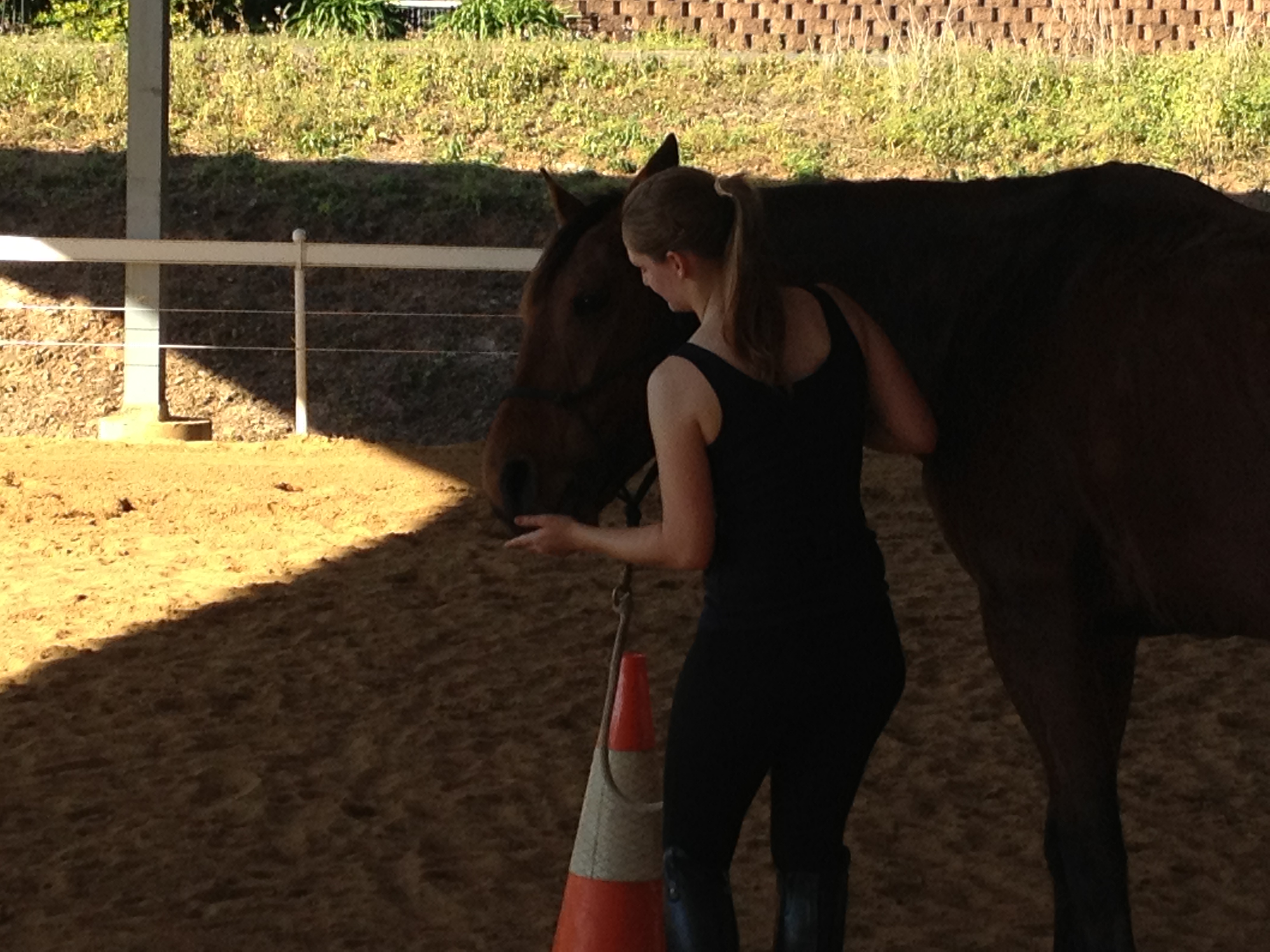
Training Josie to TouchMy daughter, Ellie, is training her horse to touch an object. Ellie points at the object and says the word ‘touch’ and her horse, Josie, touches it with her nose. This seems like an odd skill to train. So I asked Ellie why she was doing this. She told me that if a horse sees something that is new, like a paper bag or a traffic cone, then their natural response is fear. Their focus narrows down to the thing that is frightening them, as if they were wearing blinders. Josie then becomes skittish and unpredictable and she ignores Ellie. But if she touches the threat, she realises that it is fine, settles down and opens up to Ellie’s instructions.

Of course horses aren’t the only ones that scare easily, and they aren’t the only ones that can learn to touch the fear. You and I can become skittish, unpredictable and cut off from what’s happening around us when we are afraid.

The big difference is, we aren’t usually spooked by paper bags and traffic cones, for most of us it’s our emotions that we’re afraid to touch.

When fear, anxiety, sadness or anger turn up, we can become both preoccupied by the feelings and also focussed on getting rid of them. We tend to treat internal discomfort as if it is the same as a real threat in the external world. In the grip of painful emotions, we find it difficult to focus on what is happening around us. We tend to ignore the suggestions of our wiser self and we make foolish or impulsive decisions.

What if we could learn how to respond differently to painful emotions? What if we could lightly touch the feelings that scare us? With time we might find that although they seem very threatening they can’t actually harm us.

Like all new skills, it is good to start small with less challenging emotions. Touch them gently and imagine yourself expanding to make room for them. If over and over again we practice the skill of turning towards emotional discomfort with curiosity, something important happens.

Eventually, when fear, anger or sadness turn up, instead of freaking out and being controlled by our emotions, we accept our feelings as signs that we are human and that we care. We are able to take actions based on both our values and what the situation affords and over time these wiser choices will help us to flourish.
So next time you feel yourself freaking out, take a breath and see if you could, just for a moment, touch your feelings with an attitude of kindness and curiosity. It might just change everything.