Closing the intention-behaviour gap

Over Christmas I put on an additional 3kg. I have been getting rid of it ever since and I have realised that losing weight is a fantastic practice in psychological flexibility.  Just about every minute of the day there are opportunities to be mindful of bodily sensations associated with hunger or satiety, and each day there are dozens of opportunities to reconnect with why losing weight is important to me.

This experience also got me thinking about why weight is such an enormous problem. Obesity rates doubled globally between 1980 and 2008.  In 2008, the total annual cost of obesity in Australia, including health system costs, productivity declines and carers’ costs, was estimated at around $58 billion.  In Australia 68% of men and 55% of women were overweight or obese in 2008. Part of the problem here is diminishing physical activity. The World Health Organisation reports “Globally, around 31% of adults aged 15 and over were insufficiently active in 2008 (men 28% and women 34%). Approximately 3.2 million deaths each year are attributable to insufficient physical activity.”  Nobody wants to be obese but people are getting fatter, and everybody knows that they should exercise more than they do.   Clearly there is a disconnect between intentions and actual behaviour. 

We don’t do what we say we will do

Many studies have examined the relationship between intentions and behaviour and, somewhat surprisingly, the correlation between the two is not all that high.  Have you ever had the experience of setting strong goals to exercise or eat well and then not followed through?  Timothy Wilson wrote a fascinating book called “Strangers to Ourselves” outlining all the evidence for unconscious, automatic influences upon our behaviour.  Meta-analyses have revealed:

“… intentions account for a weighted average of only 30% of the variance in social behavior (Armitage & Conner, 2001; Hagger et al., 2002), mainly because people with strong intentions fail to act on them (Orbell & Sheeran, 1998).”  (Chatzisarantis & Hagger, 2007).

Why might this be the case?  One reason people fail to act on strong intentions is because they simply forget to start the behaviour.  Have you ever said something like “This week I will exercise three times” and then before you know it, the week is over and you haven’t exercised at all?  This is why setting specific goals and thinking about contextual reminders is so important.  In the literature, this sort of planning is called “implementation intentions”.

But another reason why people fail to act on their intentions is because their responding has become habitual and automatic.  When we don’t reflect on our moment to moment behaviour we are very likely to do what we have always done in the past.

Mindfulness helps us act on our intentions

From one point of view, this might be a bit of a problem for the ACT model.  If our behaviour is relatively independent of our intentions, then what is the point on getting clear on our values when we might just act out of our habits and unreflected impulses anyway?  This is where mindfulness becomes really important.  Values clarification on its own is of little use unless we bring awareness to what we are doing and we have the self-regulatory skills to enact new behaviours.

But is there any evidence that mindfulness can help us do what we want to do?  Chatzisarantis and Hagger (2007) explored how mindfulness affects the relationship between people’s intentions to engage in vigorous physical exercise and their actual behaviour.

First they confirmed that people’s intentions to exercise didn’t actually predict whether people exercised or not. But the really interesting finding was that more mindful people were more likely to act on their intentions than those who are less mindful, even controlling for the physical exercise was already a habit for the participant.  So mindful people, but not non-mindful people, were more likely to do what they said they would do!  Isn’t that just the coolest reason for learning to be mindful?  “Learn mindfulness and you will do what you say you will do!”

Why does mindfulness help us act on our intentions?

The authors then went on to explore reasons why mindfulness might strengthen the relationship between behaviours and intentions. Before we go any further, what do you think? Why might mindfulness increase the tendency to act on intentions?

Got something?

Perhaps mindfulness increases awareness of goals in each moment and therefore reduces the tendency to forget what we said we would do. Or perhaps mindfulness improves our self-regulatory skills so that we are more likely to be able to manage the difficult emotions that arise when we do something new or challenging. Chatzisarantis and Hagger (2007) tested a third possibility, that mindfulness helps us control counter-intentional behaviours, in this case binge drinking.   They reasoned that binge-drinking probably interferes with doing vigorous physical activity (is it just me or do you too have an image of lying on a couch with a pillow over your head?), and that mindfulness might reduce the extent to which habitual binge-drinking interferes with intentions to exercise.

And this is what they found:
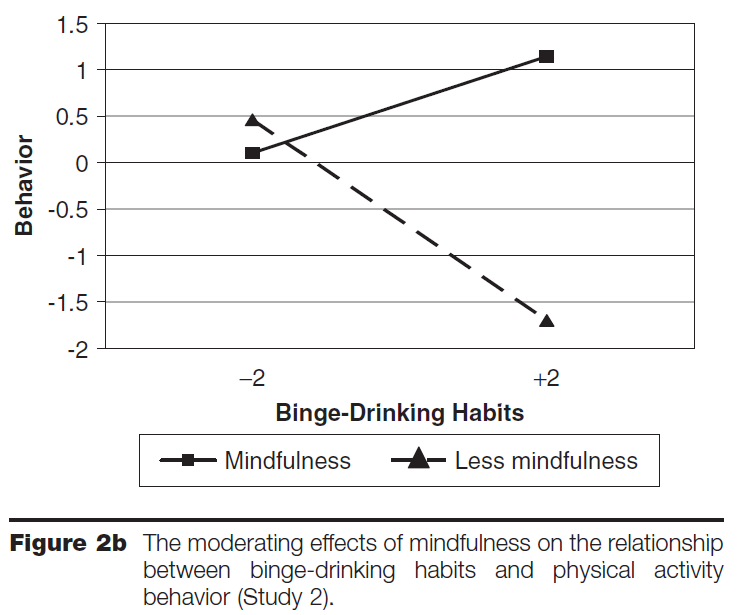
C and H 07 Fig 2b 3

Let me step you through this diagram.  Start with the dotted line first. What this says is that people who are NOT mindful and who habitually engage in binge-drinking are LESS likely to engage in physical exercise. That is, habitual binge-drinking decreases the likelihood of engaging in physical activity. So far so good, this confirms the idea that binge-drinking ain’t great for getting up in the morning and going for a run!  But look at the solid line. For this group, even if they did engage in habitual binge-drinking they were still just as likely to engage in exercise as those who did not habitually binge drink. So some mindful folk still go out on the town, but they don’t let this interfere with their intentions to exercise.  In the words of Chatzisarantis and Hagger (2007: 672):

“These results, therefore, corroborate the view that greater awareness of and attention to internal states and behavioral routines helps mindful individuals shield good intentions from unhealthy habits and thus can play a key role in fostering effective self-regulation. In contrast, diminished attention and awareness of counterintentional routines and habits is likely to prevent individuals acting less mindfully from engaging in effective self-regulation, as the negative relationship between habitual binge-drinking and physical exercise suggests (see Figures 2a and 2b).”

So maybe next Christmas I will be better at mindfully saying no to that Christmas pudding!

The Different Motivational Properties of Values and Goals

When committing to a new course of action it’s useful to distinguish between values and goals because they have different motivational properties.

  1. Goals can be achieved.  This is why they motivate – we enjoy the feeling of purpose and progress this brings.  Yet, once the goal is achieved what then?  Very often we revert to our previous behaviour.  This explains the diet industry.  And why it is hard to get a taxi in New York in the rain*.
  2. Goals can’t be achieved right now.  So they can be bad at motivating right now (when I need it).  For example, I have a SMART goal to lose a half stone in weight in the next 2 months.  The trouble is, I have had that goal for about 3 years….  The problem lies in the fact that whilst I cannot meet the goal today, what I can do is eat a piece of cake.  So, when I see a piece of cake a question arises in my mind; can I eat the cake and still meet my goal?  Then some uncertainty arises in my mind – maybe I can have both?  Minds hate uncertainty and they will do almost anything to get rid of it.  So what do you think I do to get rid of the uncertainty?
  3. Goals are powerful motivators. Humans are intrinsically goal oriented and our minds like the feeling of purpose which goals offer.  Yet goals can be set without us really examining why.  Once set, their gravitational pull can pull us away from the things we truly value.  Hence, for about 10 years I busied myself pursuing promotions which I did not really care about.  Whilst pursuing I felt busy and purposeful, but once achieved I felt empty and sad.  I worked so hard to climb the ladder, only to find the ladder leaning against the wrong wall.

In contrast values have different motivational properties which can help us in many different ways.

  1. Values can never be achieved.  So values retain their motivational properties long after a goal’s have been ticked off.  Whilst my goal of losing half a stone could be achieved, acting in accordance with the value of health can never be.  Is it important or not?  If it is, then when will it cease to be so?
  2. Values can be lived in each moment.  So, although Viktor Frankl was not free inside Auschiwtz, he was able to make the value of freedom important by choosing his response to the tyranny he saw.  In this way, values can bring us powerfully into the present moment and, over time, can bring greater coherence to patterns of behaviour over far longer periods.  This builds a much more powerful sense of meaning in life.
  3. Values are what we most want to stand for in life.  They are how we want to be remembered and what we want to stand for in life.  When we act in line with our values we act authentically and in alignment with our deepest motivations and aspirations. Maybe (like me) you have spent much of your life pursuing meaningless goals before realising that life is a musical thing – and we are supposed to sing and dance whilst the music plays…

*They knock off earlier because they meet their daily goal earlier

Training People To Do What You Want – Ethically

There is an episode of The Big Bang Theory where Sheldon trains Penny to do what he wants. He uses chocolate.

We are all constantly ‘training’ the people around us but we don’t usually use chocolates and it is rarely deliberate. Because we aren’t even aware we are doing it, we are often inadvertently rewarding behaviours that we don’t want and punishing the behaviours that we do want.

For example, imagine your new enthusiastic staff member stops taking the initiative and starts waiting to be told what to do, what could have caused the change? It might be because you criticised her whenever she didn’t follow the correct procedure and didn’t encourage her when she was proactive. Gradually, over time you shaped her behaviour.

So it seems like a good idea to become much more aware of the impact of our behaviour on others and start to more consciously reward people when they do what we want.

But people can feel manipulated by this approach. You don’t want to be like Sheldon.

So what is an approach that feels more ethical and less like manipulation?

To be collaborative. Rather than deciding what behaviour I want to shape in the other person, I ask them directly, ‘Who do you want to be at work? What behaviours do you want to demonstrate? How would we recognise those behaviours? How can I support you in those behaviours?’

It is also helpful to acknowledge that these interactions work both ways. So I talk to my direct reports about how I want to behave as a manager. And then I ask, ‘Would that work for you? Are you willing to encourage me when I do those behaviours? And let me know when I am drifting away from them?

This more collaborative, transparent approach builds trust and engagement. How could you apply it at work this week?

You might also want to take a look at this earlier post on the 10 factors to consider when rewarding staff.

How You Can Make 2013 A Successful Year

So here we are in 2013. What will it take for you to define this year as successful?

Let’s start by looking back on 2012. What did you achieve? What mistakes did you make? Where do you feel you failed?

measuring up
measuring up (Photo credit: woodleywonderworks)

Did you get a promotion or an increase in salary? Did you buy something important like a house or a car? Did you fail to get elected to serve as President of the USA?

It can be easy to focus on these external markers of success or failure. But what about your internal yard stick? How much were you the person you want to be? How often were you mindful or generous or brave or loving or …(insert your own values here).

How good were you at noticing the times when you weren’t living your values and then gently adjusting your behaviour so it aligned more closely with who you want to be?

‘Values are your heart’s deepest desires for how you want to behave as a human being. Values are not about what you want to get or achieve; they are about how you want to behave or act on an ongoing basis.’

Russ Harris  – The Happiness Trap

Measuring your life by what you achieve isn’t wrong but the research suggests that we over estimate the impact of these events. We think that if we get the good job and nice house we will be happy and so we conscientiously pursue those goals. Sometimes we are so busy striving that we neglect other important aspects of our life, like nurturing our health and our relationships, and we forget who we are and what we want to stand for.

The second way of measuring your life – Did I live my values? Was I the person I want to be? – is both more likely to create richness and meaning and will tend to support you in making those moment to moment choices that determine the direction of your life.

So as you review 2012 and before you set yourself some goals for 2013, spend a few moments revisiting your values.  Lundgren’s Bull’s Eye activity is a cool way of doing this.

Growing Compassion in Organisations

Hello!

I am so excited to be joining “Working with ACT” exactly two years to the day since Rob and Rachel started this wonderful blog. Working with mindfulness and values is a big part of my professional and personal life. My aim is to bring you interesting perspectives on ACT research.

By way of introduction, I thought I might briefly review one of my own papers written with Sharon Parker.  I promise I will focus on papers by other people in the future 🙂  Here is the citation from which you can link to the paper if you would like to read more.

Atkins, P. W. B., & Parker, S. K. (2012). Understanding individual compassion in organizations: the role of appraisals and psychological flexibility. Academy of Management Review, 37(3).

——————————————————————————————

“I don’t do emotions!”  This was a comment made by one of my students in reaction to an exercise exploring values and stressors at work. But in reality, we all “do emotions”. A growing body of evidence clearly shows that emotions are a major determinant of performance in all workplaces, including public sector organisations.  Emotions alert us to what matters, they allow us to communicate and make decisions that are effective.  Emotions are at the heart of thinking about how we wish to live and what we wish to create in society?

Becoming skilful at recognising and influencing emotions at work is a key facet of effective leadership and management. Such skill rests upon the quality of our awareness and perspective taking ability. We need to be able to take the perspective of others to act effectively. We need to be compassionate if we are to respond skilfully to our own and others emotions.

Compassion towards oneself and others is a critical part of building effective relationships and making good decisions at work. Think for example of how you handle situations where you or someone in your team fails to achieve important goals. What would it be like if people were more compassionate towards themselves and others at these times?

Compassion is not just a feeling.  It involves four stages:

  1. Noticing another is suffering,
  2. Making judgments about what is going on,
  3. Feeling empathy, and
  4. Taking action.

There are three judgments that can get in the way of compassion towards self or others.

First, we can fail to be compassionate because we judge that the person who is suffering is not deserving of our compassion. For example, we might judge that the person brought their suffering on themselves.

Second, we might judge that the person’s suffering is not relevant to us. Research shows we are much less likely to extend suffering to others who have different goals, or belong to groups with which we do not identify. If we make this judgment, we are more likely to feel disconnection rather than compassion.  One can easily see how this judgment is involved in the debate over immigration in this country.

Third, we make a judgment about our personal resources. If we don’t feel as though we can cope with being in the presence of another who is suffering in some way, we are more likely to feel distress rather than compassion.  The manager who cannot bear to be in the presence of a person crying is making this sort of judgment.  This judgment appears to be involved in the experience of burnout many people feel when they work in jobs that involve caring for others.

Of course, these judgments are sometimes justified.  Modern evolutionary theory suggests that such judgments are an important aspect of self-protection and effective group function.  Sometimes it is best not to feel compassion, or at least not to act upon it. Our argument is not that we should always feel more compassion. Our argument is that it is helpful to become more aware of the automatic reactions that drive our behaviour. To the extent that we can catch our reactions in motion, we can choose our responses more deliberately and improve our effectiveness.

So how might we learn to catch our automatic reactions, and act more in line with what really matters?

If you have been following this blog you will know that there are two aspects of effective training in emotional skills. First, we need to increase mindfulness. Being mindful means being aware of what is happening in each moment both within ourselves and in the world and bringing an attitude of openness to that experience. Second, we need to be clear about our values and the values of the organisation in which we work. There is no point developing awareness if we don’t know how we want to act in the world. Values act as a compass to guide our behaviour.

What has been your experience of compassion at work? Is it encouraged? Does it have a positive impact?

How Moments of Joy and Pain Can Help You Work Out What Really Matters To You

In this noisy world, where we are bombarded with messages telling us what to think and do, it can be hard to work out what is really important to us.

In this Big Think Interview, Steve Hayes gives two suggestions for how to connect with your values:

1. Take a moment to focus on what causes you emotional pain. What upsets, saddens or angers you? Then ask yourself, ‘What do I care deeply about here?’.

‘Look where the pain is. Flip it over; you’ll find that’s where the values are.’

This approach of looking for what our pain is telling us about what really matters can protect us from responding to pain in a way that narrow down our life. For example:

‘most people are hurt deeply by betrayals in relationships. And what your mind tells you to do is, don’t be so vulnerable; don’t be so silly; don’t open yourself up; don’t be so trusting; you can be betrayed. In fact, the reason why you hurt so much is that you want relationships that are loving, committed, intimate; you want trust. And what your mind is telling you to do in a way is, don’t care about that so much so that you won’t be hurt so much. It might be better to really get up against and sort of contact that caring, and maybe take a more loving stance even with your own pain, and keep your feet moving towards what you really want, because the cost in terms of intimacy and connection and caring that comes when you try not to be vulnerable, when you’re constantly looking out for betrayals of trust, is too great. It makes it very hard to have relationships of the kind that you really want.’

2. Notice what brings you joy and ask yourself, ‘What does this tell me about what matters to me? About who I want to be in the world?’

‘Think of the times that you’ve felt most with yourself, most connected, most vital, most energized, most flowing, natural. And if you take some of these specific memories and you walk inside them, you’re going to find that there’s things in there that you care about. There’s things in there that, when it’s really working well, are kind of a lighthouse, like a beacon in the distance, that you can move towards.’

‘Go inside the sweetness of life, catch the places where you genuinely were moved by or connected with life, and you’ll find in there kind of a light that can direct you when the cacophony gets very noisy and you get confused and lost, that can direct you towards what you care about.’

According to Steve, Acceptance and Commitment Therapy (ACT) is about:

‘living in accord with your values and in a way that is more open and accepting of your history as it echoes into the present, that’s more self-affirming, self-validating and values-based.’

…and it is based on science!

(For Brisbane based readers: I am running a session on Acceptance and Commitment Therapy at The Relaxation Centre of QLD on Sunday 16th December. We will be doing both of the activities above plus a lot of others – I am very much looking forward to it! If you are in Brisbane and you happen to be free it would be lovely to see you there. All proceeds go to the centre.)


Tackling Our Culture of Cruelty

A recent Panorama investigation found systematic abuse of elderly residents going on in a UK care home.  Some of the most vulnerable people in our society were being ritually abused by their so-called carers:

On the top floor of a special hospital, locked away from their families and friends, a group of men and women are subjected to a regime of physical assaults, systematic brutality, and torture by the very people supposed to be caring for them.  The victims are some of the most vulnerable in society – the learning disabled, the autistic, and the suicidal.

Sadly, this may be merely the tip of the iceberg.  In this week’s Sunday Times Minette Marin wrote of the terrible neglect of nurses that she witnessed first hand.  Similarly, the MP Ann Clwyd has told of her husband’s inhumane treatment at the hands of the NHS and asked whether cruelty is now normal in the NHS.  Today I listened to a phone in programme where one man described a ward of vulnerable geriatrics and simply said:

“Nobody seemed to care”.

How does this happen?  Presumably no nurse goes into that profession for any other reason than to care for others?  So what happens?

Organisational culture is clearly a factor and a number of systemic problems contribute –  poor job control, lack of autonomy, lack of a proper leadership.  But at some level cruelty is an individual choice.  We create our cultures, then they create us.  So what can we do about that?

I think this is a problem of experiential avoidance.  I propose that nurses dealing with ‘difficult’ or elderly patients are brought into contact with their own fears and insecurities about becoming old, infirm, or mentally impaired.  These fears – being intolerable – can only be dealt with by distancing themselves from the patients and dissociating from them.  And we don’t have to go far back in history to see the terrible, shaping effects of dissociation on human behaviour.

So what can be done?  Plenty, and we could start by not dissociating ourselves from the nurses.  The problem is that the alternative – empathy – is not the simple panacea that most people assume.  It takes real effort and psychological skill.  It is not something we can just do, any more than we can suddenly start sticking to diets or going to the gym five times a week.

The key to empathy is reducing experiential avoidance.  And we know how to do that.  Firstly train people – help them – to gently reconnect with what they care about.  Then help them to defuse from the difficult thoughts and emotions that will arise from taking valued action.  We know we can’t get rid of those fears and demons, but we can respond to them differently, and in so doing shift the context for our behaviour.

People often talk about practicing empathy and practicing compassion.  That’s good, because these things do take practice.  But in order to practice we need to understand what prevents us from practicing.

In most cases, it is our own demons.  And we have been running from them for too long.

warning, this is a harrowing clip:

Find Your Passion At Work! (Just Don’t Expect to Feel Passionate About It When You Do)

One of the reasons I left consultancy is because I felt that the work was meaningless.  In meetings I would try not to fall asleep as people droned on about project dependencies and stakeholder management and at the weekend all I did was dread Mondays.

It wasn’t unpleasant exactly, it was the lack of something that bothered me.  I wanted to feel passion and meaning at work, instead I experienced a sense that I did not care about the low hanging fruit as much as other people seemed to.

Now, many years later, I have created a working life which I do feel passionate about.  Some nights I have to force myself to go to bed – like a child on Christmas day – because that will make the next day come faster.  Some days I work with a client and it will hit me: I love this.

So for all the people who write about finding your passion at work: good for you.  It is possible.  It is necessary.  Well done!

But your books are still at best horribly misleading and at worst, dangerous…

passionatwork

The thing about passion at work is that it is rarely characterised by feelings of passion.  It is, if anything, characterised by feelings of anxiety and doubt, particularly in the early days.  For me those years were filled with thoughts about whether this was really the right thing, whether I could do it, whether I was falling behind my peers.

Even today those moments where I feel  passionate about what I do are rare and fleeting.  Working with people who are stuck can be draining and usually I am assailed by doubts about my own ability to help, my mind telling me what a terrible psychologist I am.  Plus it can be very painful working with people who are themselves in pain.

Is this what I left consultancy to find?  Is this really passion at work?

Well, yes.  I am truly passionate about what I do and I am so thankful that I get to do it (well, most days).

But if I had not been show how to grow more willing to respond flexibly to painful thoughts and emotions, then I would have never have reached where I am now.

In short, if I had defined passion as feelings of passion then the journey would have stopped long, long ago.

dd21e33e26cd2bc5a455e4c7bdc00dbff9a07938_m

Psychological Flexibility in Difficult Conversations

It struck me that psychological flexibility is very powerful in relationships, and particularly in having difficult conversations.  However, this is something I rarely talk about on this blog (Rachel maybe more so).  So I thought sharing a personal example of how psychological flexibility has helped me could be useful.

Earlier this year my Grandfather died and I wrote a bit about that at the time.  Having dreaded his death for much of my adult life I am grateful for the skills that psychological flexibility gave me because they helped shape my response to his decline.

In May 2011 I went home to Liverpool to visit my Grandfather, who was then aged 92.  He had been moved to a home, much to his disgust. He was grumpy because he felt he’d been locked in there against his will. He was surrounded by old women, many of them even grumpier, so we went outside for a cup of tea.

It was cold outside and windy. For some reason, we got onto talking about the gloomiest of subjects – unusual because we usually kept things light and jovial. But that day we both felt low. We talked about how he missed his daughter, Rowena, who died before I was born. It felt uncomfortable and sad.

It was sad. I felt like crying.

Some years ago I would have taken this discomfort as a sign to run away. I may have cracked a joke, or left a bit earlier, or hurriedly changed subjects.

But this time I sighed and stopped and just sat there. In the middle of the day, sitting with my Grandfather, sharing time, sharing life. I gave up the struggle with it, and just shared what was.

I look back now and am proud of what we did that day.  Above all, I’m so glad I didn’t just run away.

Psychological flexibility has not saved me from difficult conversations.  But it has lessened the struggle I have with my own thoughts and emotions during them.  That has given me more energy to focus on what matters and I have been more willing to ‘show up’ to what matters to me in everyday life.

Doesn’t the workplace need more of this?

About the same time as seeing my Grandfather I went to a workshop run by another hero of mine, Kelly Wilson.  He showed me this poem, and it means a lot.  But not as much as the difficult moments I shared with my Grandfather last year, drinking lukewarm tea in the cold.

Before you know what kindness really is
you must lose things,
feel the future dissolve in a moment
like salt in a weakened broth.
What you held in your hand,

what you counted and carefully saved,
all this must go so you know
how desolate the landscape can be
between the regions of kindness.
Before you know kindness as the deepest thing inside,
you must know sorrow as the other deepest thing.
You must wake up with sorrow.
You must speak to it till your voice
catches the thread of all sorrows
and you see the size of the cloth.

Naomi Shahib Nye, “Kindness”

Why Happiness Makes Me Grumpy (aka: The Limitations of Aiming for a Happy Workplace)

Most serious positive psychology researchers would agree with the idea that happiness should not be an objective.   But in my experience the message gets lost in translation, certainly among the many life coaches and pop psychologists who advocate the implementation of happiness strategies.

Even with heavyweight researchers the message gets blurred, for example:

  • Organisations like Livehappier.com and Action for Happiness argue that happiness is “the eternal quest of every generation since the first human beings” and argue that we should therefore try to create happy workplaces.
  • On Barbara Fredrickson’s website she writes: “experiencing positive emotions in a 3-to-1 ratio with negative ones leads people to a tipping point beyond which they naturally become more resilient to adversity and effortlessly achieve what they once could only imagine“.
  • Professor Tim Sharp relentlessly tweets about happiness, for example: “Stop; slow down; reflect; just be…happy” and “Live longer with happiness!”

The message is that happiness is correlated with all sorts of benefits – from health to productivity – so we should logically seek to attain happiness, right?

Well, no.

Happiness as an objective (whether individual or organisational) is hugely problematic for a number of reasons:

  1. If we have happiness as our goal, then unhappiness has to be avoided.  In this way individuals are encouraged to ignore, change or avoid negative emotions rather than accepting them as normal.  This can lead to experiential avoidance – a psychological phenomena which has been linked to a huge number of mental health problems (Hayes and Masuda, 2004).
  2. Thoughts and emotions are not within our control.  As natural responses to the environment, there is very little evidence to suggest that negative thoughts can be avoided.  We also have an ability to manufacture great unhappiness from pleasant events, and happiness from disaster (Gilbert, 2006).
  3. Trying to be happier can backfire.   A study by Ng and Diener found that those high in neuroticism did not benefit from cognitive reappraisal strategies and Woods (2009) found that positive self-statements provoke contradictory thoughts in those with low self-esteem.
  4. Trying to be happy ignores context.  I am motivated more often by fear, anger, jealousy and even desperation than I am by happiness.  Is happiness the ‘right’ response to inequality or corruption?  I would argue that the world needs a focus on happiness no more than it does on anger.
  5. What drives happiness is often short term.  For example, my mind will be unhappy at the prospect of going for a run, or of receiving negative feedback.  Yet these are precisely the actions which drive longer term wellbeing, performance and meaning.
  6. Happiness only drives some aspects of performance.  Linking happiness with performance is like saying extraversion is good because it is associated with success in sales.  Happiness is indeed useful for creative tasks (Fredrickson, 2005) but it is less useful for tasks like risk management (García, Sabaté, Puente, 2010).
  7. Lack of theory.  There is no theoretical reason why happiness should be exalted above other emotions.  It does not tap into any theory of language or cognition which can explain how human minds work, and so no model can be empirically tested.

However, happiness sounds good and it correlates with some nice outcomes.  So let’s pump it out there and hope for the best!  I get grumpy about this for two reasons:

  1. By focusing on happiness we fail to equip people with the tools to live more vital, fulfilling lives in practice. Plus we risk adding a second source of stress when people fail to feel happy.
  2. It means the people I compete with get an easier sell than I do.  And that makes me grumpy!

By focusing on happiness, Positive Psychology reinforces (whether overtly or not) the idea that we must change something within ourselves before we can be successful, productive, and healthy.

If we buy that idea we set ourselves up for a battle we cannot win – and risk creating enemies of our own minds.