Finding Focus in the Age of Distraction

As the amount of digital information increases tenfold every five years, a conservative estimate is that the amount of information we are exposed to daily has doubled over the last 20 years (1). Now, I don’t know if that is good or bad, because humans adapt.  But what  is happening now goes way beyond incremental growth, and this quantitative change may begin to make a qualitative difference. After all,  the human mind did not evolve to ignore new information…

Minds that ignored new information – that strange shadow over by the trees, the unfamiliar rustle in the undergrowth – were pretty rapidly rooted out of the gene pool.  The minds that survived were the ones that paid very close attention to the new and unfamiliar, and worried obsessively about it until they understood it.

Fast forward a million years and today we’re working away on our PC and up pops that little envelope and where does our attention go?

mail

Right there.  We attend to it immediately.  (Or is that just me?)

If we find it difficult to ignore new information and then the amount of information we deal with increases, what happens to the quality of our attention?  It has to become shallower and more fractured.  Again I am not arguing this is good or bad, simply that this must be the case.

The Costs of Distraction

Working in a distracted way certainly makes us feel busy.  But nearly all research shows that apart from some very routine tasks it is spectacularly bad for performance.  Effective multitasking is almost impossible with anything involving a cognitive load* – the brain is forced to refocus continuously as one switches between tasks, and this pause always costs time and accuracy.  So although we feel busy we rarely feel effective.  Is it any wonder about the explosion of the use of prescription drugs like Ritalin (“for better focus”)?

In fact if we attempt to multitask the effects are the same as if we were drunk (2).  In fact, it might even be better to turn up drunk, because at least that can be fun.

In the short term multitasking can make us feel busy and purposeful.  It can also make us feel needed and important.  It can be a badge of honour to say you are busy.  Being constantly distracted can also act as a barrier to dealing with difficult thoughts and emotions, so the emotional payoff can sometimes be even larger.

But what does the research say about longer term effects of distraction on our mental wellbeing?

Dan Gilbert’s lab ran a large study which is now an excellent TED talk by Matt Killingsworth.  Basically, he found that the times when we were least content is when we are most distracted.

This makes sense from a theoretical perspective.  High performance states involve intense focus on one thing.  Flow is the best known example, a state where we lose track of time because we are so absorbed in one task.  This, clearly is the opposite of distraction.

When we also consider the effects of distraction on relationships, perhaps we can begin to understand why there is an explosion in work disengagement, as well as the rate of anxiety?  As Robert Leahy argues:

The average high school kid today has the same level of anxiety as the average psychiatric patient in the early 1950’s.

So how can we find focus in the age of distraction?

Well I am assuming that no one is reading any more and is instead looking at videos of funny cats.  But if you are interested, I’ll post some ideas next time.

* your job involves a cognitive load

References

1. Institute of the Future

2. Strayer, David L., Frank A. Drews, and Dennis J. Crouch. “A Comparison of the Cell Phone Driver and the Drunk Driver.” Human Factors 48.2 (2006): 381–91.
Guest post: When Anger Strikes like a Bolt out of the Blue

One sunny morning around a year ago, I stormed into my office shaking with rage. In half an hour I was due to counsel someone.

My husband had driven me to work; he and the children were going on to soccer training. It had been a typical Saturday morning: coffee, croissants, music played probably a tad too loud and the children bounding around.

As we’d approached the office my husband had said something (I can’t even remember what it was), and I’d exploded with anger. My voice had sounded weird. Even as I’d glimpsed the thought “You need to keep it together,” every cell in my body steeled to fight ~ run, hit out, fix, prove ~ NOW. My eyes narrowed and hardened, and my heart felt like it was curling inwards.

I walked away, leaving my family, the people I hold most dear, sitting in the car shocked and still.

There was no turning back. I had to keep my feet moving, eyes dry; half an hour was all I had. The heavy glass doors were light as I pushed them open, fuming. Fragments of shame  ~ collided with the Imposter spectre that’d whooshed in ~ collided with phrases from ACT ~ bah!

Thanks to a few less dramatic bouts of anger over the preceding months, I had found a few things which helped…

By the time the session began I was feeling a bit bruised but otherwise fine. Guilt and apologies were tucked away to manage later.

If out-of-the-blue rage is something you struggle with, these are some things you could try:

In the heat of the moment,

  • Slow and deepen your breathing, eyes closed if possible. Do this by counting slowly, in… 2… 3…..pause….out… 2…3…. a few times.
  • Soften the muscles around your eyes, especially if a child is present. My dad had what we called “The Pirate Look” when angry, and it terrified us!
  • Rest your tongue gently on the back of your top teeth. This helps relax the jaw.
  • Run cold water over your wrists. Have a swig of cold water and notice how it feels as it moves down your throat.
  • Take note of the different parts of your experience: notice how it’s possible to unwind thoughts, feelings and impulses to act from the tangle of fury.
  • Open up: make room for discomfort. With anger it can be easy to be swept back into whirlpools of argument during this step. Loving-kindness, prayer or self-compassion offer guide-ropes which you can try using. I found this post particularly helpful, maybe because it was quite visual.
  • Picture: This will sound corny, but try softening your vision and seeing the person you are angry with at a time when you loved them to bits. This may be helpful in opening up and connecting with your values. Experiment and see what works for you. It could be a role model. Or a beloved pet. Or it could be yourself  that you see, managing the situation in a way that’s true to your values. (Assuming these are peaceful!)
  • Pursue your values: do what matters, with uncomfortable feelings in tow if need be.
  • Perspective & problem-solving: can be tricky in the eye of a storm, but do-able later on, and important. It’s tempting to get stuck in how right you are and how wrong they are..
  • Apologise (although it may feel easier to skip this step and move on.) Something we did later that Saturday which also helped, was talking about how anger had been managed in our families as children ~ and about how we wanted things to be different.

When you have calmed down somewhat,

  • Learn about anger. This is a gem, “ACT on life not on anger” by Eifert, McKay & Forsyth. Many posts on this blog may be helpful, for example, this one on touching fear and other difficult emotions.
  • Make a note in your diary when anger visits. See if there’s any pattern.
  • Get clear on the type of person/colleague etc you want to be, and the atmosphere and communication style you want in your home/office. Use this as motivation to make changes.

(Reading about values on this blog was, for me, like seeing colour TV for the first time. “Values”  till then had been abstract, dry and dull. So, Dig in! “Your Life on Purpose: How to Find What Matters and Create the Life You Want” by McKay, Forsyth and Eifert is also excellent.)

  • Get to know the triggers. This takes effort, especially if the anger seems to have no cause. Use them as alerts; to plan strategies and to problem-solve.
  • Become clever at spotting, and responding to, the earliest flush of anger possible.
  • Practice, practice, practice – even with minor annoyances.

The order is not important, nor do you need to do each step. In the service of self-compassion and workability, experiment, and see which tools work best for you.

I hauled myself off to the GP that week. She reassured me that it wasn’t Alzheimer’s, nor was it my dad’s fiery genes. Turns out it was medicine I’d been taking.


Catharina Belgraver is a counselling psychologist in Brisbane, Australia. After many years in the perinatal field, she is about to embark into health and wellbeing counselling, using ACT.  Follow her on Twitter at @Rina_Belgraver

Learning to Touch Fear

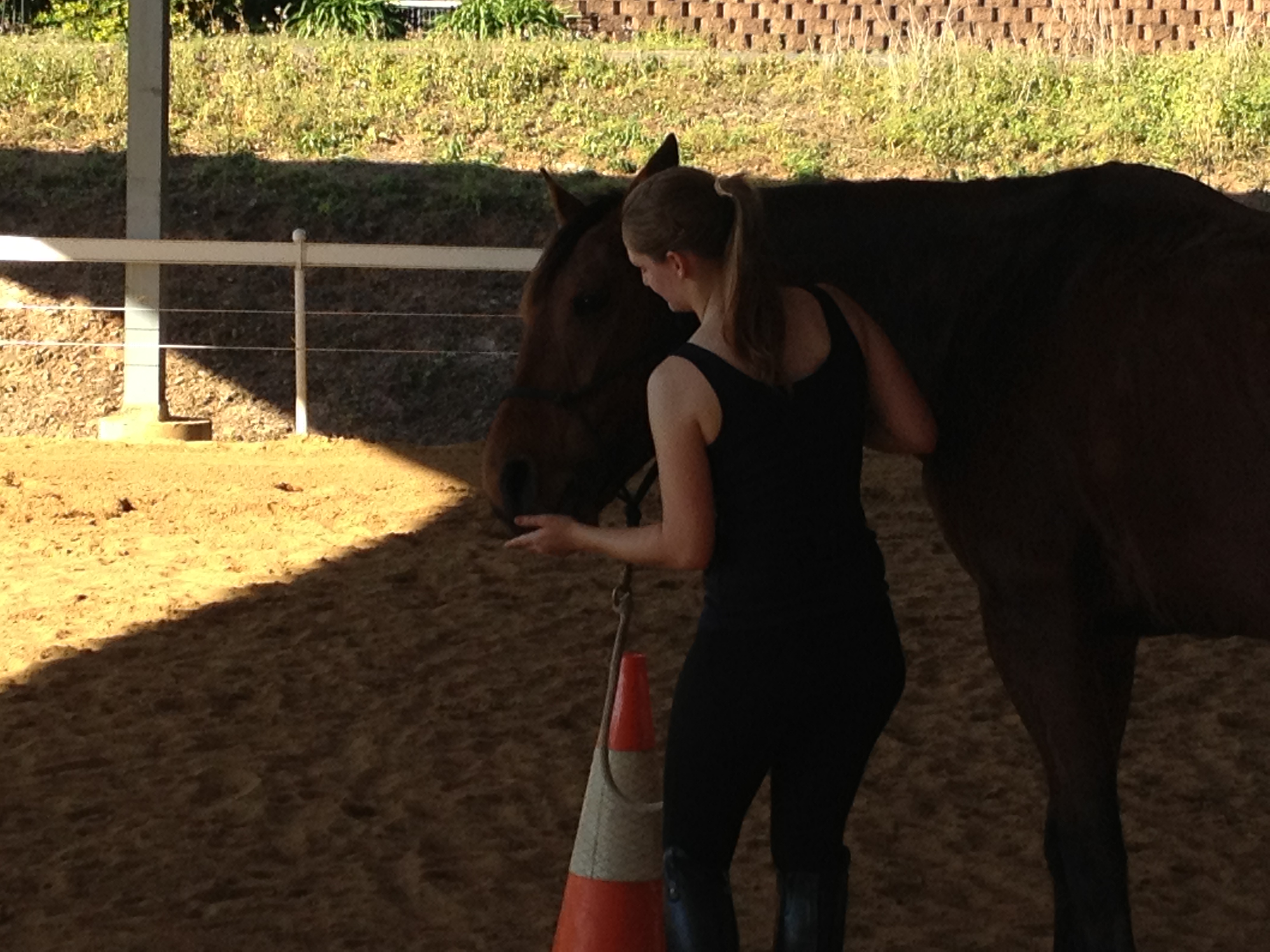
Training Josie to TouchMy daughter, Ellie, is training her horse to touch an object. Ellie points at the object and says the word ‘touch’ and her horse, Josie, touches it with her nose. This seems like an odd skill to train. So I asked Ellie why she was doing this. She told me that if a horse sees something that is new, like a paper bag or a traffic cone, then their natural response is fear. Their focus narrows down to the thing that is frightening them, as if they were wearing blinders. Josie then becomes skittish and unpredictable and she ignores Ellie. But if she touches the threat, she realises that it is fine, settles down and opens up to Ellie’s instructions.

Of course horses aren’t the only ones that scare easily, and they aren’t the only ones that can learn to touch the fear. You and I can become skittish, unpredictable and cut off from what’s happening around us when we are afraid.

The big difference is, we aren’t usually spooked by paper bags and traffic cones, for most of us it’s our emotions that we’re afraid to touch.

When fear, anxiety, sadness or anger turn up, we can become both preoccupied by the feelings and also focussed on getting rid of them. We tend to treat internal discomfort as if it is the same as a real threat in the external world. In the grip of painful emotions, we find it difficult to focus on what is happening around us. We tend to ignore the suggestions of our wiser self and we make foolish or impulsive decisions.

What if we could learn how to respond differently to painful emotions? What if we could lightly touch the feelings that scare us? With time we might find that although they seem very threatening they can’t actually harm us.

Like all new skills, it is good to start small with less challenging emotions. Touch them gently and imagine yourself expanding to make room for them. If over and over again we practice the skill of turning towards emotional discomfort with curiosity, something important happens.

Eventually, when fear, anger or sadness turn up, instead of freaking out and being controlled by our emotions, we accept our feelings as signs that we are human and that we care. We are able to take actions based on both our values and what the situation affords and over time these wiser choices will help us to flourish.
So next time you feel yourself freaking out, take a breath and see if you could, just for a moment, touch your feelings with an attitude of kindness and curiosity. It might just change everything.

Tackling Our Culture of Cruelty

A recent Panorama investigation found systematic abuse of elderly residents going on in a UK care home.  Some of the most vulnerable people in our society were being ritually abused by their so-called carers:

On the top floor of a special hospital, locked away from their families and friends, a group of men and women are subjected to a regime of physical assaults, systematic brutality, and torture by the very people supposed to be caring for them.  The victims are some of the most vulnerable in society – the learning disabled, the autistic, and the suicidal.

Sadly, this may be merely the tip of the iceberg.  In this week’s Sunday Times Minette Marin wrote of the terrible neglect of nurses that she witnessed first hand.  Similarly, the MP Ann Clwyd has told of her husband’s inhumane treatment at the hands of the NHS and asked whether cruelty is now normal in the NHS.  Today I listened to a phone in programme where one man described a ward of vulnerable geriatrics and simply said:

“Nobody seemed to care”.

How does this happen?  Presumably no nurse goes into that profession for any other reason than to care for others?  So what happens?

Organisational culture is clearly a factor and a number of systemic problems contribute –  poor job control, lack of autonomy, lack of a proper leadership.  But at some level cruelty is an individual choice.  We create our cultures, then they create us.  So what can we do about that?

I think this is a problem of experiential avoidance.  I propose that nurses dealing with ‘difficult’ or elderly patients are brought into contact with their own fears and insecurities about becoming old, infirm, or mentally impaired.  These fears – being intolerable – can only be dealt with by distancing themselves from the patients and dissociating from them.  And we don’t have to go far back in history to see the terrible, shaping effects of dissociation on human behaviour.

So what can be done?  Plenty, and we could start by not dissociating ourselves from the nurses.  The problem is that the alternative – empathy – is not the simple panacea that most people assume.  It takes real effort and psychological skill.  It is not something we can just do, any more than we can suddenly start sticking to diets or going to the gym five times a week.

The key to empathy is reducing experiential avoidance.  And we know how to do that.  Firstly train people – help them – to gently reconnect with what they care about.  Then help them to defuse from the difficult thoughts and emotions that will arise from taking valued action.  We know we can’t get rid of those fears and demons, but we can respond to them differently, and in so doing shift the context for our behaviour.

People often talk about practicing empathy and practicing compassion.  That’s good, because these things do take practice.  But in order to practice we need to understand what prevents us from practicing.

In most cases, it is our own demons.  And we have been running from them for too long.

warning, this is a harrowing clip:

Having The Courage To Be Vulnerable

You know, sometimes all you need is twenty seconds of insane courage. Just literally twenty seconds of just embarrassing bravery, and I promise you, something great will come of it – Benjamin Mee (Matt Damon) in ‘We Bought a Zoo’

When was the last time you committed an act of insane courage?

Emotional vulnerability takes a degree of fierce bravery. You might be hurt or criticised. You risk shame and humiliation. When it goes wrong you might feel like you want to run and hide. The events often play over and over in your mind as you try to work out how you could have avoided the pain.

But vulnerability can also help us to feel closer and more connected to others. We often find that when we share our pain, shame just melts away. We take a risk and ‘something great’ comes of it.

I want to suggest though that vulnerability just for the sake of it isn’t helpful. Vulnerability has to be in the service of something. It might be about love, belonging and joy. It might be part of doing extraordinary work or making a difference in the world. But it has to have a purpose.

Although the nature of vulnerability means that it is risky and takes courage, we can make it a little safer if we:

  • Make thoughtful choices about who to trust, when and with what aspects of our vulnerability.
  • Have clear boundaries and hold people accountable when they cross those boundaries.
  • Listen to our needs.
  • Respect the needs of others.
  • Stay connected to the people we are talking with. Notice their reaction.
  • Check assumptions about what they are thinking. They might be quiet because they are horrified but it could also be because they are deeply moved.
  • Increase resilience to the painful thoughts and emotions that come along with vulnerability. (You will be surprised to read that Acceptance and Commitment Training is helpful for this!)

I am running a low cost session on The Courage to Be Vulnerable at The Relaxation Centre of QLD on Sunday 16th September 2012 ( All proceeds go to the centre). If you happen to be in Brisbane on that day do come along. I would love to meet you.

Why I Am Not As Empathic As I Want to Be

Last year, my daughter Ellie, had her wisdom teeth out. It was horrible. It is a painful and unpleasant procedure and, to make matters worse, Ellie has a needle phobia. Ellie felt terrified but she hid it well and looked completely calm. This meant that I looked like a crazy, over-anxious mother insisting that my daughter wasn’t coping whilst Ellie appeared to be fine.

My worry for Ellie, combined with the difficulty in getting her the help she needed, was just horrible.

After the operation Ellie had a lot of pain and vomiting. I felt so bad for her. It was so distressing to see her in such discomfort.

Even now, when we talk about the operation, I have a tendency to get upset and hijack the conversation – suddenly I am going on about how I found the whole thing awful.

When my loved ones are in pain, I feel it so acutely that I struggle to be present and helpful. This is because I lack some key empathy skills.

Louise McHugh recently taught me that there are three aspects to empathy:

1. Perspective taking – Imagining how I would feel if I were you. Or, even better, if I was you, with your history and temperament and circumstances, how would I feel?

2. Being open to feel the painful emotions provoked by taking the other person’s perspective.

3. Handling those painful emotions effectively so as not to get so swamped and distressed that you can’t focus on supporting the other person. Strategies for handling painful emotions include mindfulness (getting present with your five senses; holding your pain with compassionate awareness) and connection to that still part of yourself that observes what is happening without being caught up in it.

If I am to become more empathic I need to work on the third aspect of empathy. When the feelings swamp me, I need to remember to breathe and get present. I need to connect to the part of me that can observe and transcend pain and difficulty. When a precious human being needs my help and support; I want to become better at giving them what they need.

How empathic are you? What gets in the way of empathy for you?

On Holding Our Feelings Gently

This post is based on some writing by Dr Hank Robb. Hank is a deeply wise psychologist based in Oregon. You can see a video of him here.

Sometimes, when we act to make something important in our lives, we experience painful emotions. And, we can choose to feel them willingly.

There are, really, two important aspects to that willingness. There is “willingness with your feet” and also “willingness with your heart.” If you think about “flight phobics” you see
 both kinds. Some won’t get on the airplane – they lack “willingness with their feet.” However, many who do get on the plane are then “white knuckleflyers” – they lack “willingness with their heart.” Both kinds of willingness are choices.

To give you a sense of “willingness with your heart”. Cup your hands. Imagine holding a feather in your cupped hands, it will be gentle. And, you can hold it gently. Now imagine putting the fruit of a prickly pear cactus in your cupped hands. It will not be gentle. And, you can still hold it gently. Willingness with your heart is holding gently whatever is there to be held.

Prickly Pear Cactus a kind of common vegetatio...
Prickly Pear Cactus a kind of common vegetation found in the hills of Balaghat Range (Photo credit: Wikipedia)

Whatever feelings turn up, you can choose to treat them with compassion and gentleness.

What would that be like? Which are the emotions that are hardest for you to hold with gentleness? For me anger is really tricky.

Can you catch yourself when you harden your heart against your pain…and soften?

The Benefits of Accepting Your Emotions and Treating Yourself Like A Child

Recently I was a bit upset. I was feeling sad, anxious and angry about a challenging situation in my life.

I am not good with anger. My natural tendency is to fight it. I try to fix the feeling. My mind grinds over and over whatever seems to have triggered the anger. Part of me believes that if I can just figure out how to solve the problem then I won’t have this bad feeling.

How does that work for me? Not real well!

So I caught myself in my old pattern. Ruminating on the problem in a doomed attempt to get rid of the anger. And then I made a different choice. I decided to observe the feelings with curiosity. To notice exactly where I could feel the emotions in my body and what they felt like?

Then I realised the extent of my foolishness. The feeling was actually only one part anger, the other three parts were probably illness. I was sore across my shoulders, the glands in my neck were aching, I had a headache. I wasn’t so much angry as sick!

When toddlers get irritable we ask them:

  • Are you thirsty?
  • Are you hungry?
  • Do you need a rest?

And in Derbyshire, the response to a particularly crabby and inconsolable child is often, ‘She is probably sickening for something‘ (which means ‘She is probably suffering the prodromal symptoms of a viral illness‘).

So next time a difficult emotion comes up, don’t make my mistake. View the feelings with a bit more curiosity and see if you need to show yourself some kindness…or perhaps just have a little rest.

How Promising Managers Sometimes Derail Their Careers…and How to Prevent It

According to The Centre for Creative Leadership almost 1 in 2 of the managers who have the makings of success fail to reach their potential. They ‘derail’ and are either demoted, fired, plateau or opt for early retirement (William A Gentry).

There seem to be some key problems that cause this derailment:

  • Failing to build effective interpersonal relationships
  • Showing poor team leadership
  • Having problems adapting to changes in the environment
  • Lacking growth and development in the face of the changing demands of their role
  • Failing to meet business objectives (due to either failing to follow through or being overambitious )
  • Maintaining a narrow focus, so that they aren’t able to supervise outside of their area of functional expertise

What seems to happen is that these managers are defensive in the face of challenging feedback, don’t learn from their mistakes and don’t identify and address their weaknesses.

Why do they do that?

I suspect that they lack self-compassion. Self-compassion makes it easier to be open to difficult feedback; learn from mistakes and admit failings. Self compassion can probably be increased*.

These managers also need to get better at noticing when their approach is ineffective and then quickly adjusting their behaviour. A starting point here may be to learn to become more mindful and psychologically flexible.

So, if you are a beginning manager, it might be good to focus on becoming more mindful, flexible and compassionate.

* For readers based in Brisbane, I am running a low cost public workshop on self-compassion on Sunday 6th May 2012.

Successful People Often Feel Bad Too

For most of my adult life I have worked in roles where people told me the truth about how they felt. This privilege has meant that I know an important secret. The secret is that most of us have good days and bad days; good weeks and bad weeks, sometimes even good days and bad months. When I worked as a psychiatrist I thought that only my clients and I felt like this. But then I moved into executive coaching and discovered it was also true of people who, on the outside, look very successful.

Most of us know that we have times when we feel happy and times when we feel sad, anxious or angry. However, we can tend to assume this isn’t true about other people. Other people look like they have got it together and so we assume that they have. Which leads me to the second secret – most of us hide it when we are feeling bad. We spend a miserable evening feeling like s*#t and the next day we do our best to act like everything is okay.

So when all of our efforts to become happy, secure and confident seem to only work in the short term. When over and over again our confidence disappears and we feel scared, sad or anxious, we assume that there is something wrong with us. That we are some how more broken than other people.

A woman dries her tears as she says goodbye to friends emigrating to New Zealand, 1953 (We can all relate to the pain of loss) (Flickr http://flic.kr/p/5uBE8s)

So we hide our pain. And what is worse than feeling heartbroken, sad or frightened? It is the feeling of being alone in that suffering. The feeling that everyone else is out having a good time – happy and successful – whilst Rachel, the loser, stays home alone feeling overwhelmed and scared.

Next time that you feel like howling into the wilderness (or even just feel a bit sad and forlorn) remember that you are not alone. Somewhere out there in the seething mass of humanity will be someone who, at this very moment, is feeling a very similar emotion. And, likely, just like you, they will get up tomorrow and go out into the world and when someone says ‘How are you’ they will smile and say, ‘I’m fine’.

It is a myth that most of us are happy most of the time and it is a cruel myth. The nature of being human is that we have a tendency to suffer. We suffer often and sometimes we suffer deeply. However, if, when emotional pain turns up, we choose to take an open, curious, compassionate approach to our pain; we then seem to get less hooked by the pain. This means that in the very next second, we might just find ourselves feeling content… at least for a moment.

If we stop seeing emotional pain as something to avoid then we can get our life moving. We can take bold and courageous emotional risks and give ourselves a chance to experience joy too.