Are we more likely to be compassionate to others when we are compassionate to ourselves?

When you feel judgemental about yourself, do you also feel more judgemental about others? Or are you one of those people who speaks harshly to yourself in ways that you would never dare or care to speak to another?  What do you think is the relationship between self-compassion and compassion towards others?

These questions matter a lot. A strong relationship between self-compassion and compassion perhaps suggests common learning histories for the two behaviours. While ACT directly cultivates self-compassion through acceptance, it emphasises other-related compassion only indirectly. If we want to improve the ways we relate to one another in organisations and daily life, we need to know how and if changing our relationship to ourselves changes our relationship to others.

The evidence is mixed. Some research suggests we treat people very differently to ourselves, while other research suggests commonalities. Looking carefully at the differences between these studies may help us learn more about what is going on.

Evidence compassion towards self and others might be unrelated

There might be no relationship between self-compassion and other-directed compassion. As children, we learn to distinguish between “I” and “you”, and much of our early sociolinguistic experience teaches us that others have different perspectives, preferences, Two-girls-looking-at-each-othertraits and experiences to ourselves (McHugh & Stewart, 2012).  We can learn to behave quite differently towards ourselves than we do towards others.

Language can create powerful differences between how we behave towards ourselves and others. One example is the fundamental attribution error where, when someone acts badly, we overestimate the effect of personal characteristics and underestimate the effects of the situation as a cause of their behaviour.  Towards ourselves we are more likely to take account or circumstances influencing our behaviour.  For example, while we are quite happy to blame bad driving on someone else’s incompetence or malice, we are more likely to see our own poor driving as the result of situational factors like being late for work. This is a clear case where we behave quite differently in our judgements towards self and others.

Once we make an appraisal that a person is personally responsible for the situation in which they find themselves, we are less likely to experience empathic concern and more likely to experience non-compassionate emotions such as anger (Atkins & Parker, 2012).  And of course in Australia we have seen how it is perfectly acceptable to treat asylum seekers arriving on boats with their children in a very different way to how we would expect ourselves and our children to be treated.  The more we see the other as different to ourselves, the less likely we are to extend compassion towards them (Goetz, Keltner, & Simon-Thomas, 2010).

Society reinforces big differences between compassion towards self and others. It wasn’t that long ago that our society seemed to reinforce young women in particular for being kind to everyone except themselves.  Many older women in particular seem to feel badly about themselves unless they place others’ needs ahead of their own. So, if the distinction between self and other is seen as real, and the right social reinforcers are in place, it is entirely possible that self-compassion and other-directed compassion could be quite unrelated.

Evidence compassion towards self and others might be related

But, perhaps fortunately, there is also a growing body of evidence that emphasises the similarities between the ways we relate to ourselves and others.  Many of the psychological approaches developed during the 50’s and 60’s relied upon the assumption that self-acceptance was related to acceptance of others (Williams & Lynn, 2010).   More recently researchers have begun to test this idea empirically. Neff and Pommier (2013) recently found that self-compassion is positively related to compassion towards others.

Neff and Pommier (2013) studied three groups: college undergraduates, community adults and meditators.  They measured both self-compassion and different aspects of other-focused concern such as perspective taking, forgiveness, compassion, empathy and altruism.  Overall there was a significant positive relationship between self-compassion and other-focused concern.

Why might self-compassion and other-compassion be related?

Why did this relationship occur?  The factors that were consistently related to self-compassion across all groups were perspective taking, forgiveness and the capacity to manage personal distress.  Perhaps our capacity to stay present to our own difficult experiences helps us to stay present to the difficult experiences of others. Or perhaps our capacity to stand back and see our self-critical thoughts as thoughts and not necessarily the truth, is exactly the same skill as our capacity to stand back from our automatic stereotypes and judgements about others.  Perhaps learning to accept our own failings teaches us that we are all fallible. Or perhaps we acquire a deeper knowing that we are not, after all, ever separate from others, that we are all “caught in an inescapable network of mutuality, tied in a single garment of destiny” (Martin Luther King in his letter from Birmingham Jail).

However, Neff and Pommier’s study also revealed interesting differences in the strength of the relationships for different groups.

  • For meditators, there was a stronger link between self-compassion and other-focused concern – perhaps we can explicitly train people to break down barriers between self and others?
  • For women, there was a weaker link. Women are more likely to display higher levels of other-focused concern than men, but they are not more likely to display higher levels of self-compassion.  Perhaps that social training of young girls that I mentioned earlier is still alive and well.
  • Finally younger adults showed weaker links between compassion for self and others. Neff and Pommier argued that this might have been because young adults over-estimate their distinctiveness from others and they are still forming their own identities and understandings of others.

Neff and Pommier’s study has big limitations. It ignores individual differences and relies upon self-report measures.  We cannot tell whether the relationship between self-compassion and compassion for others really is weaker for women or whether this is just an artefact of women feeling more pressured to self-report compassion towards others.  What we really need are within-person studies using measures of behaviour and context.  Am I more likely to act compassionately towards others in circumstances that have primed me to act compassionately towards myself: e.g. when I have just meditated or been treated kindly by another?

And what life experiences strengthen or break down the distinction between self and other?  ACT is one experience that can build both self-compassion and compassion for others (Atkins & Parker, 2012). Perhaps other life experiences work the other way.

lawyers-arguingAs I have been writing this blog, I have been working with legal educators to design programs to enhance well-being and relationships among legal students and practitioners. In emphasising objectivity and the distinction between right and wrong, legal training seems to sometimes create almost impenetrable walls between thoughts and feelings, and between self and others. And legal students and practitioners are among the unhappiest people in Western society  (e.g. Kelk, Luscombe, Medlow, & Hickie, 2009).  Could lawyers perhaps be a canary in the coal mine for what happens when we let language excessively dominate our lived experience and we build the walls too high between ourselves and others?

Relational Frame Theory offers a very useful way of understanding what is going on here. Consider the two sentences:

  • I am less deserving
  • I am more deserving

The first thought might precede a lack of self-compassion, while the second might precede a lack of compassion towards another.  What is going on in these sentences? Our society generally focuses on the comparison words MORE or LESS, and so we have endless debates about who is more or less deserving of compassion. But by focusing on this comparison we ignore the more fundamental move contained in these sentences. The shared “I am” slips by unnoticed.  It is in these little words that the “truth” gets established that there is a separate “I” that has inherent qualities. And of course what these sentences really mean is “I am more or less deserving THAN YOU” so in making the claim that I have certain qualities I am implicitly and always making the simultaneous claim that YOU are separate and have certain qualities as well.

Macro-Water-Drops-Grass-GreenDifference and separation arise in language. We relate to ourselves and others differently only when we are caught up in the world of words, judgments and abstractions. Perhaps Neff and Pommier’s results point to what is left when the language of separation loses its hold just a little. In those moments we see that these divisions only exist in language not in the underlying reality. In the end we are drops of water, or bubbles rising in a pot.  What looks like difference and separation is really only a temporary expression of an unfolding process – and “I am” and “you are” become simply “IS”.

Of course, philosophers through the ages have come to the same view.  Rumi put it this way:

Out beyond our ideas
Of wrong doing
And right doing
There is a field.
I’ll meet you there.

When the soul lies down in that grass
The world is too full to talk about.
Ideas, language, even the words
You and me
Have no meaning.

– Jalaluddin Rumi

Taoism is a rich source of similar ideas. I would love to hear from you if you have other examples of similar quotes illustrating the power of language to create separation between self and other as this is an area I would like to explore further. Thank you.


References

Atkins, P. W. B., & Parker, S. K. (2012). Understanding individual compassion in organizations: the role of appraisals and psychological flexibility. Academy of Management Review, 37(4), 524-546.

Goetz, J., Keltner, D., & Simon-Thomas, E. (2010). Compassion: An Evolutionary Analysis and Empirical Review. Psychological Bulletin, 136(3), 351.

Kelk, N., Luscombe, G., Medlow, S., & Hickie, I. (2009). Courting the Blues: Attitudes towards depression in Australian law students and legal practitioners: Brain & Mind Research Institute: University of Sydney.

McHugh, L., & Stewart, I. (2012). The Self and Perspective Taking: Contributions and Applications from Modern Behavioral Science: Context Press.

Neff, K. D., & Pommier, E. (2013). The Relationship between Self-compassion and Other-focused Concern among College Undergraduates, Community Adults, and Practicing Meditators. Self and Identity, 12(2), 160-176. doi: 10.1080/15298868.2011.649546

Williams, J. C., & Lynn, S. J. (2010). Acceptance: An Historical and Conceptual Review. Imagination, Cognition and Personality, 30(1), 5-5.
Working in a harsh environment can mess you up more than you think…

Have you ever had to survive a harsh environment at work? This woman has…

Most of us have lived through an unpleasant time at work. When it ends, we sigh with relief and assume all will now be fine. Unfortunately things aren’t that simple.

The hostile environment changes us, we learn strategies to cope, to get our work done despite the difficulties. However, the very strategies that helped us to survive a dysfunctional workplace can be counterproductive in a more supportive environment. And in a cruel twist of fate, it is seems to be almost impossible to unlearn something that you learnt when you were scared or stressed. So we often continue to be defensive, aggressive or self-protective even when it is no longer needed.  We can’t seem to get rid of the mental junk we have acquired during our painful experiences.

A reader wrote to us about a problem she encountered when she moved from a hostile, aggressive environment to a much more harmonious workplace.

She was really happy in her new job and was doing well but she was given feedback that her communication skills needed work. This hadn’t been a problem for her in previous workplaces. She realised that she had learnt some unhelpful habits in her last role. Now she needed to relearn how to interact in more workable ways. She was worried that she didn’t know how to bring about this change.

So how do you let go of problematic interpersonal behaviour and start to behave in ways that work? Here are some tips:

1. Start with self-compassion. The less you beat yourself up for your failings, the more you will be able to notice the times when your behaviour isn’t working.

2. Get present. Mindfulness helps us to act on our good intentions. In this moment now, what is happening? Try to notice your behaviour moment to moment.

3. Do a self-assessment and get feedback from people you trust. There are some good questions about interpersonal functioning here that you could adapt to the workplace.

4. Don’t just change as a reaction to what others want. Spend some time thinking deeply about your values. Who do you want to be at work? How do you want others to experience you? Changing your behaviour is a hard slog, linking the change to your values will help you to keep going.

5. Aim to gradually evolve your behaviour rather than suddenly transforming yourself overnight. Just focus on one or two small changes and see if you can repeat those behaviours over and over until they are a habit. Then pick some more behaviours you would like to change.

6. Get really present in your interactions with people. Notice the impact of your behaviour on others. See if you can get out of your head and into this moment now.

7. Accept that when you feel threatened you are likely to revert to self-protective and unhelpful behaviours. Consider what might trigger that in you and make a plan to be particularly mindful and self-compassionate at those moment. Hold those feelings gently.

8. Seek feedback on your progress but accept that it may take people a while  to notice that you have changed. Our opinions of others are quickly formed and slow to change.

Becoming the person we want to be is hard. Facing those times where our behaviour isn’t in line with those ideals is painful. Can you turn to yourself in kindness?

The Dangers of Language

“So, how do you feel?”

“I feel like I’m grinding through life, sort of like I’m pushing a heavy boulder uphill.  Every day I’m grinding forward, but it feels relentless.”

“So how does this feeling of ‘grinding’ actually show up in your body?”

Pause.  Interesting question.

I was receiving supervision from one of the most respected therapists within the ACBS and the question threw me for a moment.  I scanned my body as mindfully as I could.

“I notice I feel a bit tired.”  Pause.  “And I notice that I have some tension in my shoulders”.

“OK.  Anything else?”

“Hmmm.  Not really.  The tension is certainly there but it’s not that severe.  It’s actually pretty bearable.”

“OK.  So what would the person you want to be do next?”

Another long pause.

“I guess I would take a few more breaks, but other than that nothing, actually”.

And there we had it. For several weeks my mind had been telling me about the grind; how tough my life was and how relentless.  But on closer examination that story turned out to be based on feeling slightly tired and having slightly sore shoulders.  From where I was now – skillfully led to a different perspective – my life was actually going really well.  I was doing the work I wanted, with people I liked, whilst making my own small dent in the universe.  If this is a grind, then it is the kind of grind I would definitely have chosen.

This is a clue to one of the most powerful lessons within contextual behavioural science; that part of our lives (or ‘context’) is shaped by the words that we use to describe it.

If we get it wrong, language has the capacity to sell us a version of life that is not particularly accurate or helpful and which may leave us feeling shortchanged.  In my case this was certainly true as it was detracting from the joy and privilege I felt when doing my job.

This was a timely reminder that whilst language is incredibly useful and powerful, it should come with a warning.  Checking in on the accuracy of the metaphors we us  in everyday life is really useful (as the brilliant Yvonne Barnes Holmes makes clear in this talk about constructing effective metaphors).

But every now and again it also pays to connect to our actual ‘felt’ experience of life, and separate this from the language we use to describe it.

Noticing How Desire Can Pull You Away From Your Values

When does desire pull you away from your values?

It might be the impulse to buy more stuff that you don’t really need; watch TV instead of doing some exercise; let work dominate your  life; make poor choices that change your life forever…

In this TEDx talk, Kelly McGonigal explains that the urges provoked by desire (the promise of happiness) have a tendency to overpower current happiness and satisfaction.

Desire for something you don’t have, but would like (in my case, millions of dollars and to write a best selling book!) can create stronger impulses than the feelings of contentment associated with what you do have (for me now: love, health, safety, meaningful work that uses my strengths). Even though what you have now may be much more important to you than what you desire.

When we feel that experience of wanting something, we feel an urge to do something to get that desire met. If we are to handle this tricky emotion wisely then we need to be clear about who we want to be and what we want our life to stand for. We need to have chosen the values we want to live by. But knowing your values isn’t enough.

Last week, Paul suggested that mindfulness helps us to turn our values into action. When desire is moving you away from what really matters, mindfulness can help you to ride out the urges rather than mindlessly chase what you desire .

You can mindfully notice how feelings of wishing and wanting are pulling you in a particular direction and check if that would be a move towards your values. You can become aware when desire is in control of your behaviour, catch yourself and come back to what really matters to you in the long term – love? kindness? connection? your health? security?

I want to be clear here that I am not suggesting that you abandon your ‘big, hairy, audacious goals‘, what I am suggesting is that you also:

1. Compassionately notice when pursuit of those goals feels driven and addictive. Pause and breathe and see if you can ride those impulses like waves rather than act on them.

2. Keep checking in as to how the goals you are currently pursuing fit with your values and life purpose

3. Have the ‘willpower’ to spend some time paying attention to other important areas of your life even though you may feel the addictive pull of the desire for something ‘bigger and better’ calling to you. Your thoughts might whisper, ‘I’ll just send one more email; read/write one more blog post; sign up for that course that promises to make me rich.’ Can you have those thoughts and the feelings associated with them and still spend the afternoon in the garden with your loved ones? Can you have those thoughts and feelings and bring your attention back to this moment now with all its small pleasures and pains?

Kelly McGonigal suggests that the recurring difficulties we experience in handling our desire well is not a sign that there is:

Something uniquely wrong with us – but it is actually part of being human. it is not just you, it is all of us.

Oddly, for me, accepting this makes it easier to deal with. How about you?

[I am running a low cost, one day workshop on ACT at The Relaxation Centre of QLD on  Sun 3rd March.  All proceeds go to the centre. I would love to see you there.]

Closing the intention-behaviour gap

Over Christmas I put on an additional 3kg. I have been getting rid of it ever since and I have realised that losing weight is a fantastic practice in psychological flexibility.  Just about every minute of the day there are opportunities to be mindful of bodily sensations associated with hunger or satiety, and each day there are dozens of opportunities to reconnect with why losing weight is important to me.

This experience also got me thinking about why weight is such an enormous problem. Obesity rates doubled globally between 1980 and 2008.  In 2008, the total annual cost of obesity in Australia, including health system costs, productivity declines and carers’ costs, was estimated at around $58 billion.  In Australia 68% of men and 55% of women were overweight or obese in 2008. Part of the problem here is diminishing physical activity. The World Health Organisation reports “Globally, around 31% of adults aged 15 and over were insufficiently active in 2008 (men 28% and women 34%). Approximately 3.2 million deaths each year are attributable to insufficient physical activity.”  Nobody wants to be obese but people are getting fatter, and everybody knows that they should exercise more than they do.   Clearly there is a disconnect between intentions and actual behaviour. 

We don’t do what we say we will do

Many studies have examined the relationship between intentions and behaviour and, somewhat surprisingly, the correlation between the two is not all that high.  Have you ever had the experience of setting strong goals to exercise or eat well and then not followed through?  Timothy Wilson wrote a fascinating book called “Strangers to Ourselves” outlining all the evidence for unconscious, automatic influences upon our behaviour.  Meta-analyses have revealed:

“… intentions account for a weighted average of only 30% of the variance in social behavior (Armitage & Conner, 2001; Hagger et al., 2002), mainly because people with strong intentions fail to act on them (Orbell & Sheeran, 1998).”  (Chatzisarantis & Hagger, 2007).

Why might this be the case?  One reason people fail to act on strong intentions is because they simply forget to start the behaviour.  Have you ever said something like “This week I will exercise three times” and then before you know it, the week is over and you haven’t exercised at all?  This is why setting specific goals and thinking about contextual reminders is so important.  In the literature, this sort of planning is called “implementation intentions”.

But another reason why people fail to act on their intentions is because their responding has become habitual and automatic.  When we don’t reflect on our moment to moment behaviour we are very likely to do what we have always done in the past.

Mindfulness helps us act on our intentions

From one point of view, this might be a bit of a problem for the ACT model.  If our behaviour is relatively independent of our intentions, then what is the point on getting clear on our values when we might just act out of our habits and unreflected impulses anyway?  This is where mindfulness becomes really important.  Values clarification on its own is of little use unless we bring awareness to what we are doing and we have the self-regulatory skills to enact new behaviours.

But is there any evidence that mindfulness can help us do what we want to do?  Chatzisarantis and Hagger (2007) explored how mindfulness affects the relationship between people’s intentions to engage in vigorous physical exercise and their actual behaviour.

First they confirmed that people’s intentions to exercise didn’t actually predict whether people exercised or not. But the really interesting finding was that more mindful people were more likely to act on their intentions than those who are less mindful, even controlling for the physical exercise was already a habit for the participant.  So mindful people, but not non-mindful people, were more likely to do what they said they would do!  Isn’t that just the coolest reason for learning to be mindful?  “Learn mindfulness and you will do what you say you will do!”

Why does mindfulness help us act on our intentions?

The authors then went on to explore reasons why mindfulness might strengthen the relationship between behaviours and intentions. Before we go any further, what do you think? Why might mindfulness increase the tendency to act on intentions?

Got something?

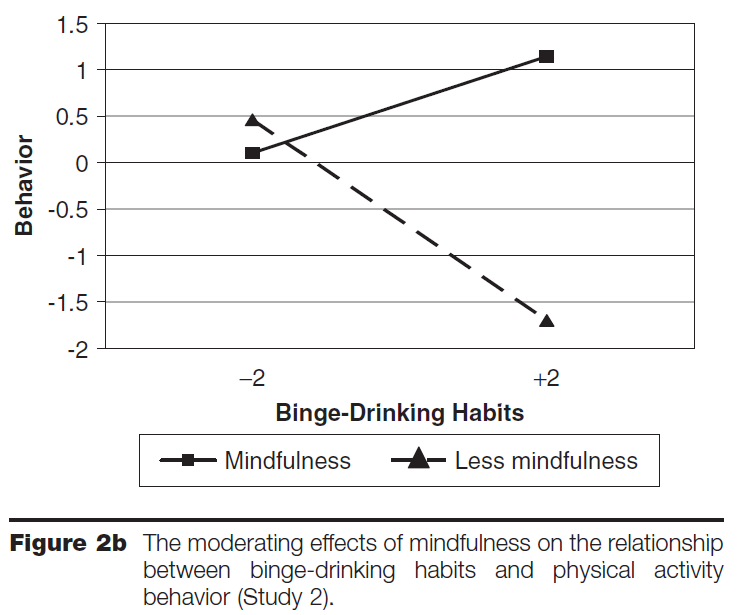
Perhaps mindfulness increases awareness of goals in each moment and therefore reduces the tendency to forget what we said we would do. Or perhaps mindfulness improves our self-regulatory skills so that we are more likely to be able to manage the difficult emotions that arise when we do something new or challenging. Chatzisarantis and Hagger (2007) tested a third possibility, that mindfulness helps us control counter-intentional behaviours, in this case binge drinking.   They reasoned that binge-drinking probably interferes with doing vigorous physical activity (is it just me or do you too have an image of lying on a couch with a pillow over your head?), and that mindfulness might reduce the extent to which habitual binge-drinking interferes with intentions to exercise.

And this is what they found:

C and H 07 Fig 2b 3

Let me step you through this diagram.  Start with the dotted line first. What this says is that people who are NOT mindful and who habitually engage in binge-drinking are LESS likely to engage in physical exercise. That is, habitual binge-drinking decreases the likelihood of engaging in physical activity. So far so good, this confirms the idea that binge-drinking ain’t great for getting up in the morning and going for a run!  But look at the solid line. For this group, even if they did engage in habitual binge-drinking they were still just as likely to engage in exercise as those who did not habitually binge drink. So some mindful folk still go out on the town, but they don’t let this interfere with their intentions to exercise.  In the words of Chatzisarantis and Hagger (2007: 672):

“These results, therefore, corroborate the view that greater awareness of and attention to internal states and behavioral routines helps mindful individuals shield good intentions from unhealthy habits and thus can play a key role in fostering effective self-regulation. In contrast, diminished attention and awareness of counterintentional routines and habits is likely to prevent individuals acting less mindfully from engaging in effective self-regulation, as the negative relationship between habitual binge-drinking and physical exercise suggests (see Figures 2a and 2b).”

So maybe next Christmas I will be better at mindfully saying no to that Christmas pudding!

Growing Compassion in Organisations

Hello!

I am so excited to be joining “Working with ACT” exactly two years to the day since Rob and Rachel started this wonderful blog. Working with mindfulness and values is a big part of my professional and personal life. My aim is to bring you interesting perspectives on ACT research.

By way of introduction, I thought I might briefly review one of my own papers written with Sharon Parker.  I promise I will focus on papers by other people in the future 🙂  Here is the citation from which you can link to the paper if you would like to read more.

Atkins, P. W. B., & Parker, S. K. (2012). Understanding individual compassion in organizations: the role of appraisals and psychological flexibility. Academy of Management Review, 37(3).

——————————————————————————————

“I don’t do emotions!”  This was a comment made by one of my students in reaction to an exercise exploring values and stressors at work. But in reality, we all “do emotions”. A growing body of evidence clearly shows that emotions are a major determinant of performance in all workplaces, including public sector organisations.  Emotions alert us to what matters, they allow us to communicate and make decisions that are effective.  Emotions are at the heart of thinking about how we wish to live and what we wish to create in society?

Becoming skilful at recognising and influencing emotions at work is a key facet of effective leadership and management. Such skill rests upon the quality of our awareness and perspective taking ability. We need to be able to take the perspective of others to act effectively. We need to be compassionate if we are to respond skilfully to our own and others emotions.

Compassion towards oneself and others is a critical part of building effective relationships and making good decisions at work. Think for example of how you handle situations where you or someone in your team fails to achieve important goals. What would it be like if people were more compassionate towards themselves and others at these times?

Compassion is not just a feeling.  It involves four stages:

  1. Noticing another is suffering,
  2. Making judgments about what is going on,
  3. Feeling empathy, and
  4. Taking action.

There are three judgments that can get in the way of compassion towards self or others.

First, we can fail to be compassionate because we judge that the person who is suffering is not deserving of our compassion. For example, we might judge that the person brought their suffering on themselves.

Second, we might judge that the person’s suffering is not relevant to us. Research shows we are much less likely to extend suffering to others who have different goals, or belong to groups with which we do not identify. If we make this judgment, we are more likely to feel disconnection rather than compassion.  One can easily see how this judgment is involved in the debate over immigration in this country.

Third, we make a judgment about our personal resources. If we don’t feel as though we can cope with being in the presence of another who is suffering in some way, we are more likely to feel distress rather than compassion.  The manager who cannot bear to be in the presence of a person crying is making this sort of judgment.  This judgment appears to be involved in the experience of burnout many people feel when they work in jobs that involve caring for others.

Of course, these judgments are sometimes justified.  Modern evolutionary theory suggests that such judgments are an important aspect of self-protection and effective group function.  Sometimes it is best not to feel compassion, or at least not to act upon it. Our argument is not that we should always feel more compassion. Our argument is that it is helpful to become more aware of the automatic reactions that drive our behaviour. To the extent that we can catch our reactions in motion, we can choose our responses more deliberately and improve our effectiveness.

So how might we learn to catch our automatic reactions, and act more in line with what really matters?

If you have been following this blog you will know that there are two aspects of effective training in emotional skills. First, we need to increase mindfulness. Being mindful means being aware of what is happening in each moment both within ourselves and in the world and bringing an attitude of openness to that experience. Second, we need to be clear about our values and the values of the organisation in which we work. There is no point developing awareness if we don’t know how we want to act in the world. Values act as a compass to guide our behaviour.

What has been your experience of compassion at work? Is it encouraged? Does it have a positive impact?

What To Do With Feelings of Shame

SHAME
SHAME (Photo credit: BlueRobot)

Do you think it is bad to feel ashamed?

In this interview, Maarten Aalberse suggests that we have a tendency to feel ashamed about feeling shame and that this causes us problems. He suggests responding to those feelings with empathy and compassion instead of trying to reject these painful emotions. What does that look like?

Shame comes up quite often for me. The other day, a participant in a session I was facilitating said, ‘Well I think this sort of thing is a waste of time. Nothing ever changes as a result.‘ and pop there it was… shame. Gnawing away at my gut. Making me want to crawl into a corner and hide.

My mind went into overdrive: I am a waste of space. All those years of training were a waste of time. I have been deluding myself. It was all pointless. ( I actually feel a bit ashamed letting you know the crazy thoughts my mind can come up with!)

And then, I remembered Maarten’s suggestions and I breathed and asked myself , ‘Can I turn towards this pain with kindness? Can I hold these feelings with compassion? Can I use all of those years of training to choose my next words? Even though the urge to react is so strong?’

This sounded like a good plan, so instead of getting defensive I responded with curiosity, ‘What would have to happen for today to be worthwhile? What would we each need to do?

The conversation moved forward and we made a plan.

I think that Maarten may be right. That allowing those feelings to be there and treating them with kindness may lead to more effective responses.

What about you…are you ashamed of shame? What happens when you treat those feelings with compassion instead? Does that work better for you?

On Holding Our Feelings Gently

This post is based on some writing by Dr Hank Robb. Hank is a deeply wise psychologist based in Oregon. You can see a video of him here.

Sometimes, when we act to make something important in our lives, we experience painful emotions. And, we can choose to feel them willingly.

There are, really, two important aspects to that willingness. There is “willingness with your feet” and also “willingness with your heart.” If you think about “flight phobics” you see
 both kinds. Some won’t get on the airplane – they lack “willingness with their feet.” However, many who do get on the plane are then “white knuckleflyers” – they lack “willingness with their heart.” Both kinds of willingness are choices.

To give you a sense of “willingness with your heart”. Cup your hands. Imagine holding a feather in your cupped hands, it will be gentle. And, you can hold it gently. Now imagine putting the fruit of a prickly pear cactus in your cupped hands. It will not be gentle. And, you can still hold it gently. Willingness with your heart is holding gently whatever is there to be held.

Prickly Pear Cactus a kind of common vegetatio...
Prickly Pear Cactus a kind of common vegetation found in the hills of Balaghat Range (Photo credit: Wikipedia)

Whatever feelings turn up, you can choose to treat them with compassion and gentleness.

What would that be like? Which are the emotions that are hardest for you to hold with gentleness? For me anger is really tricky.

Can you catch yourself when you harden your heart against your pain…and soften?

If You Had a Couple of Extra Hours In The Week, What Would You Spend Them On?

Just imagine, something magical happens and you suddenly find yourself with two extra hours in the week. Empty…waiting to be used. What a delicious thought!

How would you choose to spend those hours?

Romanian Family
Romanian Family (Photo credit: JoshLawton)

Would you:

  • Work on a pet project that matters to you?
  • Spend more time with loved ones? Doing what?
  • Look after yourself a little better – perhaps exercising more often; cooking healthier food; getting more sleep?
  • What would it be…..?
And…what wouldn’t you choose to do with that time?

I invite you to sit with those questions. To let them be with you over the next few days and see what turns up.

If you want to find time for an important but neglected activity, then I encourage you to start small. Just pick one action and commit to focussing on that area for 10 minutes more each week.

If that change seems to give your life more vitality, you might then choose to gradually increase it over time.

This question comes from an interesting book: Power Questions: Build Relationships, Win New Business, and Influence Others by Andrew Sobal and Jerold Panas

How Promising Managers Sometimes Derail Their Careers…and How to Prevent It

According to The Centre for Creative Leadership almost 1 in 2 of the managers who have the makings of success fail to reach their potential. They ‘derail’ and are either demoted, fired, plateau or opt for early retirement (William A Gentry).

There seem to be some key problems that cause this derailment:

  • Failing to build effective interpersonal relationships
  • Showing poor team leadership
  • Having problems adapting to changes in the environment
  • Lacking growth and development in the face of the changing demands of their role
  • Failing to meet business objectives (due to either failing to follow through or being overambitious )
  • Maintaining a narrow focus, so that they aren’t able to supervise outside of their area of functional expertise

What seems to happen is that these managers are defensive in the face of challenging feedback, don’t learn from their mistakes and don’t identify and address their weaknesses.

Why do they do that?

I suspect that they lack self-compassion. Self-compassion makes it easier to be open to difficult feedback; learn from mistakes and admit failings. Self compassion can probably be increased*.

These managers also need to get better at noticing when their approach is ineffective and then quickly adjusting their behaviour. A starting point here may be to learn to become more mindful and psychologically flexible.

So, if you are a beginning manager, it might be good to focus on becoming more mindful, flexible and compassionate.

* For readers based in Brisbane, I am running a low cost public workshop on self-compassion on Sunday 6th May 2012.